Get Full Government Meeting Transcripts, Videos, & Alerts Forever!
Get email alerts on the Wildlife Protection topic
No spam. Unsubscribe anytime.
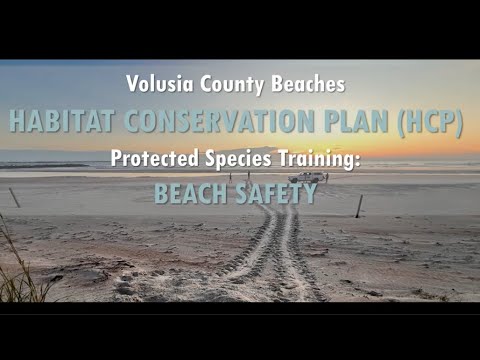
Volusia County HCP staff brief beach-safety personnel on nesting-season vehicle rules, reporting and rescue procedures
Summary
A Volusia County Habitat Conservation Plan staff member gave a training briefing to beach-safety personnel detailing vehicle access rules, volunteer coordination, incident reporting and handling of sea turtles, washback hatchlings and other wildlife during nesting and washback seasons.
A Volusia County Habitat Conservation Plan (HCP) staff member told beach-safety personnel during a training briefing that county staff, law enforcement, permitted volunteer groups and some contractors must follow specific vehicle-access, reporting and handling rules intended to protect nesting sea turtles, their hatchlings and other beach wildlife.
The guidance, presented as operational instructions rather than a policy vote, covered training frequency for staff, which groups may use the beach at different times, how volunteers and permit holders clear sections for vehicle access, procedures for responding to live or stranded animals and incident-reporting requirements.
The briefing is intended to reduce “incidental take” of protected animals during routine beach operations and to coordinate Beach Safety, Volusia County HCP staff, contracted crews and volunteer survey teams ahead of and during nesting season.
The presenter said full-time county employees must complete the HCP training every three years; newly hired full‑time staff must complete it before they are permitted to drive on the beach and for three consecutive years, then transition to the three‑year cycle. Seasonal part‑time employees, such as lifeguards, must complete the training before driving on the beach for three consecutive seasons and then every three years thereafter.
On vehicle access, the presenter described four user groups — beach-safety employees, the sheriff’s office, county HCP staff and volunteer turtle-survey groups — that may be on the beach 24 hours a day when performing essential duties. Youth user groups during nesting season may be allowed on the beach only after volunteers have cleared sections and confirmed ramps are safe to open; such youth access ends at 7 p.m. or sunset, whichever is earlier. The general public may drive on ramps beginning at 8 a.m. or after a nesting survey has been completed, and access runs until 7 p.m. or sunset, the presenter said.
The presenter named two permit holders who coordinate volunteer monitoring: Beth, permit holder for the Volusia Turtle Patrol, which surveys county-managed beaches north of the inlet; and Abby Cheney, a contracted biologist and the EAI permit designee who coordinates volunteers south of the inlet, including the New Smyrna Beach Turtle Trackers. The volunteer groups mark new crawls, protect nests and monitor nests through hatching; when volunteers cannot clear a section of beach, they will notify beach-safety personnel by 7:45 a.m. by radio.
Operational guidance included: drive low on hard-packed sand rather than in soft sand; avoid driving over the apex of turtle crawls; do not park or drive inside the 15-foot conservation zone seaward of the 4x4 posts; and prefer access at low tide in natural areas where contractor rut‑breaking does not occur. The presenter said county contractors (referred to as “CFB” in the briefing) and volunteers will smooth ruts in front of nests approaching hatch, and that flagged nests are placed out beginning at about day 45 of incubation as a visual cue that hatchlings may appear in the coming days.
On hatching timelines and hatchling handling, the presenter said eggs that have hatched may take several days for hatchlings to dig to the surface (the briefing referenced two related timelines, noting hatchlings can take about two to four days from egg hatching to emergence). If personnel observe a daytime hatch or hatchlings on the beach, they should give the animals space, discourage crowds and dogs, call permit holders (Beth or Abby) and the HCP staff, and complete an incident report. For washback hatchlings (hatchlings pushed ashore by storms, the presenter said these surveys occur August–November), staff should place hatchlings in a bucket on a damp towel with no standing water and transport them to the Marine Science Center with a chain-of-custody form; trainings on this protocol were planned for July.
For live stranded turtles and other marine mammals, the presenter said beach staff are likely to encounter these animals and should call the permit holder first (wait about 15 minutes for the permit-holder response), then contact the county HCP staff or the Marine Science Center as instructed. Personnel were advised not to push weak animals back into the surf, to keep animals moist and upright without covering blowholes, and to maintain crowd control because stranded animals can be dangerous. The presenter noted the narrow North Atlantic right-whale population and that NOAA conducts photographic ID surveys; training and coordinated response with federal and nonprofit partners were emphasized.
The presenter described incident documentation requirements: take multiple photographs of the location and animal before touching or moving it, preserve and label specimens when required, complete the county incident report and send it to HCP staff, and, for injured animals that permit holders authorize for transport, coordinate delivery to the Marine Science Center (do not deliver injured animals unannounced).
The briefing included a county summary of reported incidental-take figures since the HCP program began in 1996–97: more than 9,000 washback hatchlings saved; zero adults reported hit by vehicles; two unmarked nests recorded; three marked-nest impacts over three consecutive years (presenter noted the cause was not specified); 12 daytime hatchling impacts and 16 nighttime hatchling impacts; an average of about 1.6 hatchling/rut incidents per year; 22 washback-hatchling incidents and two live stranded turtles. The presenter said these numbers are included in the county’s annual report to federal authorities and stressed accurate reporting.
Other operational points: contractors collecting beach furniture or trash operate at night (roughly 9 p.m.–1 a.m. as stated); special events that require beach driving are permitted but must follow the county process and show proper placards at job sites; dogs on vehicles are allowed only at three named areas (the inlet beaches at Smyrna Dunes, Lighthouse Pointe Bark and the Ormond Dog Beach — the presenter listed those specific locations); and conservation-zone posts should be reported to HCP staff when 10 or more consecutive posts are missing so a new line can be measured.
The presenter also encouraged staff to use red LED lights when assisting hatchlings at night or loaned red flashlights to reduce hatchling disorientation, to use white headlights while driving to be able to see hatchlings then switch to amber running lights when stationary, and to routinely check email messages from volunteer survey teams for daily logs that may require acknowledgement or response.
The training concluded with contact information slides for HCP staff, permit holders and partner organizations and an invitation to ask questions; the presenter emphasized that beach-safety personnel should document suspected infractions and call the sheriff’s nonemergency line for enforcement when appropriate.