Get Full Government Meeting Transcripts, Videos, & Alerts Forever!
Get email alerts on the State Salary Study topic
No spam. Unsubscribe anytime.
Finance Committee reviews Segal salary study; finds midpoints near market but gaps at higher target, estimates $93M–$180M to align pay
Summary
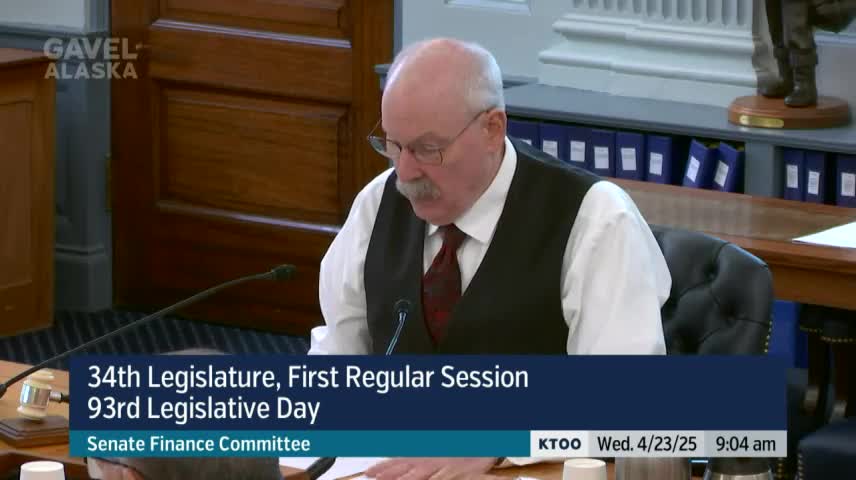
The Alaska State Legislature Finance Committee heard a presentation April 20, 2025, from Segal on a statewide salary study that found the state's published base pay structures generally near the market median but below a market‑leading point, with rough implementation cost estimates of about $93 million at the median target and about $180 million at a higher target.
The Alaska State Legislature Finance Committee heard a presentation April 20, 2025, from Segal, a national public‑sector compensation firm, on a long‑awaited statewide salary study that compares Alaska’s formal base pay structures to public‑ and private‑sector market data effective Jan. 1, 2025.
Segal presented methodology, findings and recommendations and answered senators’ questions about data sources, treatment of overtime and premium pay, geographic adjustments and next steps. Patrick Bracken, Segal’s senior vice president, said the study compares the state’s published pay range minimums, midpoints and maximums (not individual employee pay) with two market reference points: the 50th percentile (median) and the 65th percentile (market‑leading).
“Base pay is defined as the published or formalized salary structure, pay grade minimum, midpoint, and maximum,” Bracken said. He added the study’s purpose is to “equip state leadership with data‑driven insights to understand the competitive gaps with the current market conditions,” not to recommend individual employee adjustments.
Study scope and methods Segal said it selected 404 benchmark job classes to represent the state’s mix of occupations and bargaining units; 384 of those had sufficient market matches to analyze. The firm collected data from a custom public‑sector survey (68 organizations solicited; a mix of completed survey returns and publicly available published pay schedules), private‑sector published sources (CompAnalyst, PayFactors, Economic Research Institute, WorldatWork and others), and Segal’s own compiled survey repository.
Segal adjusted all data to a common effective date of Jan. 1, 2025. The firm applied a 4% “aging” factor to move older published data forward to that date and used cost‑of‑labor adjustments to make outside jurisdictions comparable to Anchorage, which the state uses as the baseline location. Mike Verdorn, Segal vice president, said Segal did not analyze individual overtime, letters of agreement or premium pay in the same comparison because those elements vary widely by department and would be difficult to normalize across 68 surveyed organizations.
Key findings At an aggregate level across benchmark jobs, Segal reported Alaska’s pay range minimums, midpoints and maximums fall within a 95–105% “market competitive corridor” when compared to the 50th‑percentile market point. When compared to the 65th percentile (a market‑leading point), Segal reported the state’s minimums, midpoints and maximums were below that point (midpoints and related values near 90–92% of the 65th percentile), with more variability by occupational group.
Segal highlighted occupational groups that trended below market midpoints, including executive and senior administrators (PA), education/information/libraries/museums (PE), biological sciences, and physical sciences/engineering. Groups consistently at or above market included legal/judicial, police/fire/corrections and many craft and labor classifications.
Benefits and total compensation Richard Ward, Segal’s West Region public‑sector market director, summarized health‑benefits comparisons and said Alaska’s employee benefit package (as measured in Segal’s report) is comparable to other public‑sector employers and more generous than the private‑sector published data once employee premium contributions and geography are considered. Ward noted Segal adjusted benefit values for Alaska’s higher health‑care cost environment.
Cost estimates and implementation considerations When senators asked about budget implications, Segal provided high‑level, order‑of‑magnitude implementation estimates the committee could use for planning: roughly $93 million to align pay to the 50th percentile and about $180 million to align more broadly toward the 65th percentile. Segal and the Department of Administration stressed those figures are broad estimates and that any implementation plan would require a detailed, job‑by‑job cost model and legal/collective‑bargaining analysis.
Recommendations and next steps Segal recommended the state consider adopting a written compensation philosophy, frequent (at least every three years) market refreshes, clearer minimum/midpoint/maximum definitions for pay ranges, occupational family groupings to simplify administration, supervisory differentials and modernization of the classification structure. Segal recommended further work to identify where base pay gaps are driven by non‑base pay (overtime, letters of agreement or premium pay) before decisions on across‑the‑board changes.
Department of Administration response Paula Grama, commissioner for the Department of Administration, told the committee the division of personnel will develop a project plan to modernize and streamline the classification system. Camille Brill, acting director of the Division of Personnel, said the department will prioritize job families that fall at or below roughly 10% under market at the minimum and produce a more detailed implementation plan for the commissioner’s consideration.
Data access and committee requests The committee asked Segal and the department to provide committee members with the underlying benchmark‑level data in an Excel format and follow‑up on several item‑level questions (for example, whether specific Alaska Native health corporations were included in the survey and the treatment of attorney and corrections pay). Segal agreed to provide the appendix and to respond to follow‑up queries. The Division of Personnel staff stated the datasets and appendices are available on the division’s webpage.
What the committee asked senators to watch for Committee members pressed Segal and administration staff on three issues they said will shape any policy response: (1) how to treat non‑base pay (overtime, letters of agreement) that can materially affect total compensation; (2) geographic differentials — the last formal geographic‑differential study cited by staff was 2008 (preceded by 1985), and the division said such studies require separate appropriations; and (3) the interaction of any changes with ongoing collective‑bargaining obligations.
Next committee steps Department staff told the committee they will produce a project plan and return with a status report next session; senators asked for a status update early in the budget cycle (the department said it would seek to provide an update timed for the next legislative session).
The presentation and the committee’s questions focused on base pay structures and high‑level cost implications; Segal and the department repeatedly noted that detailed implementation estimates and legal/collective bargaining analysis would be required before policy decisions committing budget increases could be made.