Get Full Government Meeting Transcripts, Videos, & Alerts Forever!
Get email alerts on the Transportation Revenue Package topic
No spam. Unsubscribe anytime.
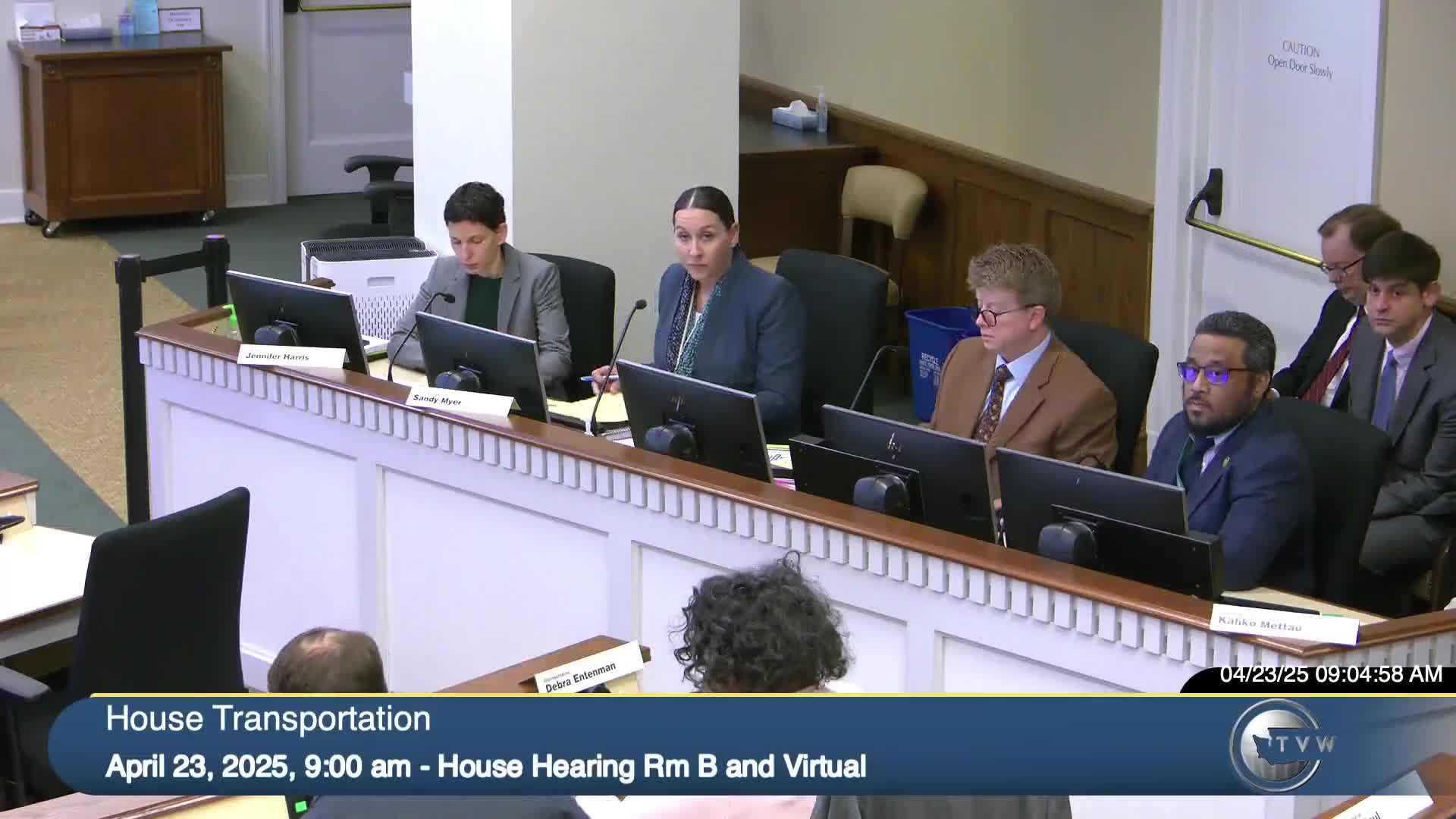
Committee forwards transportation revenue package after narrow 14-13 vote; bill would raise fuel and other transportation-related taxes
Summary
The House Transportation Committee voted 14-13 on April 23 to advance engrossed Substitute Senate Bill 5801, a wide-ranging transportation revenue and policy package that includes fuel tax increases, expanded sales taxes related to vehicles and vessels, changes to tolling and project streamlining, and multiple contested amendments.
The House Transportation Committee voted 14-13 on April 23 to send engrossed Substitute Senate Bill 5801 (striker H-2311.3, as amended) out of committee with a "do pass as amended" recommendation. The package would raise multiple transportation-related taxes and fees, create a new road repair account, expand certain tax increment financing authority, and alter several transportation policies including tolling, project streamlining, and green-transportation provisions.
The package matters because it would change state transportation revenue and funding priorities, including significant fuel-tax adjustments, new and expanded sales- and use-tax applications for vehicles and recreational vessels, and programmatic changes with implications for ferries, safety, and local projects.
As presented to the committee, the striking amendment increases the motor-vehicle fuel tax rate by $0.06 per gallon beginning July 1, 2025; it also included additional $0.03-per-gallon increases on special fuel in 2025 and 2027 and a 2% annual inflation adjustment to the fuel tax rate. The striking amendment raises several other transportation-related taxes and fees, including vehicle weight fees and the rental-car tax, imposes retail sales and use tax on recreational vessels, and creates a luxury retail sales and use tax on certain motor vehicles and certain noncommercial aircraft. It also contains an expansion of authority under tax-increment financing law allowing certain cities with combined assessed valuation greater than $200,000,000 but no more than $500,000,000 to designate a tax-increment area for transportation-related public improvements under specified conditions.
Representative Ed Orcutt expressed concern about the burden on truck drivers and agriculture: "When you start putting, 6¢ a gallon, on top of that, ... That's $2,400 a year that's either coming out of the truck driver's pocket, the trucking company's pocket, or is being added to the cost of goods that are being shipped," he said. Representative Reed countered on health grounds, saying diesel particulates harm residents' health and that the committee must balance economic burden with public health impacts.
Several amendment votes shaped the final striking amendment as reported out. Notable committee actions recorded in the transcript include:
- Amendment HIRS 100 (Rep. Birnbaum), which applies the peer-to-peer car-sharing tax to transactions where the shared vehicle was acquired without paying retail sales or use tax, was adopted. - Amendment HIRS 102 (Rep. Griffey), which clarifies or narrows exemptions related to large-event transportation assessments and clarifies the definition of a large event facility (and leaves in place a separate amendment that would have removed the assessment entirely), was adopted. - An amendment to create a dedicated road repair account (MattM656) that would redirect proceeds from $0.01 per gallon of the fuel increase and excess tire-fee proceeds to a nonappropriated "road repair account" was offered by Representative Stevie and debated; the amendment failed in committee. - Multiple other amendments were offered and failed, including proposals to remove special-fuel increases and to remove the 2% annual indexing adjustment, an amendment to add a 10% luxury tax on certain aircraft (HIRS 101), and criminal penalties for damage to EV charging stations (H-465). The committee did adopt MatM660, which removed a categorical State Environmental Policy Act (SEPA) exemption for certain paths and trails decisions in the underlying striker.
Representative Stevie advocated for a targeted maintenance fund, saying the road repair account would fund chip sealing, paving, restriping, guardrail replacement and other preservation activities; Representative Klicker and others argued concerns about how zero-emission school bus purchases and EV infrastructure would be funded in rural districts.
On final action, the clerk recorded 14 ayes and 13 nays on the engrossed striking amendment as amended; the committee moved SSB 5801 out with a do-pass-as-amended recommendation.
The transcript shows the debate focused heavily on distributional impacts (truckers, farmers, rural school districts), public-health considerations tied to diesel emissions, and tradeoffs between creating new dedicated funding for maintenance and imposing new or higher taxes. Several members urged continued negotiations over the coming days with the other legislative body as the package is refined.
The committee did not provide dollar totals for projected revenues in the portions of discussion captured by the transcript, nor did committee staff provide an enrollment or fiscal note in the cited excerpts. Several amendments were described as under negotiation, and the bill as reported includes multiple provisions that will require implementing language and administrative rules if enacted.