Get Full Government Meeting Transcripts, Videos, & Alerts Forever!
Get email alerts on the Rainier School Closure topic
No spam. Unsubscribe anytime.
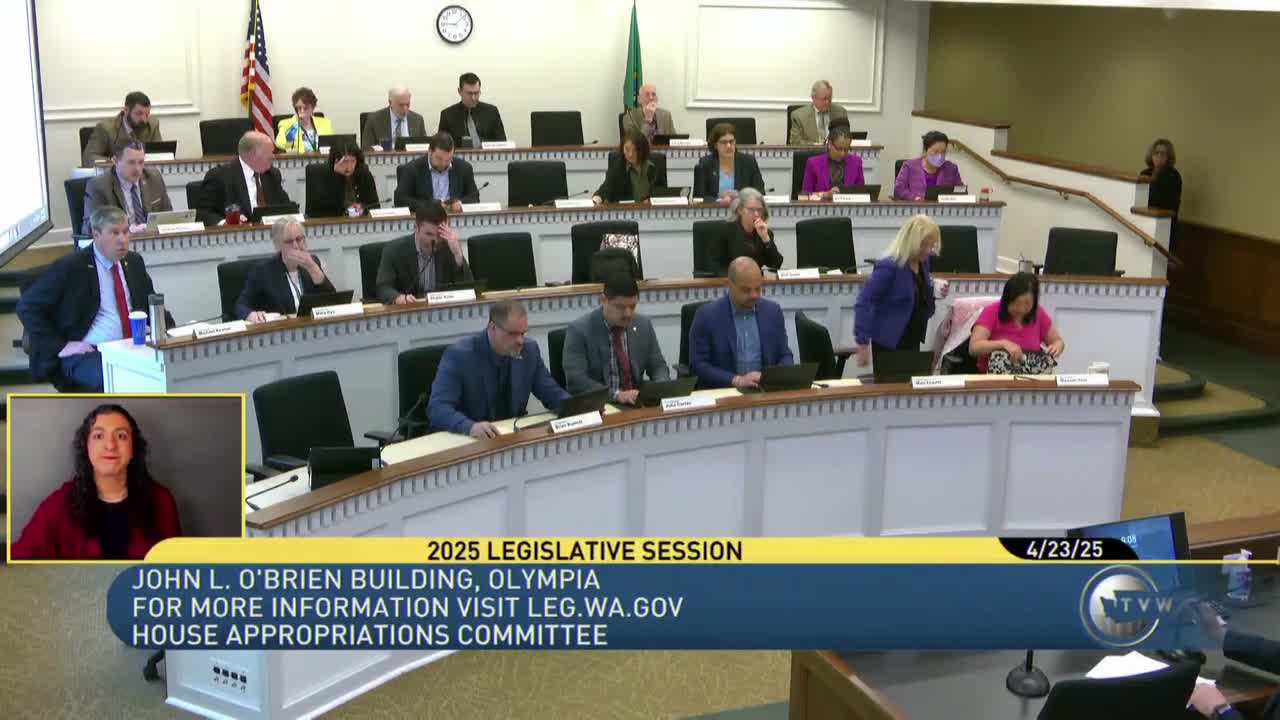
Appropriations committee advances bill to close Rainier School after hours of debate
Summary
The House Appropriations Committee on [date not specified] voted 17-14 to report substitute Senate Bill 5393 out of committee with a do-pass recommendation; the bill would close Rainier School and set a statutory closure timeline.
The House Appropriations Committee on [date not specified] voted 17-14 to report substitute Senate Bill 5393 out of committee with a do-pass recommendation. The bill would close Rainier School, a state residential habilitation center for people with intellectual and developmental disabilities, and set a statutory closure timeline included in the bill text.
The committee’s executive-session briefing opened with counsel Luke Wickham outlining the bill and six amendments posted for consideration, including proposals to rewrite or remove the bill’s intent language, to remove the bill’s contingency on appropriated funds, to require individualized transition plans, to guarantee comparable pay and benefits for relocated staff, and to remove an emergency clause. Several committee members and outside speakers pressed for stronger, funded, and enforceable transition protections for residents and staff; others urged prompt implementation and trust in state planning.
Advocates for stronger protections repeatedly said community capacity is insufficient now. Representative Penner argued the bill, as drafted, “doesn’t commit to taking care of anybody afterwards,” and cited Department of Social and Health Services (DSHS) figures that staff presented to the committee that indicated only 11 adult state-operated living alternative (SOLA) beds and four children’s beds were currently available statewide. Penner said those figures, and the fiscal note’s admitted uncertainties, mean the state risks displacing residents without adequate placements. “We closed a SOLO down this month,” Penner said, quoting a DSHS letter about administrative closures tied to budget reductions.
Other members recounted past closures. Representative Schmick read parents’ post-closure comments from the Francis Hadden Morgan Center closure report and argued the committee should learn from earlier transfers where families said they lacked information and suffered harms. Representative Dye described personal family experience caring for a severely disabled sibling and urged caution, saying the state has a moral obligation to provide safe settings for people who cannot reciprocate care.
Committee supporters of reporting the bill said the closure was requested by the prior executive branch and remains on the current governor’s agenda and that the administration and DSHS had been planning transitions. The bill’s sponsor on the floor noted appropriations in the budget to support transitions and described the proposed plan as “robust.” The motion to report the bill was made by Vice Chair Gregersen.
Several amendments were proposed and defeated: HARO 786 (Representative Penner) to replace the bill’s legislative-intent language; HARO 788 (Representative Keaton) to remove intent language entirely; HARO 787 (Representative Penner) to remove the “subject to amounts appropriated” contingency so transition requirements would be mandatory; HARO 792 (Representative Burnett) to require DSHS to develop and transmit de-identified individualized transition plans to appropriate legislative committees; HARO 791 (Representative Manjaras) to require alternative employment offers with comparable pay and benefits for Rainier staff; and HARO 790 (Representative Marshall) to remove the bill’s emergency clause. Each amendment was discussed at length and was put to a voice vote; none were adopted by the committee.
Members pressing for amendments repeatedly cited concrete fiscal and capacity uncertainties recorded in the fiscal note. Representative Penner referenced the fiscal note and DSHS statements that the total supported-living rates and tiers for many Rainier residents were not fully accounted for in the estimate; Penner argued that the fiscal assumptions (including supported-living base rates and assumed occupancy) created a multimillion-dollar delta in cost estimates. Concerns raised by several members included possible PERS termination liabilities tied to workforce reductions (an example figure mentioned in debate was a $20 million potential lump-sum PERS liability), a cited $6 million ICF tax revenue loss noted in the fiscal discussion, and litigation risk if closures outpace capacity under federal Medicaid law. Representative Penner and other members said the fiscal note itself notes the work is incomplete and that costs and timelines could grow.
Supporters of moving the bill argued the legislature must balance fiscal stewardship with care, and that the executive branch and DSHS had been engaged on transition planning. At the committee’s conclusion, the roll was called and the committee chair announced the final tally: 17 ayes, 14 nays; the bill was reported out with a do-pass recommendation.
Votes at a glance (other executive-session bills reported out during the same meeting): - Substitute Senate Bill 5785 (Washington College Grant/College Bound striker as amended by H-2321.2): reported out as amended; roll call announced 19 ayes, 0 nays, 12 absent. - Second Substitute Senate Bill 5786 (liquor license fee changes): reported out as amended; roll call announced 17 ayes, 2 nays, 12 absent. - Substitute Senate Bill 5790 (cost-of-living indexing for educator COLAs): reported out with a do-pass recommendation; roll call announced 19 ayes, 0 nays, 12 absent. - Second Substitute Senate Bill 5802 (transportation/operating transfers and tax dedication changes): reported out with a do-pass recommendation; roll call announced 19 ayes, 0 nays, 12 absent. - Senate Bill 5807 (wellness incentives program funding changes): reported out with a do-pass recommendation; roll call announced 19 ayes, 0 nays, 12 absent.
Context and what’s next: Reporting a bill out of Appropriations with a do-pass recommendation moves it forward in the legislative process but does not by itself enact the change. The debate in committee highlighted contested factual and fiscal questions that committee members said remain unresolved in the fiscal note and DSHS materials. Proponents said transition planning is underway; opponents said the bill lacks guaranteed, funded pathways for the most medically and behaviorally complex residents and raised legal and human-rights concerns tied to federal Medicaid rules and Olmstead-related considerations.
Closing note: Committee debate repeatedly separated three categories of outcomes — discussion of possibilities and concerns; requests and directions for further planning and oversight; and the formal committee decision to report the bill. The record shows extensive commentary from family members, staff advocates and multiple representatives urging added safeguards; the committee chose to advance the bill without adopting the amendments that would have inserted those safeguards into the bill text.