Get Full Government Meeting Transcripts, Videos, & Alerts Forever!
Get email alerts on the Zoning Setbacks topic
No spam. Unsubscribe anytime.
Council, planning commission debate easing front-yard setbacks for restricted lots
Summary
City staff proposed code language to allow reduced front setbacks on lots with steep slopes or an R (restricted) designation; planning commission advised against a blanket change and staff recommended following that advice. Council agreed to return the item after the planning commission finalizes its recommendation.
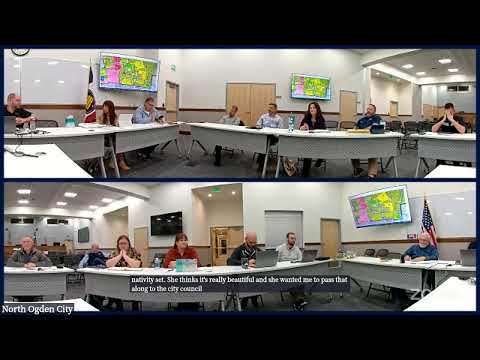
North Ogden City Council and Planning Commission members discussed proposed code language that would give builders more flexibility on front-yard setbacks for lots with steep slopes or an R (restricted) designation.
The discussion, led by Economic and Community Development Director Scott Hess, revisited an ordinance provision that already allows reduced front setbacks on lots with an average slope of 10 percent or greater. Staff had proposed amending the language to allow administrative setback reductions on lots that carry an R designation (restricted lot), such as for high groundwater, steep slope, or utility easements. Hess said the intent was to give homeowners and builders flexibility to place a house on a constrained lot without forcing a large number of variance hearings.
Hess described a recent example in White Rock subdivision where Lot 7R is constrained by a power-line easement that imposes a vertical clearance requirement and effectively caps roof height. That constraint led the developer to seek reduced north and east setbacks to place a buildable house footprint outside the easement. Hess said staff initially considered letting the R designation trigger administrative setback flexibility so that similar cases could be resolved more quickly.
The planning commission reviewed the draft language and, according to staff, declined to apply a blanket setback reduction to all R lots because the R designation covers a wide range of physical and environmental conditions. Hess suggested a more nuanced approach — a “menu” of options keyed to the specific reason for the R note (for example, slope versus high water table versus easement). He said the existing code section (11-9-M-6) that permits reduced front setbacks on lots with a 10 percent or greater slope was born out of White Rock to avoid repeated variance hearings.
Council members and planning commissioners questioned whether a wholesale change to allow a 20-foot front setback on any R lot would be appropriate. Members noted trade-offs such as driveway length and on-street appearance, and emphasized that many R-lot designations are applied for different technical reasons. Staff explained the existing R-lot code (11-22-2) lists hazards and constraints that justify the designation and that planning review occurs at the preliminary plat stage to evaluate whether a lot truly meets those criteria.
Staff also reviewed the variance process that remains available for site-specific constraints. City staff said grading or cut/fill beyond 4 feet must be engineered and that the building permit/topographic survey establishes the lot’s highest and lowest points used to calculate the slope (rise over run). The council heard from an online commenter, Chad Bailey, who said moving a home closer to the street often reduces driveway depth and parking and therefore limits homeowner choices.
Outcome: No code amendment was adopted at the meeting. Staff recommended following the planning commission’s recommendation not to amend the code as drafted; the item will be returned to the council from its November 12 postponement after the planning commission finalizes its review.
Votes at a glance: At the start of the meeting the council moved to approve minutes for the Nov. 26, Dec. 3 and Dec. 10, 2024 meetings. Council Member Goldberg moved the motion; no second was named in the transcript. The motion passed unanimously (recorded as "aye" by members present).