Get Full Government Meeting Transcripts, Videos, & Alerts Forever!
Get email alerts on the Animal Services topic
No spam. Unsubscribe anytime.
Animal Services retains staff and spay/neuter rollout; committee backs phased increases for animal care attendants and adds pet food bank request to recon list
Summary
Office of Animal Services presented a same‑services FY26 budget and reported a slow rollout of a county low‑cost spay/neuter program; staff confirmed plans for two monthly clinics and requested continued monitoring. Committee asked for tranches of additional animal care attendant positions and placed a $30,000 pet food bank request on the budget
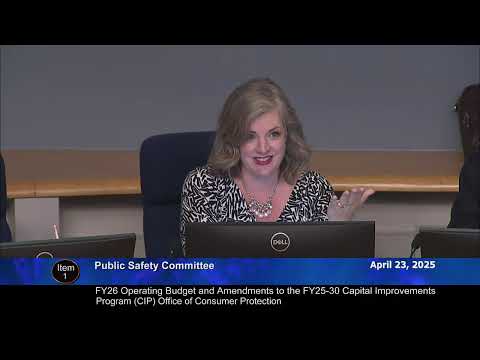
The Office of Animal Services (OAS) presented a FY26 same‑services operating budget on April 23 and updated the Public Safety Committee on the county’s recently launched low‑cost spay/neuter program and other programmatic changes.
Why it matters: OAS told the committee the executive recommended a $502,521 increase (4.79%) over FY25—primarily continuation of services—and highlighted the department’s shift toward a human‑animal support services model intended to provide upstream interventions to keep families and pets together.
Program updates and staffing: OAS said the low‑cost spay/neuter clinic began a phased rollout on March 1 and is operating two clinics per month serving roughly 6–10 animals per clinic; staff noted challenges with screening and scheduling that have resulted in lower actual surgery counts for some clinic dates. OAS advised that current staffing levels limit the program’s ability to scale: the department has 15 animal care attendants (ACA) while Maddie’s Million Pet Challenge best‑practice staffing would call for 24 ACAs. OAS requested that the committee consider phased (tranche) additions to the ACA roster so the department could expand capacity; staff estimated an ACA midpoint step with benefits would be about $83,000 per full‑time position.
Other items: OAS asked the committee to retain the $125,000 the council added last year for the sterilization program, which the executive has continued in the recommended budget. The department also requested an additional $30,000 for a more dependable pet food bank and asked that the committee place the $30,000 on the reconciliation list for further consideration.
Committee response and outcome: Committee members praised OAS’s recent award recognition and the department’s human‑animal support approach. Members directed staff to place the $30,000 pet food bank request on the reconciliation list and agreed to consider adding ACAs in tranches (committee discussed two tranches). Committee staff also recommended reclassifying a small uniform cleaning contract decrease to a miscellaneous operating reduction due to collective bargaining constraints; committee members agreed.
Ending: OAS will continue operating the sterilization clinics at current capacity, report back on progress, and work with council staff on tranche‑based staffing additions and the pet food bank reconciliation request.