Get Full Government Meeting Transcripts, Videos, & Alerts Forever!
Get email alerts on the Rv Occupancy topic
No spam. Unsubscribe anytime.
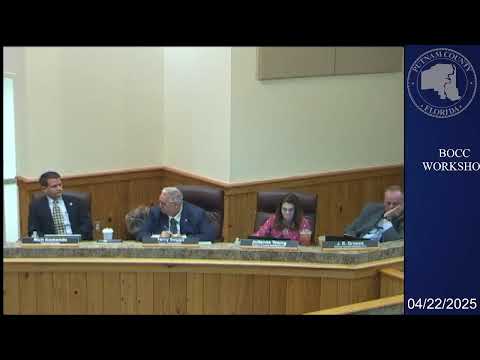
Putnam County commissioners split on how to regulate RVs: magistrate proof standards and a proposed SUP for large parcels dominate debate
Summary
Putnam County commissioners directed staff to remove the current recreational-vehicle language from a Land Development Code text-amendment packet and return later with revised rules after prolonged debate about enforcement, public-safety and property rights.
Putnam County commissioners spent more than two hours debating a proposed rewrite of rules for recreational vehicles (RVs) used as temporary shelters, focusing on enforcement challenges, public-safety risks and property-rights concerns. The workshop did not finalize the language; instead the board directed staff to remove the current RV section from the LDC package and return later with revised language.
Planning staff introduced the RV changes as part of a wider Land Development Code update, describing a proposed new requirement that “under no circumstance is an RV to be stored, left, or abandoned on a vacant property” but also offering a staff-drafted exception for large agricultural parcels. Zachary Baker said staff’s intent was to help code enforcement obtain more reliable outcomes from the magistrate and to give the county a clear path for certain temporary, seasonal uses.
“For example, parcels greater than 5 acres may be approved to have an RV as a temporary use if approved by a special use permit,” Baker read aloud. The draft SUP language included multiple conditions: an E-911 address must be assigned before application; the RV must be registered with the Florida Department of Motor Vehicles; the RV and the property must be in common ownership (staff later agreed this could instead be satisfied by written permission from the property owner); the RV had to be lawfully connected to permitted electric, water and septic systems; failure to provide proof of required improvements within 90 days would void approval; and the SUP would be valid for six months with a limited renewal.
Code-enforcement staff and emergency responders urged tightening the rules. Zee Lawrence of code enforcement told commissioners magistrates have dismissed many living-in-RV cases because staff could not meet an occupancy burden of proof. “It’s a hardship. It’s a burden of proof. It’s on us,” Lawrence said, describing difficulty proving daily occupancy absent admissions or regular witness testimony. She said derelict, unregistered or untagged RVs are easier to pursue, because photos can show disrepair and lack of registration.
JR, identified in the transcript as an emergency-services representative, described operational risks when temporary structures or RVs are placed on unaddressed parcels. He said responders often “get paged to 100 Main Street or a medical emergency on Main Street” and then cannot find the correct location. JR added that crews’ tactics change when they encounter occupied sheds or substandard structures, increasing firefighter and responder safety risk.
Several commissioners expressed concern about property rights. Commissioner Wilkinson gave the example of a resident who allowed a divorced friend to store a camper on his lot; she argued that the owner should not be penalized for lending space to a friend if the camper causes no nuisance. Commissioner Harvey proposed a compromise that would allow maintained parcels to host a single permitted RV; commissioners ultimately asked staff to revise the draft to permit one RV on qualifying property with written owner permission and to allow a single renewal, rather than create a permanent occupancy path.
Quantitative points cited during the discussion included staff estimates that the county had more than 2,000 open code cases and roughly 659 of those were related to people living in RVs. Staff and commissioners repeatedly returned to three enforcement tools: fines and liens, magistrate hearings, and creating a short-term legal permitting path for seasonal or recreational occupancy that would require E-911 addressing, proof of registration and connection to utilities.
The board stopped short of adopting final language. Instead, commissioners agreed to remove the current 3(b)(6) provision (the broad “no RV on vacant property” rule) from the packet and replace it with revised paragraph 7 drafted by staff, with the following working directions from the board: - Retain the residential allowance (2.f) for RV temporary occupancy tied to an existing dwelling unit. - Remove 3.b.6 (a flat prohibition on storing/abandoning RVs on vacant properties) from the version to go to the first public hearing. - Add a revised paragraph allowing a special-use permit on parcels greater than 5 acres with staff-specified conditions; commissioners asked staff to permit only one RV per SUP, require written permission from the property owner, make SUPs valid for six months and limit renewals (board suggested one renewal), and require E-911 addressing and proof of legal utilities.
Next steps: Staff will return with the LDC packet for public hearings without the present RV language and will prepare revised recreational-vehicle language for separate workshop consideration. Commissioners also asked staff to consider enforcement mechanics—fees, connection to the solid-waste assessment roll, and the magistrate’s evidence standards—when drafting the revised section.
Ending: The workshop ended without a final vote; staff and the board will continue work on the RV rules in a follow-up session and will bring the remainder of the LDC amendments to the required two public hearings.