Get Full Government Meeting Transcripts, Videos, & Alerts Forever!
Get email alerts on the Land Development Code topic
No spam. Unsubscribe anytime.
Putnam County staff to advance Land Development Code changes to public hearings; RV rules separated for further work
Summary
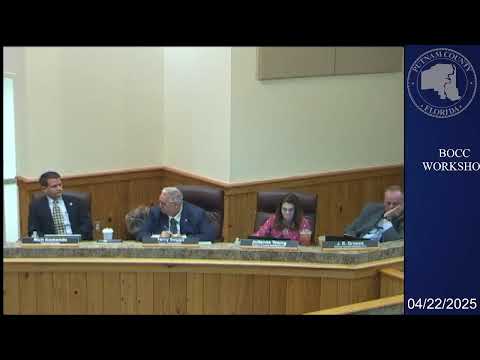
The Putnam County Board directed staff to take a proposed package of Land Development Code text amendments to two public hearings, with the board asking staff to remove the recreational-vehicle section for separate consideration and to return with revised language.
Putnam County commissioners directed staff on Oct. 12 to move a broad package of proposed Land Development Code (LDC) text amendments to the first of two required public hearings, while setting aside the portion of the draft that would change rules on temporary recreational-vehicle occupancy for separate review.
Planning and Development Services senior planner Zachary Baker presented the package to the board, describing changes across multiple zoning districts and administrative sections. “Within the allowed uses for the commercial professional office zoning district, we have included emergency services by right, struck an emergency or struck emergency services with a special use permit,” Baker said during the presentation. He also covered accessory dwelling unit provisions, setback rules for small pump houses and a variety of technical edits.
The package updates allowed uses in CPO, C1, C2 and C3 commercial districts, aligns accessory dwelling-unit language between the text and the use table, removes a “major/minor” distinction where no thresholds exist, and adds a permitting path for small well/pump houses under defined size limits. Public-works-driven edits clarify acceptable cross-drain materials and private-road/easement design standards; other changes include adding canals to the county’s definition of water bodies, a de facto lot-split procedure, and amendments to subdivision and vesting procedures.
Why it matters: The revisions touch permitting, public-safety siting, infrastructure standards and how the county processes development applications. Several changes are intended to reduce ambiguity in staff review and to streamline approvals for some uses while tightening technical standards for roads, drainage and waterfront setbacks.
Key details from the presentation and discussion included: - Emergency services: Staff said adding emergency-service facilities as an allowed use in several commercial districts is intended to “make it easier for the county to build out that infrastructure as our community needs it,” while noting siting and size requirements will still apply. - Accessory dwelling units: The draft would allow accessory dwelling units occupied by the owner or a tenant of a commercial use via a special-use-permit (SUP) process, aligning the LDC with the county’s comprehensive plan language that permits residential use in commercial future-land-use categories. - Small utility structures: A new provision would permit wells or pump houses under 60 square feet and under 8 feet tall within required setbacks if set back 3 feet from the property line. - Technical and process updates: The package includes revisions requested by public works for approved pipe materials, clarifies use of easements and shared driveway standards, reduces the minimum width of certain previously approved private roads from 35 to 30 feet subject to approval by the public-works director, and formalizes a staff-handled de facto lot-split process for specific conditions.
Staff and several commissioners stressed that many of the edits are intended to correct inconsistencies and to give clearer direction to staff and applicants. Baker told the board the package also reinstates the Development Review Committee (DRC) roster language so the committee will include voting representatives (planning, building, public works, sheriff, emergency services) and listed nonvoting agencies, which staff said helps ensure required participants attend DRC reviews.
The board gave staff a clear directive on next steps. Commissioner Alexander asked that the board move forward with what he called the “easy” portions of the package and exclude the RV section for further work. County staff confirmed the next step is two public hearings on the full text amendment; the board directed staff to bring the full packet back for the first of two readings but to remove the current RV language and return with revised RV rules later.
No formal roll-call vote on final adoption was recorded during the workshop; commissioners indicated consensus and discussion-level direction to staff.
Ending: Staff will prepare the LDC text-amendment packet, excluding the current recreational-vehicle language, for the first of two required public hearings and return with revised RV provisions after further work, including clarifying fees and enforcement mechanics.