Get Full Government Meeting Transcripts, Videos, & Alerts Forever!
Get email alerts on the Impact Fees topic
No spam. Unsubscribe anytime.
Putnam County hears proposed impact fees totaling roughly $7,700 (non-utility); commissioners schedule workshop
Summary
Consultants presented a technical impact-fee study proposing roughly $7,700 in non-utility capital fees (about $16,000 including water and wastewater). Commissioners asked staff to draft an ordinance and set a workshop with stakeholders to review timing, interlocal coordination and public input requirements.
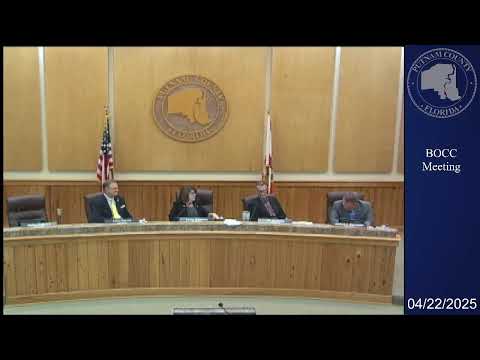
Consultants presented a new impact-fee study to the Putnam County Board of County Commissioners on April 22, proposing non-utility capital fees that total about $7,700 per single-family home and roughly $16,000 per home when water and wastewater fees are included.
The study, presented by Nighyun Kemp (consultant) and Brian Mance of GovRates, examined five non-utility service areas and utility capacity for water and wastewater. It recommended a network-wide transportation fee, countywide charges for government buildings, fire-rescue, law enforcement vehicle replacement, parks and recreation, and separately calculated water and wastewater fees by meter size or flow. "Impact fees are a one-time capital charge to new development," Kemp said, noting the county has not charged most of these fees since a moratorium in 2006.
Why it matters: the proposed fees shift some capital costs from the existing tax base to new development, a policy framed in Florida law as "growth paying for growth." The county's consultants said the new fees are driven by recent permit activity, local capital inventories and projected growth; state law changes also require counties and cities to coordinate on transportation fees if both collect fees in overlapping areas.
Key details from the study: Kemp described the methodology used to calculate non-utility fees (inventory → level of service → cost → credits → demand). The draft schedule summarized by the consultants included: - Non-utility fees (all service areas combined): about $7,700 per typical single-family unit; the largest components were transportation and government buildings. - Transportation (network-wide, collectors and above, including state roads when improvements produce capacity): roughly $4,900 per single-family home. Kemp said that figure assumes a blended lane-mile cost and subtracts credits for other funding sources. - Government buildings, law enforcement (vehicle-based), fire-rescue, parks: fee estimates were presented for single-family and nonresidential categories during the presentation. - Utilities: Brian Mance said the proposed water fee is $2,605 per equivalent residential connection and the wastewater fee $5,455 per equivalent residential connection using a gallons-per-day level of service. The consultants used a 75% assumed grant/other funding allowance in the wastewater calculation and described these fees as comparable to larger utilities when adjusted for local conditions.
Revenue and legal constraints: consultants projected the county could collect roughly $1.7 million to $6.0 million annually depending on permitting levels and fee choices. They cautioned the board about statutory limits and timing: technical studies must be based on recent local data, changing the fees after adoption has statutory limits (a cap on increases and, where applicable, coordinated interlocal requirements). The consultants highlighted a statutory requirement to complete and adopt studies within 12 months of contract engagement and that interlocal agreements are required by Oct. 1, 2025, if both a county and a municipality charge transportation impact fees in the same geographic area.
Public comments and policy options: resident Michael Woodward urged the board to consider tiered residential fees tied to house size or bedroom count so small homes pay less than very large homes. Woodward said, "It hardly seems fair that the impact fee for a 2-bedroom 1,000-square-foot bungalow would be just as large as the impact fee for a 5-bedroom, 3,500-square-foot house." The consultants acknowledged the board may adopt lower fees than the study supports but warned that starting low can make future increases difficult under statutory constraints.
Board direction and next steps: Commissioners agreed to continue stakeholder engagement. Commissioner Alexander moved to hold a county workshop with city and industry partners and the board approved the motion by voice vote; staff will schedule a stakeholder workshop and prepare a draft ordinance and public hearing schedule. The consultants and county attorney will draft ordinance language; staff said water and wastewater fees carry an additional customer-notification requirement and that non-utility fees have statutory notice and adoption timing implications (e.g., 90-day notice in some cases). Kemp told the board that fees become effective in line with statutory timing (consultants noted 9 days after adoption for some ordinances and consumer notice requirements for utility fees).
What happens next: staff will collect board questions, return written responses from the consultants, prepare a draft ordinance and coordinate a stakeholder workshop that county leaders said should include municipal leaders, builders and the Chamber. The board asked for a stakeholder forum and a draft ordinance to review before a public hearing. Staff also will provide a cost/benefit and schedule analysis for coordinating fees with the City of Palatka to meet the Oct. 1, 2025 interlocal deadline.