Get Full Government Meeting Transcripts, Videos, & Alerts Forever!
Get email alerts on the Human Resources topic
No spam. Unsubscribe anytime.
Committee backs County Executive budget for Office of Human Resources; flags large self‑insurance increase
Summary
The Government Operations and Fiscal Policy Committee recommended the County Executive’s FY26 operating budget for the Montgomery County Office of Human Resources, which includes the executive’s proposal for a $46,400,000 increase in the county’s self‑insurance (employee group health insurance) budget and a $120,000 enhancement for the Montgomery County Leadership Academy.
The Government Operations and Fiscal Policy Committee recommended the County Executive’s FY26 operating budget for the Montgomery County Office of Human Resources, which includes the executive’s proposal for a $46,400,000 increase in the county’s self‑insurance (employee group health insurance) budget and a $120,000 enhancement for the Montgomery County Leadership Academy.
The recommendation came during the committee’s budget review when staff explained the executive’s FY26 request. “The county executive is recommending an increase of about $46,400,000 or 12.03% from the FY25 approved operating budget,” a staff presenter said, noting that roughly $45,600,000 of that increase reflects cost adjustments for employee and retiree health benefits.
The budget packet also lists $367,000 in programmatic and staffing enhancements, which include $120,000 to support two Montgomery County Leadership Academy cohorts to provide management training and $32,075 for NEOGOV applicant tracking subscription modules. The executive also proposes shifting two vacant customer service positions from TEBS to OHR ($176,076) to restore in‑person customer care for county employees and several administrative realignments of personnel costs between the general fund and the employee group health insurance fund.
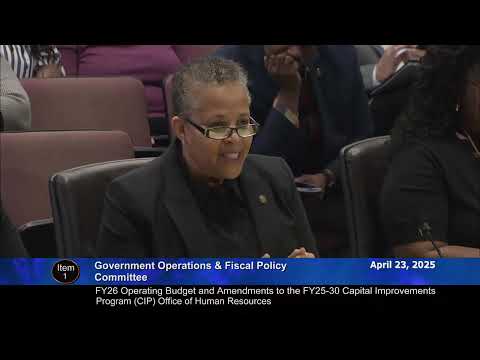
Tracy Anderson, Director of the Office of Human Resources, told the committee OHR’s work is “foundational” to county operations and urged support for the leadership training money. Anderson said manager performance is a primary driver of turnover, calling it “the number 1 reason that employees leave.”
Jenna Shevlin, OHR division chief for administration, and other staff detailed the self‑insurance increase as a claims expenditure adjustment tied to rising medical and prescription costs. OHR staff said trend projections used in annual rate‑setting showed medical costs increasing and that inflationary pressure in health care contributed to the recommended increase.
Jenna Shevlin described steps OHR and its vendor(s) have taken to manage prescription costs and high‑cost brand therapies. “We implemented a utilization management program called Smart Logic, 01/01/2024. And based on that program alone, we were actually able to save over $5,000,000 on the commercial side in 2024 and close to $600,000 on the Medicare side,” Shevlin said, adding that the county is working to align prescriptions with FDA‑approved indications and adopt biosimilars where appropriate.
Committee members expressed concern about the long‑term sustainability of rapidly rising health care costs. Council member Andrew Friedson described the trend as “a ticking time bomb for fiscal dynamics here,” pressing staff to return with long‑term strategies for cost containment. Other council members asked for comparisons showing what the county would pay if it were not self‑insured and for greater detail on how realigned positions were budgeted.
The committee recorded no objections and noted it would send the recommended OHR budget to full council for adoption, while requesting follow‑up information on vacancy/lapse accounting, the self‑insurance trend, and the projected fiscal impact of new high‑cost drug therapies.
The packet supplied to the committee lists 22 OHR vacancies as of April 2025, with 20 in active recruitment and 16 with pending start dates; two term positions associated with the LEAP 4 MCG program were not being actively recruited. The packet describes the $120,000 leadership training line as critical to OHR’s ability to run two cohorts and comply with county personnel regulations requiring leadership development for managers and supervisors.
The committee discussion separated the budget request (formal appropriation recommendation) from ongoing management questions. Members asked for additional details on how personnel reclassifications and restored lapses affected FY26 numbers and sought plans for controlling health‑care spending in future years.