Get Full Government Meeting Transcripts, Videos, & Alerts Forever!
Get email alerts on the Climate Change topic
No spam. Unsubscribe anytime.
James Hansen warns of climate ‘tipping points,’ urges moratorium on new coal plants without carbon capture
Summary
At a University of Montana lecture in Missoula, climate scientist Dr. James Hansen described observed warming, potential irreversible impacts such as rapid sea-level rise and species loss, and urged near-term policy steps including a moratorium on new coal-fired power plants that do not sequester CO2 and a steadily rising price on carbon.
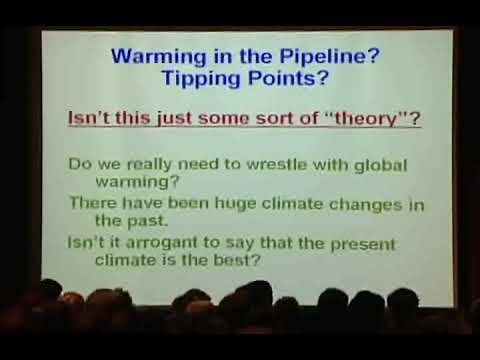
Dr. James Hansen, a climate scientist who discussed his decades of work at the Goddard Institute, told an audience in Missoula that “there’s more global warming already in the pipeline” because of the ocean’s slow response and that positive feedbacks now predominate in the climate system.
Hansen said those feedbacks and the warming still to come create a risk of passing “tipping points in the climate system” that could produce changes ‘‘out of your control’’ and lead to a substantially different planet. He described observed changes including a doubling of glacier discharge rates in recent decades and a global sea-level rise of about 3.5 centimeters per decade, and warned that if current trends continued “we will be at such a level that it’s just impractical” to meet safer stabilization scenarios.
Why it matters: Hansen framed the talk around long-term paleoclimate evidence and recent observations to argue that human-caused greenhouse-gas forcings now dwarf natural forcings, and that policy choices in the coming years will determine whether irreversible outcomes — large sea-level rise, large-scale species extinctions, and loss of Arctic summer sea ice — become unavoidable.
Hansen summarized the science with paleo records showing strong correlation of CO2 and temperature over hundreds of thousands of years and said the current human-driven rise in greenhouse gases is both much faster and larger than the natural changes that shaped past climates. He described the atmospheric lifetime of CO2 as a major constraint on policy: “About half of it is gone within 25 years… by a hundred years, still one-third of what we put up there is still there… by 1000 years, one-fifth is still there,” language he used to emphasize the long-term consequences of current emissions.
On policy, Hansen urged immediate, concrete actions. He called for a moratorium on any new coal-fired power plants that do not capture and sequester CO2 and said a gradually rising price on carbon is needed to shift investment and consumer behavior. He said preventing further conventional coal emissions and ensuring new coal plants use sequestration technology ‘‘is 80% of the solution’’ to the problem of long-term CO2 accumulation, and recommended stretching existing oil and gas supplies to avoid turning to unconventional fossil fuels such as tar sands or oil shale.
Hansen also recommended near-term efforts to reduce non-CO2 forcings — methane, black carbon (soot), tropospheric ozone and nitrous oxide — and to pursue land-use and agricultural practices that can draw down atmospheric CO2 (for example, no-till agriculture and bioenergy with sequestration): “There are things we could do on the long run,” he said, contrasting those options with “corn-based ethanol,” which he dismissed.
During a Q&A, audience members asked about the roles of solar variability, tar sands and regional fossil-fuel developments, nuclear power, diet-related emissions, methane sources such as rice paddies and landfills, population growth, and the potential of renewables and efficiency. Hansen said solar forcing is measurable but small relative to the anthropogenic forcings now in play; he called nuclear power a locally decidable option that produces little CO2 but has trade-offs; and he said dietary shifts and methane mitigation could contribute meaningfully to overall mitigation.
Hansen argued that responsibility is tied to cumulative emissions rather than current annual rates, noting per-capita U.S. emissions remain much higher than many developing countries and that the developed world bears the largest share of historical emissions. He compared the needed global strategy to past international responses such as the Montreal Protocol and said offering developing countries more time — as was done with ozone-depleting substances — could be part of a negotiated approach to reduce global emissions.
Hansen closed by urging civic engagement and electoral pressure to secure policy changes, telling the audience to ask political candidates whether they would support a moratorium on new coal plants without sequestration and a fair, gradually rising carbon price.
The lecture combined long-term scientific context, recent observational evidence, and specific near-term policy prescriptions. It did not involve any formal votes or binding decisions by the university or other bodies.