Get Full Government Meeting Transcripts, Videos, & Alerts Forever!
Get email alerts on the Land Use topic
No spam. Unsubscribe anytime.
Gulf County denies Indian Pass RV-park expansion, citing incomplete technical approvals and local concerns
Summary
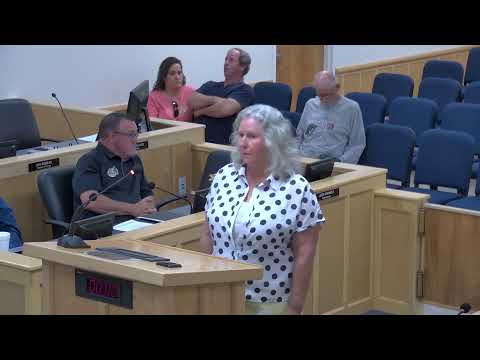
The Gulf County Commission voted 5-0 to deny a development order that would have expanded an existing Indian Pass RV campground from 44 to 78 pads after extensive testimony on preemption, traffic, wetlands buffers, wastewater treatment and erosion.
The Gulf County Board of County Commissioners denied a development order application for an Indian Pass RV campground expansion on a 5-0 vote, concluding the record did not provide sufficient technical detail — particularly on wastewater, stormwater and geotechnical issues — and after extensive legal and planning debate about state preemption of local rules.
The decision followed a multi-hour quasi-judicial hearing in which the applicant sought permission to increase an existing campground from 44 pads to 78 pads and to carry out related site improvements. The commission's motion to deny was made by Commissioner Husband and seconded by Commissioner McCrone; the motion passed unanimously, and the development order request was refused.
County planners and the applicant debated whether state law and Department of Health rules limit local authority over RV-park density and setbacks. The applicant's counsel argued the county is preempted by state statute and by recent floodplain management ordinances; county staff pointed to the Gulf County Land Development Regulations and the comprehensive plan's wetland-buffer language as grounds for local conditions and review.
Traffic, wastewater treatment and coastal setbacks were the central technical issues. David Munting Jr., P.E., a transportation consultant retained by the applicant, testified that campground-generated traffic is very low and estimated the park would consume roughly "1.5% of the roadway's capacity," a level he characterized as negligible for Indian Pass Road. Munting also said RV arrivals are staggered and that projected peak-hour trip generation for the expanded park would be under one trip per RV pad.
Connie Lambert Lamerson, manager of Indian Pass Campground, described typical guest behavior and emergency procedures, saying the park monitors storms well in advance and evacuates when county mandatory orders are issued. "Our policy is that as soon as our emergency, the county issues a mandatory evacuation of low lawn areas, we evacuate the park," Lamerson told the commission.
On wastewater, Naiman Nassif of Nassif Engineering described a below‑grade secondary treatment and drip-irrigation plan intended to produce a higher-quality effluent than existing septic systems and to reuse treated water for landscaping. Nassif said he had not completed detailed engineering because the number of pads had been a moving target; he told commissioners he could supply a formal design if the commission wanted that information before a final decision.
County planner testimony and commissioner questions repeatedly flagged missing or incomplete technical submissions in the development-application packet: no geotechnical report, no completed Coastal Construction Control Line (CCCL) permit application, no finalized drain-field or drain-field sizing shown on plans, and no environmental resource-permit materials or wetland mitigation commitments. Commissioner Husband said those gaps made it difficult to approve a development order and moved to deny the application on that basis.
Applicant counsel and the applicant’s speakers emphasized legal arguments that the Department of Health holds exclusive permitting authority over RV parks under the cited state statute language and that state law allows rebuilding or restoring preexisting park density in some circumstances. The applicant also proposed a two‑phase approach that would tie a larger second phase to completion of beach renourishment; the commission did not adopt that approach as a condition in this hearing.
After deliberations the commission recorded motions earlier in the hearing recognizing the application as complete for processing, accepting evidence into the record, and acknowledging public notice and hearing procedures, but concluded the substantive development-order request should be denied because required technical approvals and supporting documents were not present or were unresolved on issues the commission considered material to protecting public welfare, access and environmental resources.
The denial leaves the campground at its prior approved footprint and pads pending any future application that includes the missing technical reports and the required state and federal approvals.