Get Full Government Meeting Transcripts, Videos, & Alerts Forever!
Get email alerts on the Climate Sensitivity topic
No spam. Unsubscribe anytime.
James Hansen says paleoclimate data and models point to ~3°C sensitivity; urges moratorium on new coal plants without CO2 capture
Summary
At a university event, Dr. James Hansen, director of NASA's Goddard Institute for Space Studies and a Columbia University scientist, reviewed evidence that Earth—s climate sensitivity is about 3°C per doubling of CO2, described long CO2 residence times, and called for no new coal-fired power plants unless they capture and sequester CO2.
Dr. James Hansen, director of NASA's Goddard Institute for Space Studies and a scientist at Columbia University's Earth Institute, told a campus audience that multiple lines of evidence—rom climate models and the planet's paleoclimate record—onverge on an equilibrium climate sensitivity near 3 degrees Celsius for a doubling of atmospheric carbon dioxide.
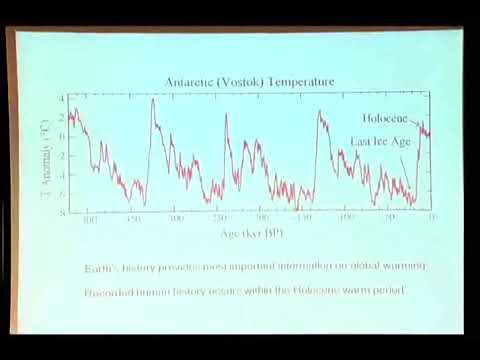
Hansen said the estimate from the 1979 Charney-led National Academy of Sciences review produced a central value of about 3°C with a large uncertainty, and that paleoclimate comparisons between the last ice age and the current interglacial give independent support for a similar sensitivity. "I think the Earth's history provides a much better way... and actually it gives us a higher accuracy," Hansen said during the talk.
Why it matters: Hansen stressed that climate sensitivity underpins long-term warming projections and near-term policy choices. He warned that, absent major changes in emissions trajectories, continued use of fossil fuels would push global temperatures into ranges not experienced by modern human societies, with consequential sea-level rise and other impacts.
Evidence and numbers cited - Ice-age vs. interglacial comparisons: Hansen said the global mean temperature difference is about 5°C and estimated the net forcing between those states at roughly 6.5 watts per square meter, implying a sensitivity near 0.75°C per watt and ~3°C for a 4-watt forcing (doubling CO2). - Climate models: Hansen noted contemporary models cluster near ~3°C sensitivity; his institute's model runs around 3°C per doubling. - Carbon dioxide lifetime: Hansen described the decay of an atmospheric CO2 pulse: about half is removed in ~25 years, ~33% remains after 100 years and ~20% persists after 1,000 years, because long-term burial as carbonate sediments operates on millennial timescales. - Sea level and past warm climates: He said past climates ~3°C warmer had sea level ~25 meters higher and that the last ice age lowered sea level by about 120 meters.
Forcings and ocean inertia Hansen explained the concept of climate forcing (changes in Earth's energy balance) using the 1991 volcanic eruption and a hypothetical 1% change in solar brightness as examples. He emphasized the ocean's thermal inertia: about half the equilibrium surface response can appear within two decades, but full response may require centuries to a millennium, depending on ocean mixing.
Coal, carbon capture and policy comments Hansen argued coal presents the largest controllable source of CO2 and described carbon capture at coal-fired power plants as central to limiting long-term atmospheric CO2. "That's 80% of the solution," he said referring to using coal only at plants that capture and sequester emissions. He recommended a moratorium on construction of new coal-fired plants unless they include CO2 capture and sequestration.
On sequestration technicalities, Hansen said geologic storage beneath ocean sediments or in suitable onshore reservoirs can be stable if sited away from legacy oil- and gas-drilling holes, and noted existing enhanced oil recovery projects suggest the CO2 can remain underground. On costs, he relayed expert estimates that early large-scale capture could raise coal plant electricity costs substantially but might fall to roughly a 25% premium once widely deployed.
Q&A highlights Audience questions covered technological fixes, geoengineering, ocean circulation, nuclear power and forest fires. Hansen expressed skepticism about solar-shade geoengineering as a primary solution, described nuclear power as a climate-friendly option that raises local policy and proliferation considerations, and said that improved forestry and agricultural sequestration could be part of a solution. On ocean circulation, he said models reproduce thermohaline changes and that shutdowns would locally reduce warming but not cause global cooling.
Attribution and context Hansen repeatedly emphasized that his remarks reflected his personal views, not an official government statement: "I'm not, although I'm a government employee, I'm not speaking for the government." He framed much of the talk around peer-reviewed paleoclimate measurements (ice cores, ocean sediment proxies) and model comparisons rather than policy prescriptions, though he made explicit policy recommendations about coal.
Ending Hansen noted an evening public lecture and a separate 7 p.m. campus rally on coal that same day; he said he would address impacts and policy in his later talk. The session concluded with audience questions and a thank-you to the speaker.