Lifetime Citizen Portal Access — AI Briefings, Alerts & Unlimited Follows
Barnett Rubin: Afghanistan’s weak state, Durand Line and Pakistan’s tribal areas enable transnational threats
Loading...
Summary
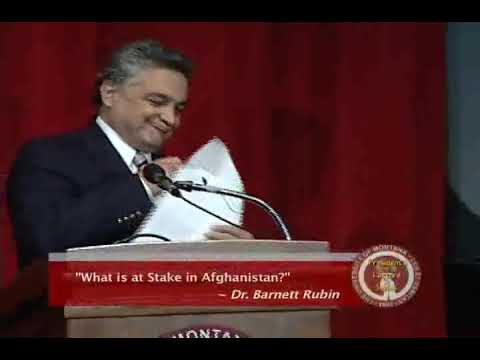
Professor Barnett Rubin, director of studies and senior fellow at the Center on International Cooperation at New York University, delivered a lecture in Missoula arguing that Afghanistan’s weak central state, long-colonial borders and the ungoverned tribal territories along the Durand Line are central to why transnational networks such as al Qaeda were able to establish bases there.
Professor Barnett Rubin, director of studies and senior fellow at the Center on International Cooperation at New York University, delivered a lecture in Missoula arguing that Afghanistan’s weak state institutions, long-colonial borders and the ungoverned tribal territories along the Durand Line are central to the current security threat and to why transnational networks such as al Qaeda were able to establish bases there.
Rubin said the most relevant question is how Afghanistan became “the center of organization for this transnational network, the center of which is now in the tribal areas of Pakistan,” and he warned that the tribal frontier’s weak authority and cross-border social ties helped create a space outside effective state control. “There’s not a single Afghan member of Al Qaeda, and never has been,” Rubin said, noting that al Qaeda’s recruits increasingly include European converts and second‑generation immigrants who were radicalized outside Afghanistan.
Why it matters: Rubin tied the security threat to longstanding political geography and the legacy of colonial-era agreements. He emphasized that the Durand Line—drawn in the late 19th century and referenced repeatedly in his remarks—has “never been recognized by Afghanistan,” and that many people on both sides of the line do not accept it as a state border. That, Rubin said, helps explain persistent instability and cross-border movement of fighters.
Key points and evidence
- State weakness and governance: Rubin described Afghanistan as a “highly centralized but extremely weak” state that historically delivered security for elites and external patrons rather than accountable services to most citizens. He said the state’s institutional collapse allowed regional warlords, illicit economies and armed groups to expand during and after the Soviet era.
- Durand Line and tribal areas: Rubin summarized the frontier legacy: British-era agreements and later Pakistani arrangements created a zone that Pakistan administers in a special way. He noted that Pakistan’s federally administered tribal areas (as discussed in the lecture) were governed under the Frontier Crimes Regulations and historically were not subject to the normal laws of Pakistan. “The law of Pakistan does not apply in those areas,” Rubin said in explaining why they became operational safe havens.
- Al Qaeda and geography: Rubin argued al Qaeda exploited a gap in the international state system. He described the movement as “a global, nongovernmental, transnational movement” rather than simply an extension of local national or sectarian struggles, and said modern communications—satellite links, the Internet and electronic transfers—make remote strongholds globally connected.
- Opium economy and illicit finance: Rubin traced the rise of opium as a commercial crop in Afghanistan to the 1980s and 1990s when cultivation shifted into areas with weak governance. Citing United Nations estimates, he said processing inside Afghanistan rose dramatically in the late 1990s and that “the UN now estimates it's 72 of the entire crop” is processed inside Afghanistan; he also said the opiate sector accounts for roughly “about 20% of the economy” (as described in the lecture).
- Regional politics and security: Rubin repeatedly emphasized the importance of Pakistan and Iran to Afghanistan’s stability. He said Afghanistan “will never be stable unless Pakistan wants it to be stable” and added that Iran could also affect stability. He warned that an absence of a regional political consensus makes a sustainable, self‑funded Afghan security force unlikely.
- U.S. policy and priorities: Rubin criticized what he described as an initial U.S. focus on capturing terrorists and a later diversion of attention to Iraq. He said those choices contributed to underinvestment in building Afghan institutions, which, in his view, remain unable to deliver reliable services to many citizens.
- Oil and pipelines: In response to a question about energy, Rubin said pipeline plans (for example, routes from Central Asia through Afghanistan to Pakistan) existed and that ‘‘the problem is not oil… the problem is the oil money’’—explaining that control over resource revenues matters because revenues confer power.
- Risk of escalation with Iran: Rubin said there were signs of a public‑relations campaign building pressure on Iran and called the risk of conflict “serious,” though he stated he could not independently verify all claims about directives to build support for war. On that point he told the audience, “I cannot verify this,” while warning there was a danger of escalation.
Audience questions and exchanges
The lecture included an extended audience Q&A in which Rubin addressed questions about bin Laden’s whereabouts, the profile of new recruits to al Qaeda, the history and political meaning of the Durand Line, the origins and scale of opium production, and whether global political currents (anti‑globalization, anti‑tax movements) intersect with radical Islamist appeals. On the question of bin Laden’s location, Rubin said intelligence reporting and testimony point to the tribal areas of Pakistan as the most likely base; he added the caveat that he did not have precise coordinates.
Context and limitations
Rubin repeatedly cautioned against simple explanations. He said colonial-era border drawing and modern globalization are both part of the explanation for why radical movements find footholds in the borderlands. He also warned against lumping all violent or nationalist movements together: some groups he discussed (for example, Hezbollah or Hamas in his remarks) try to distinguish themselves from al Qaeda and have different political aims.
Ending
Rubin concluded that preventing the reemergence of transnational terrorist safe havens will require more than military action: it will require sustained investment in Afghan institutions, meaningful regional diplomacy that brings Pakistan and Iran into a consensus about Afghan stability, and attention to illicit finance and narcotics markets that feed armed groups. “It’s not just about getting access to oil because it’s a fuel,” he said; “it was about power.”
Speakers quoted in this article are listed in the article’s speaker roster and all direct quotes come from Professor Barnett Rubin’s lecture and the subsequent audience Q&A as recorded in the transcript.