Get Full Government Meeting Transcripts, Videos, & Alerts Forever!
Get email alerts on the Noise Ordinance Plainly Audible topic
No spam. Unsubscribe anytime.
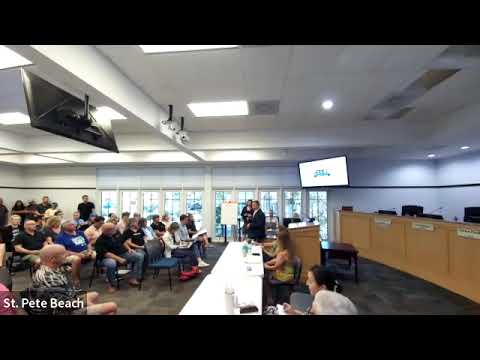
St. Pete Beach workshop probes 'plainly audible' noise standard, enforcement options
Summary
City staff outlined a proposed change to local noise rules — a plainly audible standard for residential receivers 500 feet from a source between 10 p.m. and 7 a.m. — and residents, business owners, musicians and an acoustics consultant urged the commission to refine measurement and enforcement methods.
City staff presented a draft change to St. Pete Beach’s noise rules that would add a “plainly audible” test for noise originating from commercial outdoor venues when the receiving property is residential and the noise occurs between 10 p.m. and 7 a.m.
Brandon Barrett, planner with the city, explained that the city’s existing code currently uses decibel thresholds — 65 dB citywide and a 55 dB level overnight for residential, institutional and open-space properties — and that the proposed language would apply an audibility test for receivers 500 feet or more from the sound source while properties closer than 500 feet would continue to be governed by the existing decibel standards.
Why it matters: Residents, business owners and musicians said noise affects quality of life and commercial viability; speakers urged the city to choose enforcement tools that are objective, enforceable and tailored to the city’s compact beach geography.
Key points of the proposal and public response Barrett said the 65 dB standard “is about the sound of a normal conversation from 3 feet away” and summarized exemptions that would remain, including federally or state-regulated sources (for example aircraft), emergency operations, properly permitted special events and generators operating during power-loss events. He said some conditional-use approvals that require sound governors would likewise be exempt if in compliance with permit conditions.
Speakers at the workshop urged several practical adjustments rather than or in addition to an audible test: adopt A‑weighted decibel measurements with a two‑minute averaging period; require calibrated meters that timestamp and log GPS coordinates; provide training and clear procedures for officers who take measurements; set different standards by zone; and pursue mitigation such as speaker placement, more distributed/smaller speakers, speaker limiters and targeted sound barriers.
Acoustics expert Gary Seebine, an acoustic consultant working in Florida, urged use of calibrated sound level meters and ASTM/ANSI measurement standards so readings are defensible in enforcement and legal challenges. Seebine warned that enforcement officers need training on measurement, property-line identification, and how to handle ambient sound spikes from traffic or transient events.
Musicians and business owners offered mitigation ideas and asked for clarity and predictability. Justin Rice, a musician and CPA who said carve-outs for major holidays should be considered, urged disclosure for new residents who move into buildings with live entertainment. Musicians repeatedly said they would adapt to reasonable, clearly communicated rules.
Enforcement questions and next steps Multiple commenters noted that the city’s main enforcement partner is the Pinellas County Sheriff’s Office and that code-enforcement capacity and training will affect the ordinance’s effectiveness. Suggestions included a dedicated nighttime code/noise officer (possibly combined with other overnight duties like turtle lighting enforcement), greater use of conditional-use permit compliance checks, and educating both officers and venue operators about measurement technique and mitigation steps.
Staff said the workshop is a listening step; any ordinance revision would return to the commission for first reading and subsequent votes. No ordinance change was adopted at the meeting.