Get Full Government Meeting Transcripts, Videos, & Alerts Forever!
Get email alerts on the Land Use Rezoning topic
No spam. Unsubscribe anytime.
Council tables two industrial rezoning requests after neighbors warn of water risks
Summary
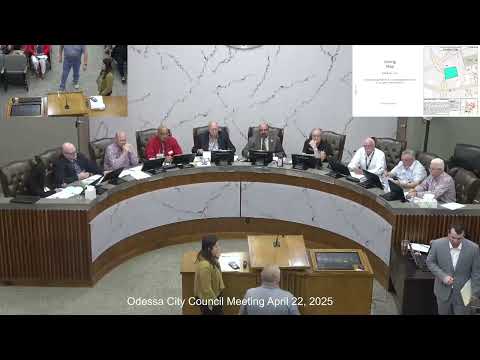
The Odessa City Council on April 22 postponed two separate rezoning requests — one for light industrial use and one for heavy industrial use — after nearby landowners and business representatives raised concerns that future industrial uses could threaten groundwater wells and said city water is not yet available in the area.
The Odessa City Council on April 22 moved to table two separate rezoning requests after nearby property owners and business representatives raised concerns about impacts to private water wells and long-term water infrastructure.
The items brought to the council were a request by S 31 B 42 LLC to change about 41.44 acres from Future Development (FD) to Light Industrial (LI) and a request by Imperative Chemical Partners Inc. to change about 43.436 acres from Future Development to Heavy Industrial (HI). Both items were removed from the consent agenda and then tabled for later consideration after public comment.
Neighbors and a representative of Blakely Construction Company said properties adjacent to the parcels rely on private water wells and expressed worry that industrial development could affect water quality and access. Donald Murray, who identified himself as representing Blakely Construction Company, said the company’s primary water well lies within an exclusion area described in the rezoning information and said his firm — which he said has operated in the area for 65 years — opposed the change because of uncertainty about future uses and possible contamination. Murray also said the water in the vicinity had been contaminated in the past and that testing had stopped "a year or two ago." The council did not accept the rezoning at this meeting.
City planning and utilities staff explained there is currently no city water or sewer infrastructure serving much of the area and that property owners now rely on wells and on-site septic systems where lots exceed two acres. Staff said a future strategy under discussion would be to bring city water and sewer to the corridor, but that funding and design are not yet in place. Staff estimated combined water-and-sewer infrastructure for the broader area could cost in the low tens of millions of dollars, with a rough and preliminary water-only portion on the order of about $4 million.
Council members and several speakers noted that light industrial zoning does not automatically allow heavy chemical handling uses; staff said many heavier chemical uses would fall under higher-intensity categories that require separate review. Several speakers asked that the city delay action until the property owners and the city could confer and until the developer (not present at the meeting) could answer questions about intended uses.
The council voted to table both rezoning items for return to a future meeting; council members asked staff to work with the property owners and with adjacent landowners to provide clearer information on projected uses, water and sewer extension plans, and possible mitigation measures.
The tabling preserves the current FD (Future Development) designation for both parcels pending further study and outreach.
Ending: The council did not take final action on either rezoning request. Staff said it will follow up with the property owners, provide additional detail about permitted uses under the proposed zoning districts, and return the items to a future agenda once more information is available.