
Littleton debates fate of historic City Ditch flumes as Englewood moves to pipe ditch
Get AI-powered insights, summaries, and transcripts
Sign Up Free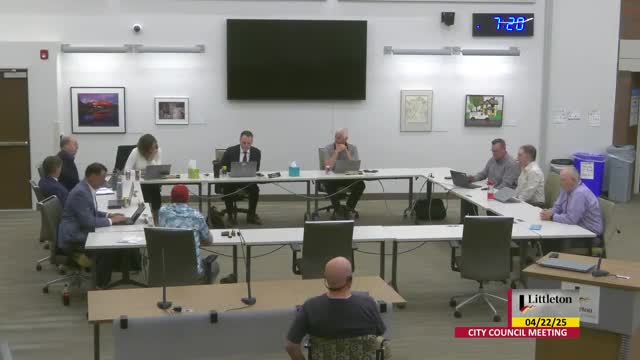
Summary
Council reviewed an engineer’s assessment showing severe corrosion and undermined foundations on two steel flume structures, and directed staff to seek removal by Englewood while trying to preserve a moderate‑sized span for display.
Littleton City Council on April 22 discussed options for two deteriorating steel flume structures that carried the Englewood City Ditch across Slaughterhouse Gulch and a Legal‑area gulch, after a structural assessment found heavy corrosion, missing anchors and undermined foundations.
The council session considered costs and liability as Englewood prepares to pipe sections of the city ditch downstream. "Both decks were corroded and leaking," said Ryan Germer Roth, deputy director of Public Works, summarizing the consultant’s findings and the safety concerns identified in the assessment.
Why it matters. The flumes are visible remnants of the city ditch infrastructure that once supplied irrigation; their fate raises competing priorities for Littleton: preserve a piece of local history, avoid long‑term maintenance liabilities and limit the city’s capital exposure. Staff presented cost estimates ranging from a modest cost if Englewood removes the structures as part of its project to about $300,000 to repair a single structure in place, roughly $20,000–$30,000 per year in maintenance, and up to $1.4 million to relocate all spans of the Slaughterhouse Gulch structure.
Assessment and ownership. City staff told council the City Ditch was constructed in the mid‑1860s by the Capitol Hydraulic Company and that the existing steel flumes were likely installed in the mid‑1940s. Consultant Benish’s inspection found corroded decking and steel supports, missing anchor bolts on abutments, heavy vegetation growth and in one case an undermined foundation estimated to retain about 10% of its original bearing capacity.
Options and staff recommendation. Staff presented three broad options: (1) direct Englewood to remove the flumes as part of its piping work (Englewood’s planned removal would impose no direct cost on Littleton), (2) repair and maintain the structures in place (staff estimate: roughly $640,000 over 10 years for one structure including repairs and maintenance), or (3) relocate and restore parts of the flumes for display (relocation costs depend on how much of the truss/spans are moved; relocating all nine spans of the Slaughterhouse Gulch structure was estimated at about $1.4 million). Staff recommended asking Englewood to remove the flumes as part of its project, and offered options for Littleton to preserve a moderate‑sized span if possible.
Council discussion and direction. Council members pressed staff on ownership, liability and precedent. Several members urged an assertive request that Englewood preserve a segment rather than allowing in‑place abandonment; others said preserving a full bridge length would be costly and preferred extracting a smaller representative span or salvaging components for display in the museum or on a history walk. Council asked staff to return with detailed legal and cost information before the council considers a quick‑claim deed or other property transfer tied to the Englewood project. The council’s working direction at the end of the session was to ask Englewood to remove the flumes with its project and to attempt to preserve a moderate‑sized span for display, with staff to pursue options for abatement, transportation and storage or curation.
Funding and grants. Staff noted limited historic‑preservation grant opportunities: Colorado’s State Historic Fund awards can range from $50,000 to $250,000 but typically require a historic designation and a municipal match (staff said a 25% local match would be required under typical criteria). Council members said they would not assume grant funding is guaranteed and emphasized exploring lower‑cost preservation options such as salvaging components or creating replicas and interpretive signage.
Next steps. The council was scheduled to consider a set of June items tied to the Englewood City Ditch work: an intergovernmental agreement covering the Slaughterhouse Gulch area, temporary and permanent construction easements, and quick‑claim deeds or conveyances to tidy property interests. Staff will return with more detailed estimates, legal analysis of property and easement status, and options for preserving a span or salvaging components if Englewood removes the structures.