Get Full Government Meeting Transcripts, Videos, & Alerts Forever!
Get email alerts on the Policy Review topic
No spam. Unsubscribe anytime.
Board reviews OSBA-recommended policy updates in first reading
Summary
The Newberg School District board discussed a set of policy updates drawn from OSBA model policies in a first reading, asked administrators for clarifications on several items and asked staff to check why OSBA recommended deleting some older community-engagement policies.
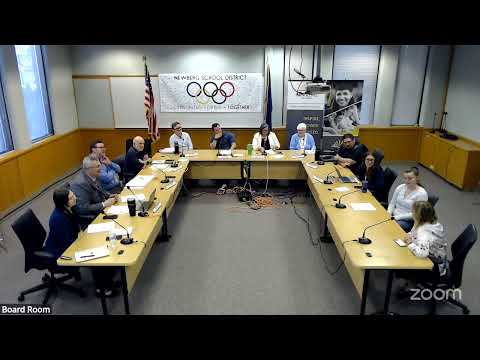
The Newberg School District Board of Directors spent a portion of its April 22 work session on a first reading of multiple policy updates drawn from Oregon School Boards Association (OSBA) model language.
Board members discussed a packet that includes the district’s current versions, a highlighted draft with district additions, and OSBA’s model policy text. Director Allen explained the packet contains three versions so directors can compare district language with OSBA recommendations and noted the district added state-required language for admissions and clearer references for foster and houseless students.
Board members asked for clarification about several items OSBA recommended deleting, including policies on community and public involvement (KC and KB), psychological testing of students (JHDA), and other older policies that appear duplicated in the district’s set. Directors said they want to know whether OSBA removed the items because those topics are covered elsewhere (for example, in the student rights and responsibilities handbook) or because OSBA no longer maintains model policy for them. Director Wolfer and others requested OSBA’s rationale for deletions before the second reading.
Administrators said the district will follow its normal process: the board adopts policy and district staff draft administrative rules (ARs) to implement the policy. Staff committed to bring an AR clarifying the district’s expectations and step-by-step procedures for child-abuse reporting tied to the policy when the policy returns for second reading.
Board members also asked staff to verify dates and duplicate policies (for example, IGBHE appeared twice in the district files with different dates) and to confirm whether OSBA will publish replacement language or updated references. Directors emphasized that removing a policy from the district manual does not prevent the board from encouraging community involvement, but some members said they consider formal policies a strong signal of district priorities and asked administrators to explore whether community-involvement language should remain as policy or be emphasized in district priorities.
Administrators agreed to: (1) ask OSBA for the reasoning behind each recommended deletion; (2) correct misspellings found in the minutes packet (a board member noted Kiwanis Club was misspelled); (3) bring the clarified child-abuse administrative rule with the second reading of the related policy; and (4) verify which of the district’s duplicate policies should remain active and correct the official dates before second reading.
Board members did not take final action on the policies at the meeting; the items were presented for first reading and scheduled to return for second reading after staff follow-up.
Why it matters: Board adoption or deletion of policies shapes the district’s official rules and signals priorities to families and staff. Directors said they want clear administrative rules that instruct employees how to meet legal reporting obligations and requested OSBA’s rationale when model policies are removed so the board can decide whether local policy language is still needed.