Get Full Government Meeting Transcripts, Videos, & Alerts Forever!
Get email alerts on the Healthcare Finance topic
No spam. Unsubscribe anytime.
Taxes committee backs HHS omnibus that restores provider tax, adds insurer-funded premium subsidy and draws debate over rebates and optometry scope
Summary
The committee recommended Senate File 2669, the HHS omnibus, which restores the provider tax to 2% (projected to raise roughly $401.3 million over four years), adopts an amendment clarifying wholesale drug-distributor rebate treatment (estimated $60 million over four years) and includes an insurer-funded 20% premium subsidy alternative to reinsu
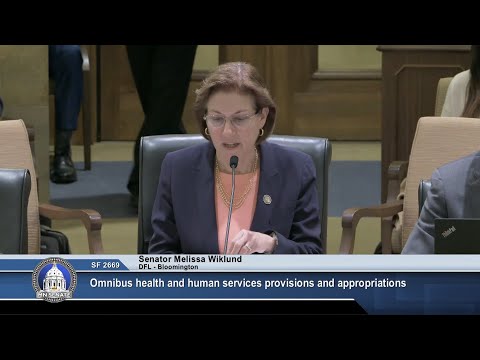
Senator Wicklund presented Senate File 2669 to the Minnesota Senate Taxes Committee on April 23, describing a health-and-human-services omnibus that restores the provider tax to 2%, proposes a 20% premium subsidy for the individual market funded by an assessment on insurers and adds directed payments and rate increases to support hospitals and emergency medical services.
Why it matters: supporters said the measures shore up provider and hospital finances, preserve access to care amid federal uncertainty and draw federal matching dollars; opponents warned the measures will raise health-sector assessments and premiums, questioned implementation timing and tax treatment, and objected to statutory clarifications that would expand the provider tax base.
Key policy and fiscal elements - Provider tax: The bill restores Minnesota’s provider tax to 2%. Department of Revenue estimates presented in committee show that raising the provider tax to 2% would increase revenue by roughly $401,300,000 over four years. The author said the restoration “maintains our fundamental commitment to health care access for Minnesotans.” - A47 amendment (wholesale drug rebates): The committee adopted the A47 amendment, which clarifies that gross revenues for wholesale drug distributors include rebates provided to customers. The Department of Revenue revenue estimate tied to the amendment showed roughly $60,000,000 in additional revenue over four years. Sponsor and counsel said the change responds to a court ruling and restores the historical tax base treatment for those distributors. - Premium subsidy (reinsurance alternative): The bill would replace the state’s reinsurance arrangement with a 20% direct subsidy for the individual market; the subsidy is funded by an assessment on health insurers, which the author said will draw federal matching funds and reduce premium costs for enrollees by about 20% compared with no subsidy. Committee discussion noted an open question about whether the subsidy would be treated as taxable income for recipients and about MNsure’s initial timeline for operationalizing such a program (MNsure’s first estimate said a 2027 start, but the author said further discussions are under way to accelerate implementation). - Directed payments and EMS increases: The bill includes a directed payment program for hospitals funded by a hospital assessment and a 15% across-the-board increase in EMS rates (plus an additional 10% for rural EMS), the sponsor said. - Provider and hospital assessments: Sponsor and staff said the assessment mechanisms are designed to leverage federal matching funds; committee members asked what would happen if federal approval were not obtained or later rescinded and whether collections would have to stop or be returned.
Committee debate and testimony Committee members pressed the author on implementation timing, the tax and fee totals in the bill, and the legal and fiscal risk if federal approval is withdrawn. Department of Revenue staff (Mr. Medina) confirmed the provider tax increase and the A47 amendment revenue estimates and identified the provider-tax revenue impact across multi-year estimates.
The committee also considered the A49/A49-type amendment (offered as A49/A49-equivalent), which would have restricted who may perform certain ocular injections; Senator Klein offered an amendment restoring more restrictive language. The amendment was debated and a representative of the Minnesota Optometric Association, Shep Harris, testified in opposition to restricting the scope further, saying optometrists are trained for the procedures described in the bill and that access issues justify the current compromise language. The A49 amendment failed on a roll call. The committee adopted two sponsor amendments (A50 technical and A47 rebate clarification) and then recommended the omnibus to Finance.
Action and votes - A50 (technical effective-date amendment): adopted (voice vote). - A47 (clarifying rebate language for wholesale drug distributors, ties to provider tax base): adopted by roll call. - A49 (scope restriction on ocular injections offered as an amendment): failed on roll call after debate and testimony from the Minnesota Optometric Association. - Final action: Senator Klein moved that Senate File 2669 as amended be recommended to pass and be referred to Finance. Committee roll-call votes recorded: Chair, Minnesota Senate Taxes Committee — yes; Senator Klein — yes; Senator Weber — no; Senator Dibble — yes; Senator Drazkowski — no; Senator Hauschild — yes; Senator Miller — no; Senator Nelson — no; Senator Putnam — yes. Tally: yes 5, no 4. Outcome: recommended to pass and referred to Finance.
Outstanding questions highlighted by committee members - Implementation timing and taxable treatment: Members asked whether the 20% premium subsidy paid through an insurer assessment would be considered taxable income for enrollees. The author said state staff are consulting with MNsure and that earlier fiscal notes had raised the taxable-income question; committee members requested updated fiscal analysis. - Federal approval and collection safeguards: Members asked for clearer statutory language to direct the commissioner to stop collecting assessments and to return funds if a federal waiver or federal matching authority were revoked; the sponsor said the bill includes commissioner discretion to adjust assessments and he would consider clearer collection/return language. - Total tax and fee increases: nonpartisan staff and sponsor confirmed the provider-tax revenue increase (approx. $401.3 million over four years) and the A47 rebate clarification (approx. $60 million over four years); members requested a consolidated accounting of all tax and fee increases (general and non-general fund) before the floor vote.
Ending note Senator Wicklund said the bill is intended to stabilize provider payment rates and preserve access to care at a time of federal uncertainty; opponents said the combination of fee and assessment increases will raise health care costs and that more detail is needed on implementation and taxpayer impacts.