Get Full Government Meeting Transcripts, Videos, & Alerts Forever!
Get email alerts on the Bridges topic
No spam. Unsubscribe anytime.
Miami County closes two bridges, staff outlines broader bridge replacement needs and grant opportunities
Summary
Road & Bridge staff reported two recent bridge closures, identified several low‑sufficiency structures that will require replacement over the next five years, and noted that many replacements are eligible for bridge grant programs.
Miami County Road & Bridge staff told commissioners the department closed two century‑old bridges on Monday and presented an inventory that shows several additional low‑sufficiency structures requiring near‑term action or replacement.
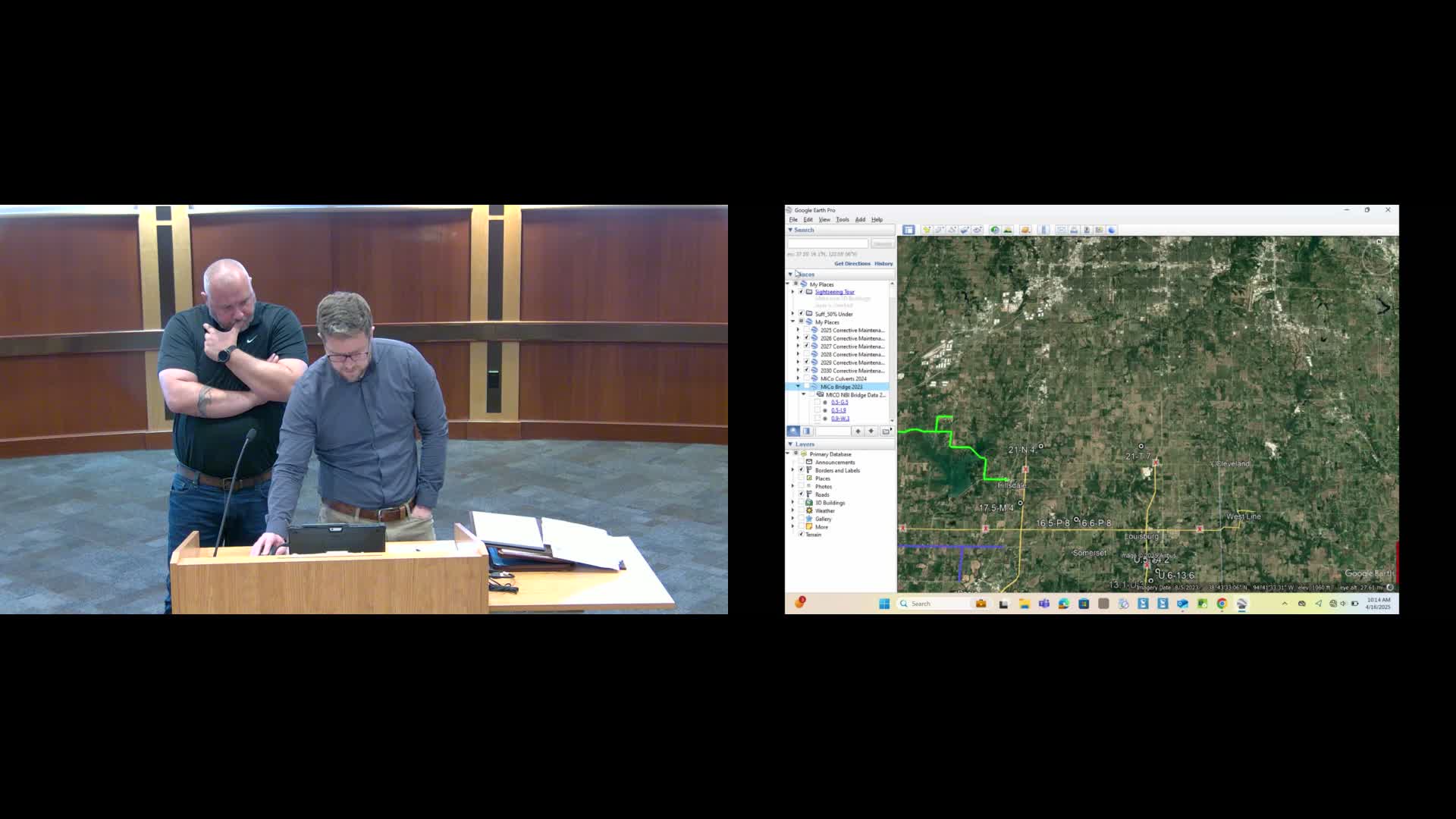
Matt told the commission the department’s inventory lists roughly 238 bridges originally; two were closed Monday, leaving 236 open to traffic at the time of the presentation. Matt identified the two recently closed structures as 21D1 (location noted in the packet) and 9G1 (330 Fifth in Plum Creek) and said both were historically old and had reached the end of their service lives. “I closed 2 on Monday,” Matt told the commission when reviewing the inventory.
Staff said 16 structures were below 50% sufficiency and about eight were in worse condition (roughly 30% sufficiency or lower) and should be prioritized for replacement. Staff recommended that the commission consider targeted closures where replacement is infeasible and pursue grant funding for replacements where practical. Matt said every structure on the prioritized list is eligible for off‑system bridge grant opportunities and noted the county had recently been awarded a $2.0 million grant to replace one project identified as 3.5‑q0.1.
Staff walked commissioners through examples: some historic masonry arch bridges had been widened with steel girders and count as two structures for inventory purposes but could be replaced with a single new structure. Staff also discussed the limits of alternative fixes: some failed low‑volume bridges are difficult and expensive to raise to modern flood elevations, and in select cases staff recommended closure rather than replacement.
The presentation described Culvert and low‑water crossing options in lieu of full replacement and explained permitting complications (state permitting agencies are less likely to permit a road raised in a floodplain; low‑water crossings require specific approvals). Staff said polymer overlays are valuable for protecting new decks but can be harmful if applied to decks with existing delamination unless comprehensive patching is done first.
Matt recommended the commission continue pursuing grants and directed staff to bring cost estimates and options for prioritizing up to roughly eight bridges over the next five years, including projects that could be bundled or replaced together.