Get Full Government Meeting Transcripts, Videos, & Alerts Forever!
Get email alerts on the Building Permits topic
No spam. Unsubscribe anytime.
Resident disputes survey requirement for portable building; commissioners ask staff to seek case-by-case fix
Summary
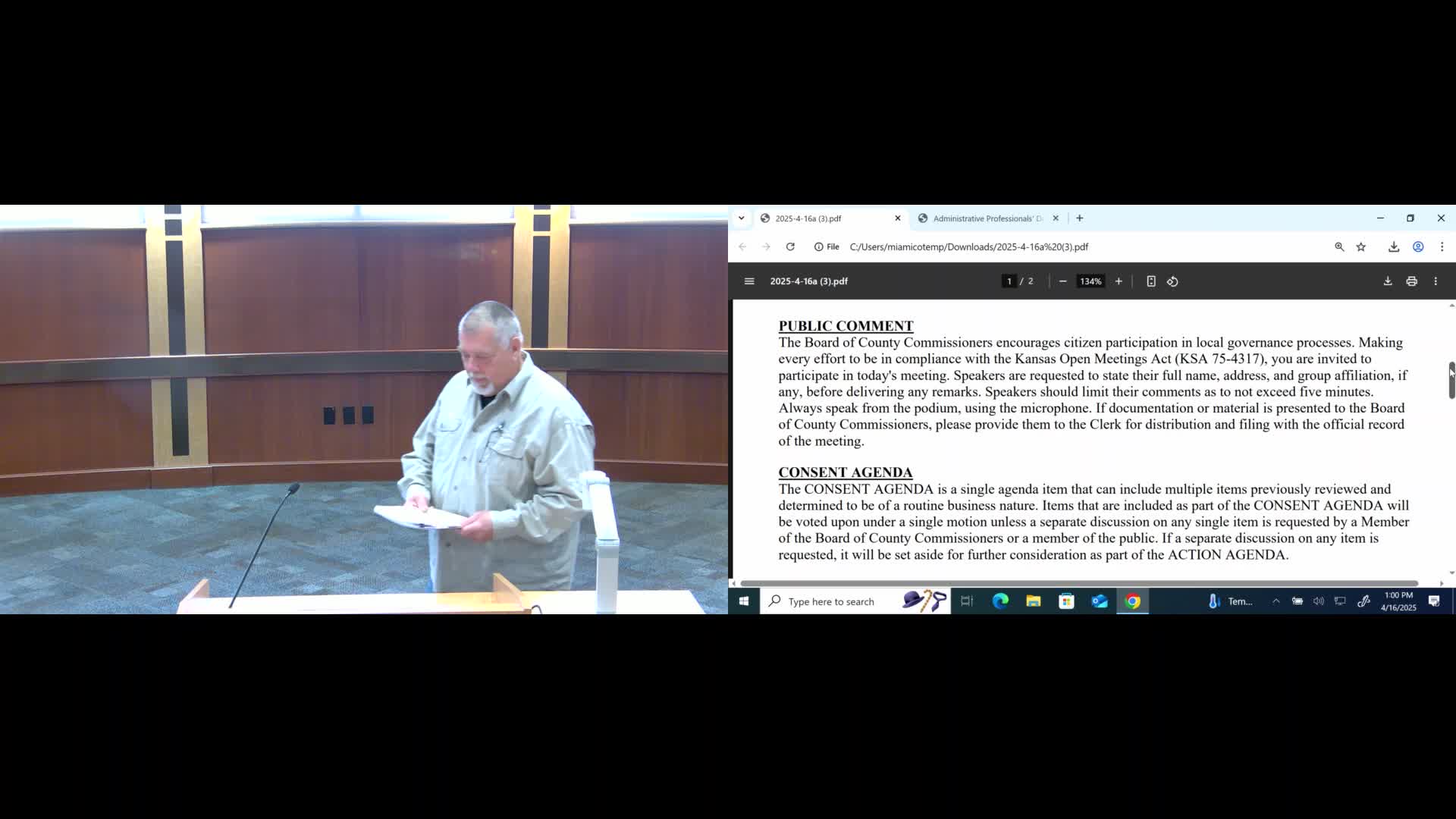
Bob Gregory, a Miami County resident, told the commissioners he was denied a permit to place a roughly 330-square-foot portable building on his two-acre lot because county rules require a current survey for parcels under three acres.
Bob Gregory, a Miami County resident, told the Miami County Board of County Commissioners on April 16 that he applied for a permit to place a roughly 330-square-foot portable building on his two-acre lot and was denied because county rules require a current survey for parcels under three acres.
Gregory said the existing survey pins from a survey completed around 2003 remain in place and that hiring a surveyor to reflag the property would cost about $850 and take 12 weeks for the field work and drawing. “I would much rather have one building than two,” Gregory said, adding that buying two small, permit-exempt units would be cheaper than paying for a survey.
Kenny Cook, Miami County planning director, told the commissioners the county enforces a site-plan standard that has been in place more than 20 years. “My understanding from talking to staff that was in place at the time when we adopted this policy is that we have ran into cases where we didn’t usually require surveys at all times and we’ve had somebody build a structure that went over the property line,” Cook said. He explained the county typically requires a survey/site plan with construction staking when a parcel is under three acres, when the proposed structure is within 20 feet of a setback, or when the parcel width is less than 100 feet.
Cook said Gregory’s lot meets two of the policy’s conditions: it is under three acres and the proposed structure would be 31 feet from the property line (the county’s 20-foot setback buffer plus an added 20-foot buffer referenced by staff). Cook said staff sometimes uses other information in borderline cases but that surveyors have, on occasion, found property pins that were incorrect and discovered structures encroaching on neighbors’ property.
Commissioners discussed options. One commissioner suggested asking a neighbor to sign a waiver; another asked whether staff could use an affidavit or other documentation. Commissioner Paul (identified in the meeting as Gregory’s commissioner representative) asked whether a short-term, case-specific approach would be possible while staff reviews broader policy changes. The board directed Gregory, Commissioner Paul and Kenny Cook to meet after the meeting to pursue an individual solution for the property while staff explores whether a policy change is warranted.
No formal change to county code or policy was made at the meeting.
Details: Gregory said the house on the lot was built around 2003 and the survey was done shortly before that. Cook said the county requires a survey for parcels under three acres, when proposed structures are within 20 feet of a setback, or when parcel width is under 100 feet; he said the county has relied on that standard for roughly two decades.
The commissioners did not vote on policy changes; they instructed staff to pursue a case-specific accommodation for Gregory and to return to the commission if broader rule changes are proposed.