Get Full Government Meeting Transcripts, Videos, & Alerts Forever!
Get email alerts on the Resilience Office topic
No spam. Unsubscribe anytime.
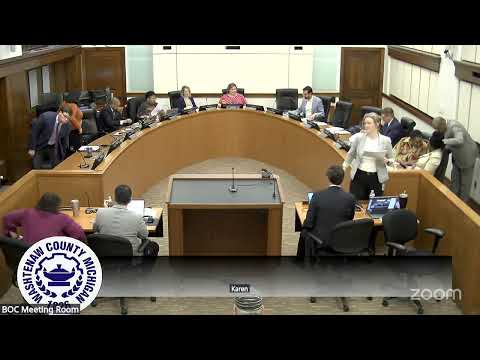
Washtenaw County resilience officer outlines 2025 priorities, including hazard‑mitigation plan to unlock federal funding
Summary
County Resilience Officer Beth Gibbons briefed the Board on the Resilient Washtenaw plan, staffing and 2025 priorities, and said the office will pursue a countywide hazard mitigation plan to enable FEMA BRIC funding and lowered flood-insurance rates for municipalities.
Beth Gibbons, Washtenaw County’s resilience officer, told commissioners the county office has grown to a three-person team and is prioritizing implementation of the Resilient Washtenaw plan in 2025, including a countywide hazard mitigation plan to improve eligibility for federal resilience grants.
Gibbons said the resilient plan sets two core targets: carbon neutrality in county operations by 2030 and countywide carbon neutrality by 2035. The Resilient Washtenaw plan also assigns eight strategy areas — energy transition, housing, mobility and access, health, working lands and natural areas, infrastructure and circular economy, and implementation and engagement — and lays out roughly 45 measurable action areas.
“We are a small and mighty office,” Gibbons said. She described the team’s early work since launching in 2024: recruiting technical assistance, placing a My Healthy Climate Corps member and interns, hosting cross‑departmental training, and coordinating renewable‑energy and resilience planning with facilities management, public health, parks and the Water Resources Commission.
Gibbons emphasized one near‑term priority: developing a countywide hazard mitigation plan that would make municipalities eligible for FEMA BRIC (Building Resilient Infrastructure and Communities) funding and allow communities to participate in the National Flood Insurance Program’s Community Rating System, which can reduce flood insurance premiums for households.
“We are working to initiate plans on a resilience funding authority and to create a regional climate network,” Gibbons said, describing outreach to county departments and municipalities to build trust and shared projects. She also discussed a countywide “decarbonization menu” of projects, technical assistance to municipalities, and a forthcoming county climate practitioners convening.
Commissioners asked about the hazard mitigation plan and other actions. Commissioner Hoch asked why the plan is necessary; Gibbons answered that FEMA requires an approved hazard‑mitigation plan for many resilience grant programs and that a multi‑jurisdictional plan would let municipalities apply for funds individually once they adopt the county plan. Commissioner Scott asked about federal policy and supply‑chain pressures; Gibbons said tariffs and global supply issues could raise costs for renewable equipment and that she would brief the board on federal‑policy impacts when staff analysis is available.
Gibbons flagged several challenges: terminations of federal technical‑assistance partnerships have reduced capacity for agricultural resilience work, and uncertainty about federal funding and policy creates implementation risk. She urged a “grounded hope” approach: pursue achievable actions even amid uncertainty.
The board did not take formal action on the resilience update but expressed support and asked staff to return with briefings on federal policy impacts and plans for the hazard mitigation process and municipal engagement.