Get Full Government Meeting Transcripts, Videos, & Alerts Forever!
Get email alerts on the Municipal Finance Tax Credits topic
No spam. Unsubscribe anytime.
Finance presents tax‑credit overhaul to target subsidies, lower homeowners’ sticker rate
Summary
Deputy Finance Director Bob Senamy told the Budget and Appropriations Committee the mayor’s tax credit work group found six themes in its review and will propose a package of reforms designed to better target development incentives, boost enrollment in a state homeowners credit and lower the apparent residential property tax "sticker" rate.
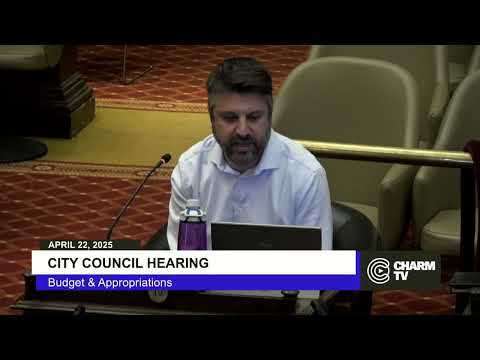
Deputy Director of Finance Bob Senamy told the Baltimore City Council’s Budget and Appropriations Committee that a mayor‑directed tax credit work group has identified six themes and will recommend reforms to better target development incentives, increase enrollment in a state homeowners credit and correct what he called misalignments that make the city’s residential property tax look higher than peer counties.
The work group, formed in January 2024 at the mayor’s direction, completed a review of eight city tax‑credit programs and is moving from fact‑finding to deliberation, Senamy said. “Our mission is, pretty simple. It's to develop a program, a mix of tax credits that accomplishes 3 things. 1 is to attract additional investment to Baltimore City,” Senamy told the committee. He said the group will next craft a reform package to present to the mayor and then to the full council.
Why it matters: tax credits affect where developers build, how much homeowners pay and how the city budgets for services. Finance officials said reforms could both reduce the city’s recurring cost of subsidies and present a lower “sticker” property‑tax rate to prospective homebuyers—a step they argue could make Baltimore more competitive with neighboring counties.
Senamy summarized six key findings. First, three structural differences make the city’s headline tax rate appear high: the targeted homeowners tax credit (often reducing the effective residential rate), a relatively generous homestead cap now set at 4% (state law allows local caps from 0% to 10%), and the practice of funding solid‑waste costs from the general fund rather than a separate fee. Senamy said the group is considering modest changes, including increasing the homestead cap from 4% to 6% and studying a solid‑waste fee that would remove those costs from the levy calculation. "I think it would be a big deal to kinda get our rate under that $2 threshold," Senamy said of lowering the effective residential levy.
Second, Senamy said Baltimore is under‑enrolled in the state homeowners tax credit, a program paid entirely by Maryland that provides meaningful relief to eligible owners. Eligibility the work group reviewed: household income under $60,000, assessed value up to $300,000, and net worth under $200,000 excluding the home. Senamy said enrollment has fallen over the last decade, “we’re under enrolled by thousands of people,” and the average tax relief for enrolled households is about $1,700.
Third through fifth findings address development credits: the department found that (3) the city lacks a consistent “but‑for” test for large subsidies (affordable projects typically face a detailed pilot review while some market‑rate projects receive large subsidies without equivalent financial scrutiny), (4) subsidies are applied uniformly across neighborhoods rather than graduated by market need, and (5) program rules are inconsistent and sometimes burdensome across credits (for example, differing transfer rules, eligibility requirements and calculation methods).
Senamy gave examples. He said affordable apartment projects that request pilot agreements go through a rigorous review and average about $50,000 in city subsidy, while some market‑rate projects receive subsidies averaging about $500,000 per year and currently have no comparable preapproval test. He proposed adding targeted financial review for high‑value market projects while reducing unnecessary rules for smaller projects to encourage applications and preserve city oversight where it most matters.
Sixth, the work group identified program‑specific quirks that raise cost or reduce value. Among them: - Brownfield: state law requires a city contribution to a state economic development fund to participate; Senamy said Baltimore has contributed more than it has received back and the city will consider adjusting its participation or the program’s optional provisions (the local extension from a default 5‑year/50% to longer/higher benefits was adopted decades ago). - CHAP: the city’s renovation credit provides a 100% abatement on improvement value for 10 years and appears concentrated in stronger market neighborhoods; the group discussed targeting or phasing benefits by neighborhood typology. - Newly constructed and high‑performance market credits: builders told the group that land availability, zoning and parcel scale often matter more than the credit itself; high borrowing and construction costs also have reduced project feasibility in recent years. - Enterprise Zone: the state reimburses about half the enterprise‑zone credit; the governor proposed eliminating new authorizations in the current year’s budget and the group is preparing for the program to be a recurring target in state budget debates.
Committee members pressed staff on equity and distributional effects. Council President Z Cohen noted that many residents face “a deluge of fines, fees, taxes, BGE bills, water bills” and asked whether changes would simply shift burdens among residents rather than providing net relief. Senamy responded that some homeowners—particularly those in properties whose assessed values are not rapidly rising—would see modest direct relief from a lower effective rate and that fee design could be structured to limit regressive effects. "If you correct those couple of misalignments, we can then be talking about a tax rate for a homeowner that's 1.8," Senamy said as an illustrative target for an effective residential rate if several reforms are adopted.
Council members and the chief administrative officer also discussed outreach to increase enrollment in the state homeowners credit. Senamy and Faith Leach, the city’s chief administrative officer, said the 10‑year plan will include an initiative on enrollment outreach; Senamy noted enrollment requires documentation of household income and net worth, so effective outreach typically pairs with tax‑season services and trusted community partners. Leach said the 10‑year plan has been drafted and that the administration is in stakeholder and community engagement with a full release planned for late summer or early fall.
What was decided: the work group will move into deliberations and assemble a reform package for the mayor’s review and, if approved, subsequent presentation to the council. No formal votes or ordinance actions were taken at the hearing.
The committee recessed at the conclusion of the presentation. Questions and next steps recorded in the meeting included direction for staff to develop targeted outreach plans for the state homeowners credit, to model effects of a 4%→6% homestead cap change, and to study solid‑waste fee designs that mitigate regressivity while creating a dedicated funding stream for waste services.