Get Full Government Meeting Transcripts, Videos, & Alerts Forever!
Get email alerts on the Sunshine Law Quasi Judicial Ethics topic
No spam. Unsubscribe anytime.
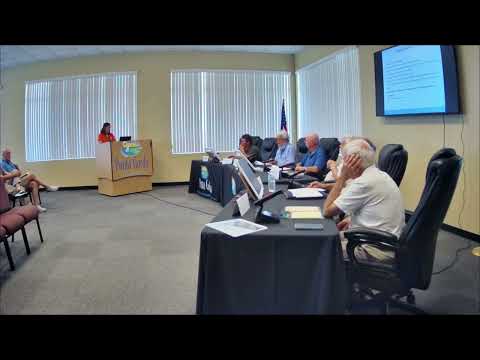
City clerk reviews Sunshine Law, quasi-judicial procedures and ethics at Punta Gorda Isles Canal Advisory Committee training
Summary
City Clerk Sarah Welch led the committee through annual training on Sunshine Law, public records, quasi-judicial hearing rules and ethics, including requirements for disclosures, recusal and evidence standards for canal construction special permits.
Sarah Welch, Punta Gorda’s city clerk, provided the Punta Gorda Isles Canal Advisory Committee its annual training on April 21, reviewing the Sunshine Law, public records requirements, quasi-judicial hearing procedures, and ethics obligations tied to canal construction special permits.
Welch emphasized that quasi-judicial public hearings — the process the committee uses for canal construction special permits — require committee members to base decisions on the competent, substantial evidence presented at the hearing and to follow the committee’s adopted procedures (Resolution 3673-2022). “You have to base your decisions on the application of the testimony presented at the hearing as they compare to the pre-established criteria for approval,” Welch said.
Key points Welch covered included: how the committee functions as the decision-making body in quasi-judicial matters; the roles of applicant, staff and any party-intervener; evidence standards and limits on hearsay; and requirements for disclosure of ex parte communications (verbal or written) before final action. She instructed members that ex parte contacts are permitted only if disclosed on the record after the item is opened.
Welch also explained Florida ethics and disclosure obligations, including the state Code of Ethics (Florida Statutes, Chapter 112), limits on serving on multiple decision-making boards under Article II, section 5 of the Florida Constitution, and the requirement to file financial disclosure forms (Form 1) annually. She noted that committee members must file the Form 1 on the Florida Commission on Ethics online portal by July 1 each year after appointment.
On the Sunshine Law, Welch warned committee members that two or more members may not discuss board business outside a properly noticed public meeting. She said the law covers in-person, phone, written and social media exchanges and carries possible criminal and civil penalties for violations. “It applies to any two or more members of the same elected or appointed board and says that you can't have two or more members discussing something that is board business outside of a public meeting,” Welch said.
Committee members asked procedural questions about reopening hearings for follow-up questions and about when to recuse. Welch advised that a public hearing should be reopened by motion if committee members need to ask additional questions of witnesses; members who previously expressed bias should abstain and consider filing Form 8B to disclose conflicts. Jake Dye and Ron Ludwig asked clarifying questions about reopening hearings and financial burdens tied to recording fees; Welch said recording fees for approval letters are typically small and that applicants are usually responsible for them.
Welch concluded by reminding members to forward any records they receive about city business to staff for retention and to use the retention email address the city provided. The training did not produce formal committee action; it was informational.
Next steps: staff will continue to assist members with filings and can provide legal advice through the city attorney when questions about evidence admissibility or ethics arise.