
Canton School Building Committee approves enrollment in Mass Save energy incentives
Get AI-powered insights, summaries, and transcripts
Sign Up Free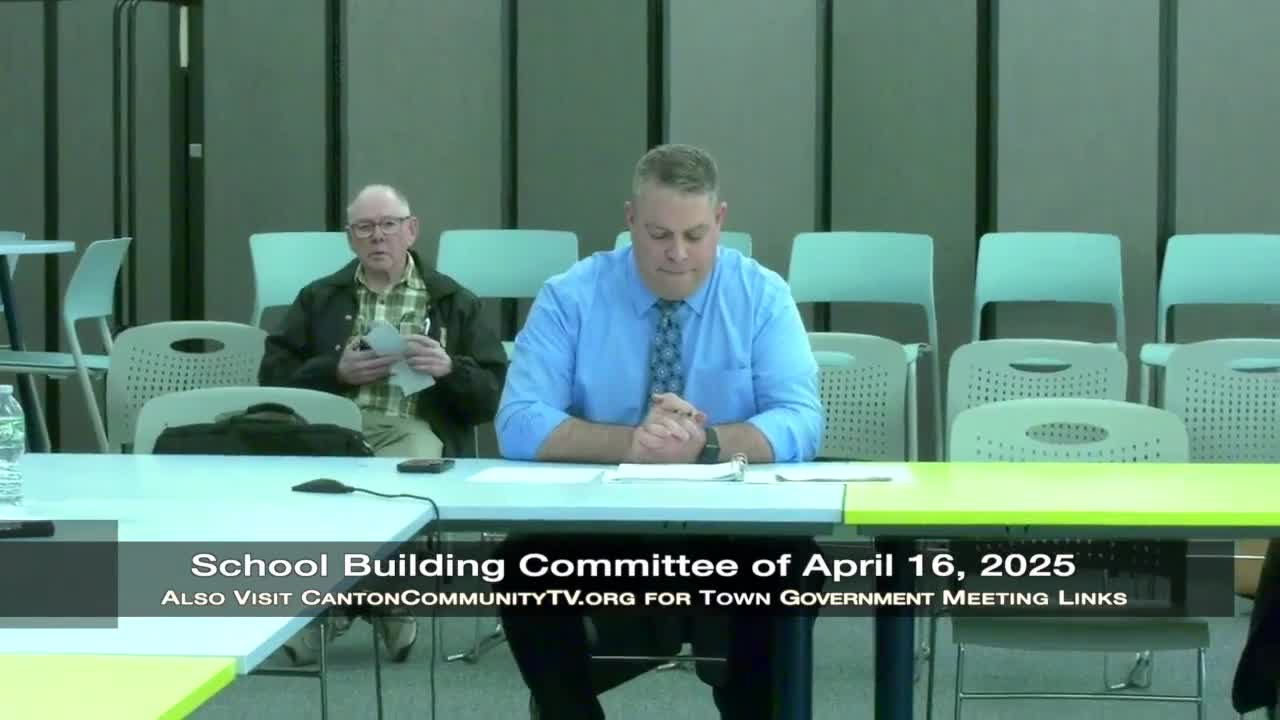
Summary
The Canton Public Schools School Building Committee voted unanimously April 16 to enroll the new school project in the Mass Save program and commit a $2,240 town share for a required energy model, potentially unlocking larger incentives tied to an all‑electric design.
The Canton Public Schools School Building Committee on April 16 voted to enroll the district’s new school project in the Mass Save program and commit $2,240 to cover the town’s share of a required energy model.
AI 3, the design consultant for the project, told the committee that the Mass Save program offers two eligible pathways for the district because the proposed building is too large for Path 3. “Path 1 identifies a specific EUI … in this case, an EUI of 25 or less,” AI 3 said, and noted that Path 1 carries larger incentives tied to meeting that Energy Use Intensity target. AI 3 also said Path 1 “does not require the install of photovoltaic panels. It needs to be ready for it, but it doesn't require the install of it.”
Why it matters: enrolling commits the project to the program’s modeling and review and requires a modest up‑front payment while preserving the project’s ability to collect incentives after construction. AI 3 estimated potential incentives of up to $3.50 per square foot if the project meets Path 1 requirements, plus additional “heat pump adders” (AI 3 said $800 per ton for air‑source heat pumps and $4,500 per ton for geothermal), though the exact final incentive amount will depend on final energy modeling and post‑occupancy verification.
Details of the enrollment: AI 3 said the program requires a project energy model costing $7,650. Mass Save will contribute $5,410 toward that modeling, leaving the district’s share of $2,240. The consultant described other eligibility rules discussed with the committee: Path 1 targets an EUI of about 25 or less; all‑electric buildings are favored (no natural gas piping or meter in the building), and while photovoltaic panels are not required, the building must be “ready” for them. AI 3 also referenced ASHRAE 90.1 as the technical standard the mechanical team will use for metering and modeling.
Committee discussion and vote: Committee members asked questions about grid readiness, long‑term electric costs and reliance on state programs; those concerns were discussed but did not block the motion. Bob McCarthy moved to approve enrollment and funding of the Mass Save energy model; Miss Vendetti seconded. The committee voted 6–0 to approve the enrollment and the $2,240 commitment. The committee chair said she would sign the enrollment paperwork.
Next steps: AI 3 will proceed with the energy modeling required by Mass Save and the team will continue coordination with the mechanical engineer to meet the program’s documentation requirements.