Get Full Government Meeting Transcripts, Videos, & Alerts Forever!
Get email alerts on the Rental Assistance topic
No spam. Unsubscribe anytime.
Joint committee accepts County Executive's HIF budget for rental-assistance programs; members press for revenue history and outcome data
Summary
A Montgomery County joint committee voted unanimously April 22 to accept the County Executive's recommended budget for Housing Initiative Fund (HIF)-funded rental assistance programs and forward it to the full council, while members requested a historical recordation-tax analysis and program outcome data on homelessness.
A Montgomery County joint committee on April 22 voted unanimously to accept the County Executive's recommended budget for Housing Initiative Fund (HIF)-funded rental-assistance programs and forward that recommendation to the full County Council.
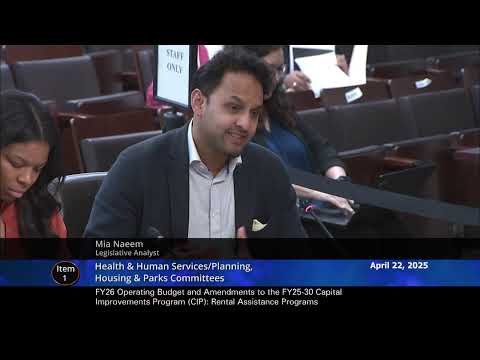
The work session, convened by the Planning, Housing and Parks and Health and Human Services committees, reviewed HIF-supported programs administered by the Department of Housing and Community Affairs (DHCA), the Department of Health and Human Services (HHS) and Montgomery County's housing partners. Committee members endorsed the executive's proposed contingency level and agreed not to reallocate HIF dollars at this time, while asking staff for a 10- to 15-year history of actual recordation-tax receipts and for program outcome data on homelessness and rapid rehousing.
The HIF is managed by DHCA and funds multiple rental-assistance efforts, including voucher and subsidy programs managed by the Housing Opportunities Commission (HOC), rapid rehousing and eviction-prevention services through HHS, and programmatic supports operated by nonprofit partners. Chelsea Andrews, president of HLC, said, "This funding is much needed, and greatly appreciated. I see that there is a recommendation for a slight increase to account for inflation." Scott Bruton, director of the Department of Housing and Community Affairs, summarized the session's purpose as a review of "the HIF funded rental assistance programs."
Budget details and contingency: County staff described two principal decisions for the committee: whether to reduce the recommended contingency and how to replace federal dollars that have ended. The County Executive recommended a contingency of $2,600,000 for the HIF to buffer volatile recordation-tax revenue. Staff said contingency has historically been programmed near 10 percent to preserve the county's ability to fund housing opportunities that arise during the fiscal year; reducing the contingency to roughly 5 percent was estimated in the materials to free about $1.2 million for program use.
Boffin Salem of DSCA explained that the county uses the recordation-tax premium to support DHCA, HHS and partner programs and that projections for FY26 built in a 3 percent inflation adjustment to allocations. Salem also noted risk from revenue swings: "a couple years ago, especially FY '22, the recordation tax premium, the actual revenue, can come back much lower," leaving less room to meet commitments.
Homelessness and program outcomes: HHS staff and partners urged continued investment in both prevention and interventions. HHS presented point-in-time data showing an increase from 1,144 people counted on Jan. 24, 2024, to about 1,500 in the most recent count, a roughly 32 percent increase. HHS staff said the number of families experiencing homelessness doubled from about 100 to about 200 year over year; more than half of people in those family households are children.
HHS described results from the SHARP rapid-rehousing effort: since a supplemental appropriation, staff said SHARP has housed 80 families and that the current family count in emergency placements is about 150 because of continuing inflow. HHS staff characterized permanent supportive housing as highly effective for chronically homeless individuals and said retention rates for that intervention are approximately 98 percent.
Council members pressed staff for more data. One committee co-chair said council members should see actual recordation-tax receipts (not just budget projections) for the last 10 to 15 years at the December fiscal update and recommended a joint committee session in January to consider allocations once more revenue information is available. Several committee members also requested more program-level outcome metrics (length of stay after rehousing, recidivism into homelessness, caseload sizes, and housing stabilization services) and greater regional coordination with COG and neighboring jurisdictions.
Decision and next steps: Committee members expressed broad support for keeping the executive's recommended contingency in place and not reallocating funds away from affordable-housing programs at this time. "Without objection, we will accept the county executive's recommended budget on these HIF funded programs, and we will forward that along to the full council," a committee co-chair said at adjournment. Staff were asked to provide: (1) actual recordation-tax receipts for the past decade or longer; (2) eviction and foreclosure data by jurisdiction; and (3) outcome analyses for SHARP and other rapid-rehousing and stabilization programs at upcoming HHS and PHB committee meetings.
The committee made no ordinance or appropriation change at this session; it forwarded the executive's recommended HIF budget items to the full council with a unanimous joint-committee recommendation and directed staff to return with the requested financial and program data later in the year.