Get Full Government Meeting Transcripts, Videos, & Alerts Forever!
Get email alerts on the Downtown Revitalization topic
No spam. Unsubscribe anytime.
EDC presents plan to revitalize Downtown Terrell, highlights housing, workforce and childcare gaps
Summary
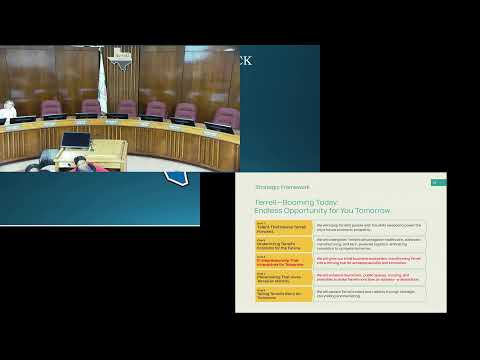
The Economic Development Corporation (EDC) outlined a strategic framework aimed at turning downtown Terrell into an economic and civic hub, focusing on shared infrastructure, absentee landlord enforcement, workforce training and housing affordability. The plan is expected to be finalized in June and will be taken to city council for action.
An Economic Development Corporation (EDC) representative told local stakeholders that the organization’s strategic plan prioritizes turning Downtown Terrell into a destination, improving housing options, expanding workforce training and pursuing shared infrastructure such as a commercial kitchen or small-business incubator.
The EDC representative said the plan, which the EDC expects to finalize in June, emerged from an analysis showing a heavy concentration of logistics and distribution jobs in the city — a location quotient of 5.79, more than 2,000 such jobs and 29% growth in the past five years — alongside other local strengths and gaps. “Now is the time to build that momentum across peer cities to revitalize downtowns,” the EDC representative said.
Why it matters: downtown property conditions, workforce needs and housing supply shape whether small merchants and new firms locate or expand in Terrell. The plan links downtown placemaking to broader economic goals and calls for coordinated action among the EDC, city council, planning and zoning, the park board and related stakeholders.
Most important elements
Shared infrastructure and small-business supports: The plan recommends exploring shared assets — for example, a commercial kitchen, food hall or incubator — to lower startup costs for locally owned restaurants and creative businesses. The EDC representative said stakeholders see potential for such shared infrastructure to “lower barriers for new ventures and support homegrown enterprises.”
Absentee owners and building maintenance: Participants repeatedly raised concerns about absentee property owners who defer maintenance while collecting rent. The EDC representative said staff will bring “nonnegotiables” to the city council tied to the Central Business District zoning ordinance and annual commercial inspections (the fire marshal already conducts such inspections). The aim is to require certain maintenance and registration of vacant buildings and to explore enforcement or fines to prompt owner engagement.
Housing affordability and inventory: The presentation said roughly 20 new housing units are in the pipeline within city limits and the extraterritorial jurisdiction (ETJ), though that figure was provided by a third-party study and described in discussion as approximate. The EDC analysis flagged that 56% of renters are cost-burdened. Local housing stock includes about 2,000 apartment units and roughly 300 housing vouchers distributed monthly. Stakeholders noted that median home prices in the area are near $250,000 and that property taxes for homes at that price can run about $800–$1,000 per month; participants linked those tax and insurance costs to higher rents.
Workforce and sector mix: The EDC review found the city has about 770 health-care workers — about 12% more than the national average for a city of similar size — but sector employment has grown only about 1% recently. The presentation emphasized that manufacturing and distribution will likely see more automation over time, so job-training strategies will need diversification.
Childcare and daycare incentives: The group discussed daycare as a barrier for workforce participation and entrepreneurship. The EDC representative said Texas law allows daycare incentives when a city passes an ordinance; the city council would need to consider that option if a childcare provider expresses interest in building here.
Financing and partnerships: Speakers pointed out that the city and partner boards (the EDC and the Paddock board) hold funds that could seed infrastructure and leverage private developers. The EDC representative noted that a public-private partnership would likely be required to build a Terrell Town Square or make infrastructure-ready parcels attractive to developers.
Timeline and next steps: The EDC told stakeholders the plan should be finalized in June, with goal-setting beginning ahead of an August planning retreat. The EDC invited city representatives to join its monthly meetings (third Wednesday at lunch) and to participate in working groups. The EDC also offered two nonvoting seats on its board and said it had invited Raylan to serve as a nonvoting member to represent council interests.
Quotes and attributions in this article come only from named speakers in the meeting record: the EDC representative and others listed in the article’s speaker list. The discussion produced no formal motions or votes recorded in the meeting transcript.