Get Full Government Meeting Transcripts, Videos, & Alerts Forever!
Get email alerts on the Community Survey topic
No spam. Unsubscribe anytime.
ETC Institute presents Battle Ground community survey; residents rate police, customer service highly and flag growth and streets as top concerns
Summary
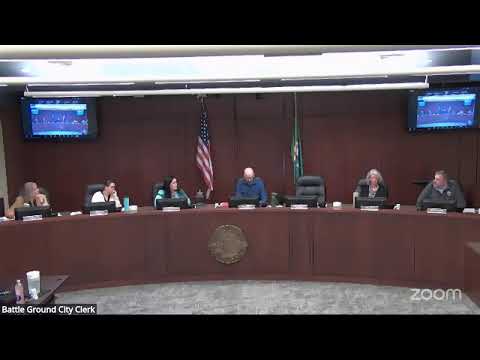
Robert Haycock, a representative of ETC Institute, presented results of a January–February 2025 community survey to the Battle Ground City Council at a work session on April 21.
Robert Haycock, a representative of ETC Institute, presented results of a January–February 2025 community survey to the Battle Ground City Council at a work session on April 21. The survey used mail and online collection, produced 405 completed responses and yielded a reported margin of error of ±4.8 percentage points.
The survey found strong resident satisfaction in several areas. ‘‘Overall quality of police services’’ was rated at about 72 percent satisfied in Battle Ground, compared with regional and national benchmarks Haycock cited at roughly 56 percent and 53 percent, respectively. Customer service from city employees also scored highly (reported at about 63 percent), figures Haycock said the city should ‘‘hang your hat on.’’
At the same time, respondents singled out several concerns. Roughly six in 10 respondents reported dissatisfaction with how the city is managing growth and development, and availability of affordable housing was also listed among higher concerns. Street maintenance and the effectiveness of city economic development efforts ranked high when residents were asked about investment priorities. For parks and recreation, an indoor pool or aquatic center and new walking paths rated highly among unfunded priorities.
Haycock emphasized the survey’s methodology and comparability: ETC benchmarked Battle Ground results against a regional ‘‘Northwest’’ average and national averages it maintains and updates periodically. He recommended using repeated surveys to track changes over time and to target resident groups marked as ‘‘neutral’’ to raise awareness of services. He also noted that nearly two-thirds of respondents said they would support increased taxes, fees, or a bond measure in principle to fund priority parks projects—Haycock described that as an indication residents want to be engaged in options and discussions, not an immediate instruction to place a measure on a ballot.
City staff framed the presentation as a study session; the council took no formal action during the meeting. Council members asked for follow-up analysis to dig into specific concerns—Haycock offered to work with staff to ‘‘peel that onion back a little bit’’ and examine drivers of dissatisfaction in future surveys.
Ending: Staff and ETC said they will make survey data and slide materials available to council and suggested a recurring (for example, biannual) survey cadence as part of future budget discussions. No votes or directives adopting the survey were taken at the April 21 meeting.