Get Full Government Meeting Transcripts, Videos, & Alerts Forever!
Get email alerts on the Buoy Maintenance Weather Safety topic
No spam. Unsubscribe anytime.
Witnesses urge federal repair of Seal Rocks weather buoy after months of outages
Summary
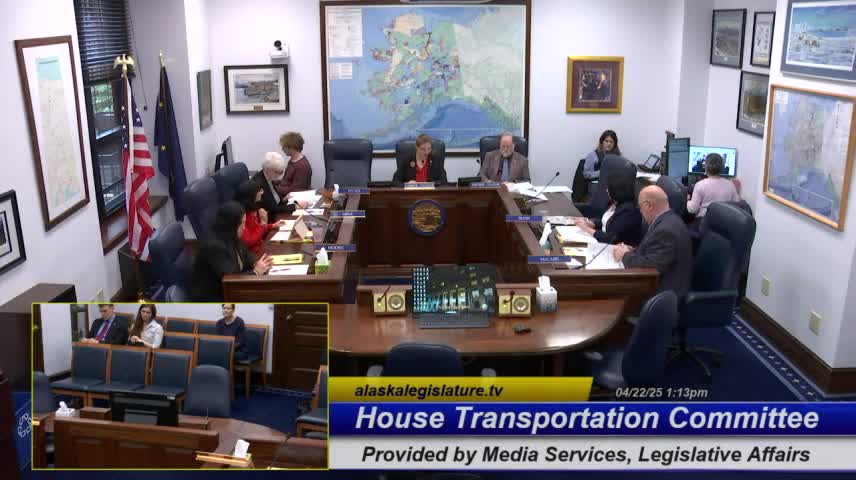
The House Transportation Committee on April 22, 2025, received invited testimony urging federal repair and maintenance of National Data Buoy Center stations in Alaska, with particular concern about the Seal Rocks buoy at the Hinchinbrook Entrance to Prince William Sound.
The House Transportation Committee on April 22, 2025, received invited testimony urging federal agencies to address outages of National Data Buoy Center (NDBC) stations in Alaska, with particular concern about the Seal Rocks buoy that serves the Hinchinbrook Entrance to Prince William Sound. Senator Forrest Dunbar’s Senate Joint Resolution 12 asks the U.S. Congress and NOAA to restore and maintain those buoys.
"Weather information at remote locations is critical to the safe transportation of oil in our region," said John Guthrie, maritime operations project manager for the Prince William Sound Regional Citizens Advisory Council, testifying from Valdez. Guthrie told the committee that the Seal Rocks buoy had been fully functional for only 35 days over the last 18 months and that the Coast Guard uses the buoy to help decide when laden tankers can transit the Hinchinbrook Entrance.
Robert Archibald, president of the Prince William Sound Regional Citizens Advisory Council, also urged prompt maintenance, saying buoy and station observations reduce risk to tug crews and other mariners. Senator Forrest Dunbar, sponsor of SJR 12, told the committee the resolution had passed unanimously in the other body and said he hoped the state could press the federal delegation and NOAA for action.
Committee members and witnesses described how the buoy outages complicate Coast Guard closure decisions. Current operational guidance cited by witnesses calls for the Hinchinbrook/Seal Rocks entrance to be closed to laden tankers when wind speeds exceed 45 knots or wave heights exceed 15 feet. Guthrie and Archibald said that without functional buoy data, the Coast Guard must rely on distant buoys, forecasts and shipboard observations, reducing the precision of closure decisions.
Witnesses explained maintenance responsibilities and timelines. Guthrie said the National Data Buoy Center within NOAA is responsible for buoy maintenance; the Coast Guard can provide logistical support when schedules align. He said the Seal Rocks buoy was originally scheduled to be repaired by the Coast Guard cutter stationed in Cordova in April, but timing did not work out; NDBC is contracting a vessel to repair the buoy in June. Guthrie also testified that funding for buoy maintenance is insufficient and that the Prince William Sound Regional Citizens Advisory Council had submitted an appropriations request to Senator Lisa Murkowski for increased maintenance funding.
The committee did not take a final vote on the resolution in this hearing. Members agreed to set SJR 12 aside and return it at a subsequent hearing; the chair said the committee will bring the resolution back on Thursday, April 24, 2025, and intends to set an amendment deadline at that time.
The committee packet and testimony emphasized public-safety and commercial navigation implications if buoys remain offline, and members asked staff to collect additional information about the number of NOAA buoys in Alaska and the scale of outages statewide.