Get Full Government Meeting Transcripts, Videos, & Alerts Forever!
Get email alerts on the Voter Preregistration topic
No spam. Unsubscribe anytime.
House committee hears bill to allow 16‑year‑olds to preregister to vote; bill set aside for follow-up
Summary
Lawmakers and witnesses debated House Bill 21, which would let 16‑year‑olds preregister to vote in Alaska, tighten confidentiality for under‑18 registrants, and add DMV/Division of Elections procedures. The committee heard testimony and fiscal notes, then set the bill aside for later consideration.
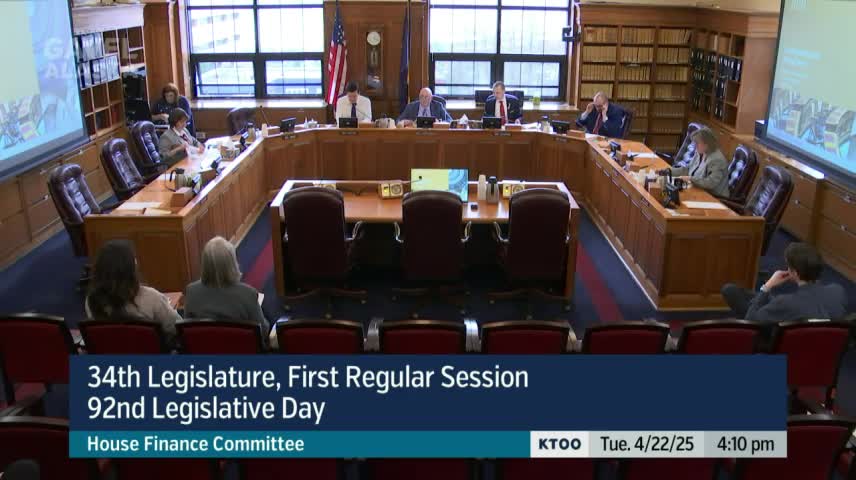
Representative Andy Story, sponsor of House Bill 21, told the House Finance Committee on April 22 that the bill would allow 16‑year‑olds in Alaska to preregister to vote and would protect the contact information of anyone under 18 who preregisters.
"This bill seeks to increase youth civics engagement, knowledge, and interest about the voting process by allowing 16 year olds to preregister to vote," Representative Andy Story said. For the record, Story represents District 3, which he described as including the North Mendenhall Valley, Juneau, Gustavus, Haines, Klukwan and Skagway.
The bill would change current state practice, which allows people to register 90 days before their 18th birthday, and instead permit preregistration beginning at age 16. Under the bill, preregistered contacts would be held in a pending status until the Division of Elections sends a nonforwardable notice to the registrant’s address 90 days before their 18th birthday; the registrant would have 45 days to confirm the address before the division issues a voter card.
Honor Miller Austin, staff to Representative Story, walked the committee through the section-by-section language, saying, "Section 1 of this bill, it allows a person who is at least 16 years of age ... to preregister to vote." Austin also said the bill would make preregistered applicants’ information confidential.
Lehi Wheelers, a high‑school U.S. government teacher in Anchorage who testified at the invitation of Representative Story, described classroom experiences that the sponsor and other members cited as justification. "Every semester for those 21 years, I have taught my high school seniors in US government classes how to register to vote," Wheelers said, adding that students who are taught about registration outside the 90‑day window sometimes later miss the 30‑day registration deadline before an election.
Committee members questioned whether preregistration at 16 is necessary given existing options, including online registration and automatic opportunities tied to driver’s license applications. Representative Bynum and others urged caution about creating new statutory mechanisms instead of relying on reminders or existing registration points.
Carol Beecher, director of the Division of Elections, gave the division’s fiscal estimate for the bill and for the verification mailings. "We anticipate this would cost approximately $15,000 from the general fund every year," Beecher said, citing an estimated 10,303 16‑year‑olds and a 73¢ postage rate.
Kathleen Wallace, acting director of the Division of Motor Vehicles, described a one‑time programming cost to enable the DMV to transmit preregistration data electronically to the Division of Elections. "We estimate not to exceed 300 hours of programming ... priced at $150 per hour. So our fiscal note is a one‑time fee of up to $45,000 to complete this programming," Wallace said.
Lawmakers pressed Division of Elections and DMV officials on data security and the legal consequences of registration. Several members cited a prior data exposure and asked what guarantees exist against future breaches; Beecher said the division now operates behind state Office of Information Technology firewalls and follows recommended security practices but acknowledged no system can be guaranteed absolutely secure.
Representative Story and Director Beecher also said the bill closes a statutory gap that currently allows preregistered 17‑year‑olds’ information to be visible on voter lists. "This bill also ... establishes that the address and telephone number of any persons under the age of 18 who preregisters to vote shall remain confidential," Story said.
No committee vote was taken. Chair Foster closed the hearing by saying the committee would set the bill aside and return to it at a later meeting. The committee adjourned after scheduling further business for April 23.