Lifetime Citizen Portal Access — AI Briefings, Alerts & Unlimited Follows
Committee hears HCR2 to change conflict‑of‑interest abstention from unanimous consent to majority vote; members debate threshold and scope
Loading...
Summary
Representative Donna Mears presented House Concurrent Resolution 2 to change the House’s conflict-of-interest abstention rule from unanimous‑consent to a majority vote and to require members to explain conflicts on the record. Committee members asked whether the new rule would apply in committee, what majority means (majority present vs. fixed
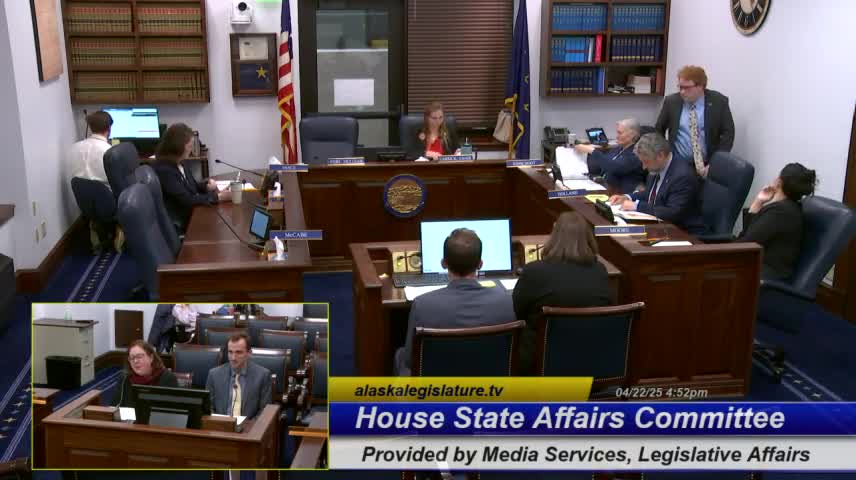
House Concurrent Resolution 2, presented to the House State Affairs Committee on April 22, 2025, would amend House uniform rules to change how members may be excused from voting because of a conflict of interest.
Sponsor Representative Donna Mears told the committee current practice requires unanimous consent to excuse a member from a vote under Uniform Rule 34(b), a process that she and staff said rarely results in an abstention being recorded. The resolution would keep the statutory definition of conflict unchanged but require that a member who declares a conflict explain it on the record and then be excused by a majority vote rather than by unanimous consent.
Corey Alt, staff to Representative Mears, told the committee the change would put Alaska in a category more consistent with other states and increase transparency: “So a member feels they have a conflict ... the member rises, in request to abstain ... members explain those conflicts,” he said. He described research showing most other chambers allow abstention by mandatory abstention, member discretion, or by vote; Alaska’s current unanimous‑consent approach is rare and, in his words, “not an effective system.”
Members raised procedural and political questions. Representative Holland asked whether the motion would be debatable (staff said the motion is generally nondebatable under uniform rules) and whether committees as well as the floor would be covered (staff said the intent is broad but they would confirm the precise application). Members also queried whether the member who requests to abstain would be allowed to vote on the threshold motion; staff confirmed the member could vote on the abstention request but indicated clarifying language could be discussed.
Representative Hemshute and others asked about the vote threshold needed to excuse a member. Staff said legal advised that ‘‘majority’’ as written would be interpreted as 21 members (a numerical majority of the 40‑member chamber), and that sponsors might consider a friendly amendment to specify “majority of members present” if the committee prefers. Several members expressed concern that a small bloc could use the rule strategically to conflict out a member and change floor outcomes; sponsor and staff said the statutory definition of conflict is narrow and the bill preserves the reporting requirement and member responsibility to declare conflicts.
Representative Mears said the resolution’s objective is transparency and to allow legitimate conflicts to be recorded and acted on without the practical obstruction of unanimous‑consent practice. “This change would require that members explain those conflicts and how they relate to the statute,” the sponsor said. The committee did not vote on HCR2 at this hearing; staff said HCR2 will be scheduled for additional committee consideration.