Get Full Government Meeting Transcripts, Videos, & Alerts Forever!
Get email alerts on the Professional Licenses topic
No spam. Unsubscribe anytime.
Committee reviews bill to ease CPA education rules, allow out‑of‑state firm practice privileges
Summary
House Bill 121 would remove an extra 30-credit statutory education barrier for CPA licensure, align Alaska with national model law and allow out‑of‑state CPA firms consistent practice privileges. Supporters said the changes address a statewide CPA shortage; the committee took testimony and set the bill aside for further consideration.
The Senate State Affairs Committee on April 22 heard House Bill 121, proposed to modernize CPA licensure requirements and firm mobility to increase the pipeline of accounting professionals in Alaska.
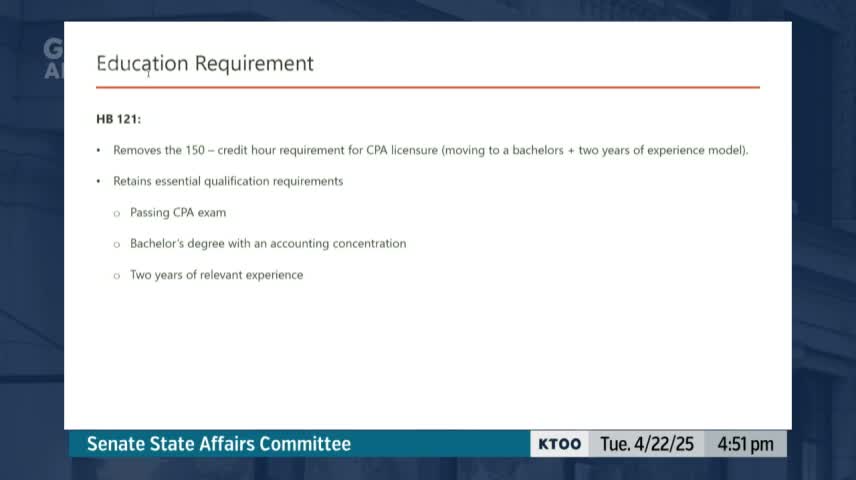
Amanda Dimo, staff presenting for Representative Calvin Schrage, told the committee HB121 would remove a statutory 50‑credit requirement that has effectively required many applicants to earn roughly an additional year of college beyond a standard bachelor’s degree. Under the bill, applicants would still need a bachelor’s degree (or equivalent) with an accounting concentration, must pass the Uniform CPA exam and meet experience requirements; the statutory extra‑credit requirement would be removed and licensing criteria updated to match national standards.
Supporters from the profession described a workforce shortfall and urged the change to retain candidates. Beth Stewart, managing partner of KPMG’s Anchorage office and chair of the State Board of Accountancy, said the extra credits can be unrelated to accounting and often require students to spend an additional year or to pursue a costly out‑of‑state master’s degree. Karen Burrit Harbour (past chair of the State Board and chair of the Alaska Society of CPAs legislative committee) and Krista Berson, president and CEO of the Alaska Society of CPAs, said the bill aligns Alaska with the updated Uniform Accountancy Act and national practice, and that other states have moved to a 120‑credit model (effectively four years of education) to improve recruitment.
Tom Neal, chair of the AICPA Uniform Accountancy Act Committee, testified that the bill’s language aligns with national model law changes and noted that many jurisdictions are adopting similar reforms and firm mobility provisions. The bill would also align Alaska’s treatment of out‑of‑state firms with how out‑of‑state individual licensees are currently allowed to provide services under practice privilege rules.
Public testimony included one commenter who referenced broader credentialing questions. The committee did not take a final vote and set HB121 aside for a further hearing; written testimony was accepted via committee email.
Proponents said HB121 maintains professional safeguards—exam, experience, and disciplinary oversight—while removing an education barrier that deters qualified candidates and increases cost and delay. Board and society supporters argued the change would help retain accounting talent in state and ease administrative burdens on firms seeking to serve Alaska clients.