Get Full Government Meeting Transcripts, Videos, & Alerts Forever!
Get email alerts on the Corrections And Police Standards topic
No spam. Unsubscribe anytime.
Longtime corrections official Daniel Crothers backs community work-service "good time" and training focus in Police Standards Council reappointment hearing
Summary
Daniel Crothers, a 28-year Department of Corrections veteran, told the House State Affairs Committee he supports adding community work-service day-for-day credit and expanding conflict-resolution and mental-health training if reappointed to the Alaska Police Standards Council.
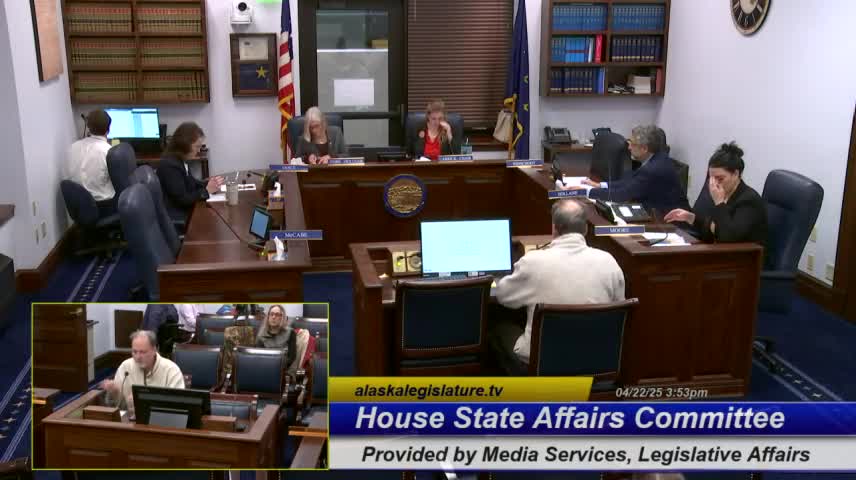
Representative Kerrick convened the House State Affairs Committee hearing on April 22, 2025, where the committee interviewed Daniel Crothers for reappointment to the Alaska Police Standards Council.
Crothers, who said he worked for the Alaska Department of Corrections for 28 years and ran Lemon Creek Correctional Center for about two decades, told the committee he could add value to the council’s work on training and corrections-related licensing. “I have a pretty, in my opinion, a pretty well rounded idea of what they do, how they do it, training needs,” he said.
The committee pressed Crothers about addressing recidivism, corrections costs and staff safety. Crothers recommended a statutory change to add a community work-service “good time” credit that would reduce a person’s sentence day-for-day for supervised work done while in custody. He described the proposal as a way to “save millions of dollars a year” by shortening incarcerations while keeping community restitution visible: “If they work a day, they get a day off their sentence.” He said the approach requires careful custody classification so only appropriate detainees participate.
Crothers also emphasized training changes for both corrections and peace officers, recommending more conflict-resolution and mental-health training in the basic academy and ongoing in-service training. “They should approach it, go in soft, build up if you need to,” he said, arguing that de‑escalation and conflict-resolution techniques reduce violence in confined settings.
Committee members asked Crothers about disproportionate incarceration rates among Alaska Native people; Crothers said recent counts show increases in Alaska Native incarceration and noted the trend “is not just corrections’ problem.” He did not present a specific program or funding plan tied to that observation.
Committee members had no further questions; Crothers’ nomination was included on the committee’s report recommending the appointment be forwarded to a joint session for consideration. The committee did not take a confirmation vote on the floor during this hearing.
Crothers’ testimony focused on three themes: (1) corrections-focused training and standards, (2) a statutory community work-service good-time mechanism he said could reduce incarceration costs if implemented carefully, and (3) attention to disproportionate impacts on Alaska Native people as part of system-level outcomes.
The committee recorded no formal change to statute or immediate council direction at the hearing; members may follow up with Crothers and staff after the session.