Get Full Government Meeting Transcripts, Videos, & Alerts Forever!
Get email alerts on the Emergency Alerts topic
No spam. Unsubscribe anytime.
Committee advances bill to add ‘feather alert’ and update missing-person notices
Summary
The State and Local Government Committee voted 6-0 to give a due-pass recommendation to an amendment and to advance bill 1535, which would add a ‘feather alert’ for missing Indigenous adults and make other changes to the state’s emergency alert statutes.
The State and Local Government Committee advanced bill 1535, focused on adding a ‘‘feather alert’’ to the state’s emergency-alert system and updating definitions for other missing-person notices, after voting 6-0 to approve an amendment and to recommend the bill for further consideration.
Chairwoman Rohrs opened the discussion by saying the committee had worked through several drafts and outside feedback to reach a compromise. ‘‘If you guys remember back to Senator Larson’s bill that updated the code and brought all of our alerts into one section of code…we were able to start amending from that bill,’’ Rohrs said, explaining the bill builds on recently enacted code changes.
The amendment the committee approved (amendment 4,006 as described in committee) adds language that explicitly creates a ‘‘feather alert notice’’ defined as ‘‘an urgent bulletin using the emergency alert system to air a description of an Indigenous individual who’s been abducted or is believed to be at imminent risk of serious bodily injury or death.’’ The amendment also harmonizes the missing-and-endangered-persons alert, updates the silver-alert wording, and requires the operational plan for alerts to include ‘‘other relevant stakeholders’’ and provide for including alert text in Indigenous languages when available.
Steve Harstead of the Bureau of Criminal Investigation told the committee that other states’ models—sometimes called turquoise alerts—use the Emergency Alert System (EAS) and non‑wireless channels but stop short of the Wireless Emergency Alert (WEA) wireless phone blasts reserved in many places for Amber Alerts. ‘‘We will push out the EAS alert…but we will stay one step short of that wireless alert until we know there’s an abduction,’’ Harstead said.
Committee members debated how narrowly to define criteria for sending a WEA (wireless phone blast). Several senators said they wanted to avoid overuse that could desensitize the public and cause people to disable emergency alerts. Rohrs and others said the committee’s approach was intentionally narrow to avoid overnotification but left the law structured so the state could revisit thresholds after collecting more data and reports required under the bill.
The bill names the Indian Affairs Commission as the primary liaison for alerts involving Indigenous people and requires BCI and the Highway Patrol to issue an annual report to that commission on implementation and effectiveness. A committee exchange noted the operational plan must still direct the Department of Emergency Services to follow its plan for other public-notification channels when a case does not meet WEA thresholds.
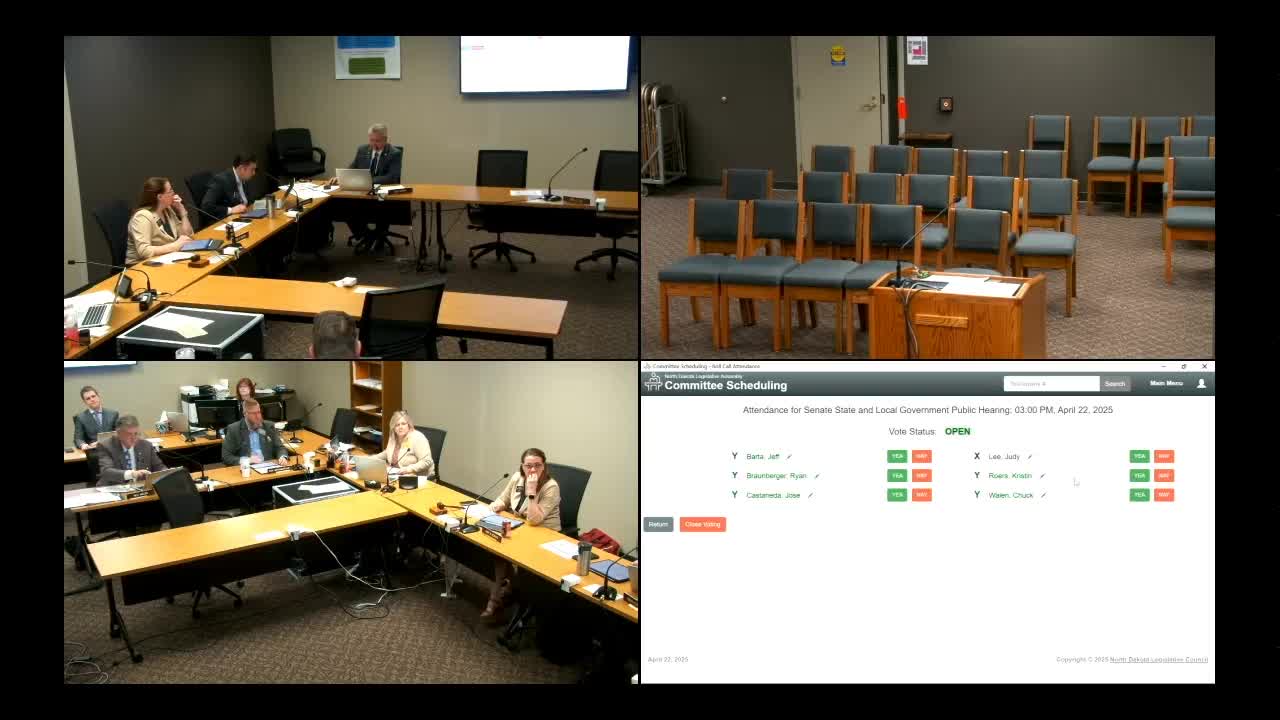
A motion to give a ‘‘due pass’’ on the 4,006 amendment, moved by Senator Wallin and seconded by Senator Lee, passed on a roll call of Chair Rohrs, Vice Chair Castaneda, Senator Barta, Senator Brownberger, Senator Lee and Senator Wallin (6-0). The committee later voted 6-0 to give a due-pass recommendation on bill 1535 as amended (mover: Senator Brownberger; second: Senator Barta). The clerk’s roll calls recorded all six members voting yes on both measures.
Why it matters: supporters said the change is intended to improve responsiveness in cases involving missing Indigenous adults, align the state’s categories with other missing‑person alerts, and create reporting and liaison duties so the state can measure outcomes and adjust criteria later. Opponents or cautious members asked for limits to prevent alert fatigue and to keep wireless alerts reserved for clearly established abductions.
The committee did not adopt a different standard for the feather alert’s substantive criteria; instead, it created a separate label and reporting requirements while keeping the same minimum standards for issuing a wireless alert. Committee members signaled willingness to revisit the thresholds after collecting data required by the bill.