Get Full Government Meeting Transcripts, Videos, & Alerts Forever!
Get email alerts on the Short Term Rentals topic
No spam. Unsubscribe anytime.
Debate on House Bill 3861 paused after hours of testimony over local control, housing and enforcement
Summary
The House subcommittee adjourned debate on H.3861, a bill that would bar local governments from prohibiting short-term rentals, after testimony from hoteliers, municipal officials, mayors, realtors, neighbors and operators raised questions about enforcement, housing supply and local control.
House debate on House Bill 3861, a proposed law that would prohibit municipalities and counties from banning short-term rentals, was adjourned after a multi-hour hearing that brought hotel operators, municipal leaders, neighborhood representatives and short-term rental managers to testify.
The measure, carried by Representative Lee Hewitt and explained to the committee as a prohibition on local ordinances, originally contained a penalty provision that would have denied affected jurisdictions their 6% property tax distributions and allowed the state treasurer to withhold state aid until offending local policies were repealed; Representative Celeste Davis presented an amendment that would strike that penalty provision. Committee members agreed to adjourn debate and take up the bill later.
Why it matters: The bill pits local home-rule authority and municipalities’ efforts to manage neighborhood character and housing supply against statewide interests in tourism and uniform rules for short-term rental operators. Witnesses said the proposal raises practical enforcement questions, potential impacts to affordable housing, and concerns about vesting and grandfathering of existing rental businesses.
Supporters and opponents
Crystal Hendrickson, vice president of sales and public relations for Pinnacle Partnership, testified in opposition and said short-term rentals often do not meet the same safety, zoning and tax compliance standards as hotels. “Short term rentals are not made to abide by many of our stringent safety, health, zoning, and tax compliance standards,” Hendrickson said. She also told the committee the state is facing a “drastic shortage of quality affordable housing” and said short-term rentals can remove long-term housing units from the market.
Todd Glover, executive director of the Municipal Association of South Carolina, likewise urged the committee to oppose the bill, saying it would strip local leaders of a tool to preserve neighborhood stability. “Whether it's a college town, a resort destination, or a quiet residential neighborhood, communities differ and their policies should too,” Glover said.
Mayor Will Haney of Mount Pleasant described that town’s local licensing and cap system — including a 400-permit cap he said the town uses — and argued municipalities are best positioned to balance tourism and resident needs. Haney told the committee Mount Pleasant’s ordinance (No. 23010) includes grandfathering and legacy protections for households that rely on short-term rental income.
At the same time, testimony from the short-term rental industry offered mixed positions. Rick Elliott, who runs a small short-term rental company in North Myrtle Beach, said the industry supports regulation and urged consideration of a state licensing or registration system to ensure tax remittance and consumer protections. Lindsay Hutto of the South Carolina Association of Realtors said short-term rentals generate significant economic activity statewide (she cited about $4.2 billion in annual revenue as of 2023) and urged continued stakeholder negotiations to craft balanced rules.
County officials and neighborhood representatives emphasized different concerns. Avery Upchurch of the Association of Counties warned that the bill’s wording could expose counties that enforce land-use plans to the proposed penalty (the 6% property tax withholding) and said that penalty would be “untenable.” A neighborhood representative said unrestricted short-term rentals “allow an adverse impact on our housing inventory” and asked lawmakers to leave zoning authority with local governments.
Enforcement questions and the amendment
Committee members pressed witnesses on how a statewide ban on local prohibitions would be enforced, particularly after Representative Davis presented an amendment to remove the penalty provision that would have withheld state aid and the 6% property tax from jurisdictions that enacted bans. Several members asked whether local licensing and registration systems — business licenses, caps, registration software to match online listings to licenses — would be sufficient to enforce local rules. Witnesses described business-license and registration regimes and multi-step enforcement processes used in some municipalities, but admitted approaches vary by jurisdiction.
Action taken
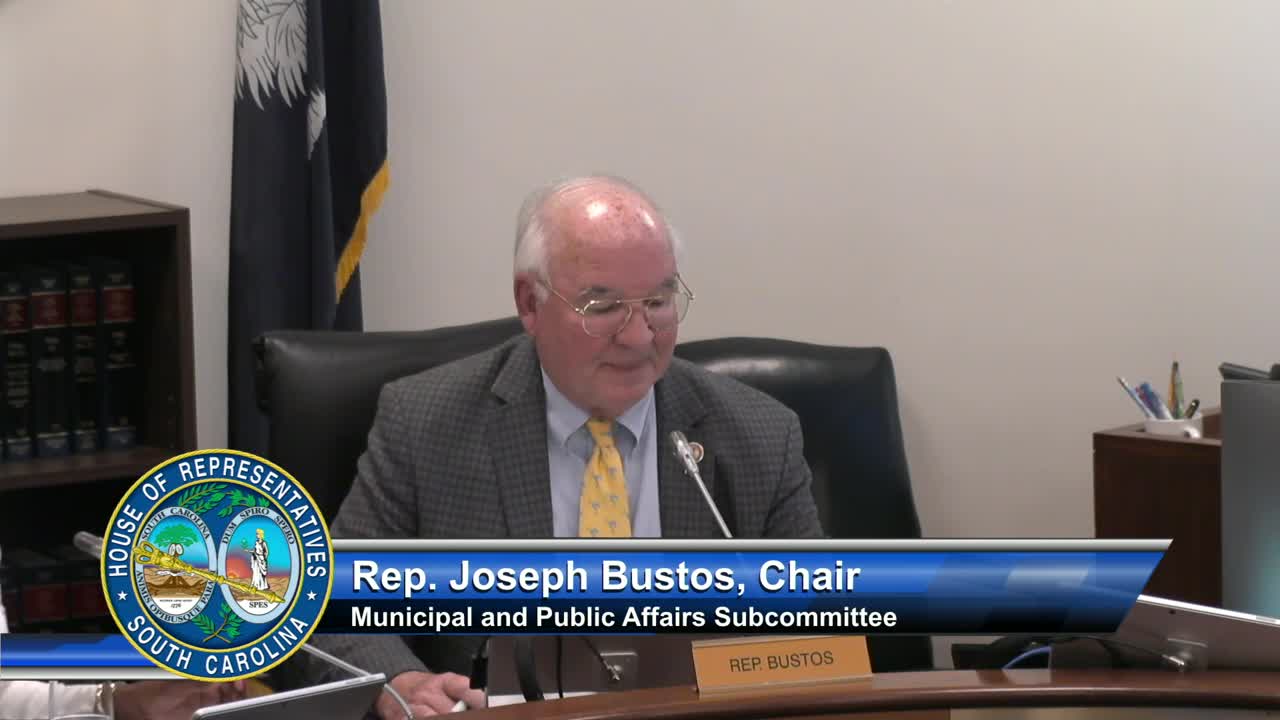
Representative Sarita Edgerton moved to adjourn debate on H.3861; the committee seconded and adopted the motion by roll call, 6–1. Roll call as recorded: Joe Bustos (Aye), Celeste Davis (Aye), Sarita Edgerton (Aye), Representative Jones (Aye), Magnuson (Nay), Blake Sanders (Aye), Courtney Waters (Aye). The committee did not vote on the amendment striking the penalty provision before adjourning debate.
What’s next
The subcommittee adjourned debate on H.3861 and said it will take the bill up again after further stakeholder work. Committee members asked for clearer enforcement language and for the bill’s author or designee to be present to explain outstanding questions about the amendment and enforcement mechanics.