Get Full Government Meeting Transcripts, Videos, & Alerts Forever!
Get email alerts on the Traffic Schoolzone 90 Sixth St E topic
No spam. Unsubscribe anytime.
Pierce County council orders traffic, school‑zone study for 90th Sixth Street East near Cascade Christian School
Summary
On April 22, 2025, the Pierce County Council adopted Resolution R2025‑129 directing county traffic engineers to study speed reductions, traffic calming and a school zone for 90 Sixth Street East from State Route 162 to the Puyallup River Bridge; report‑back dates were set for summer 2025 and early 2026.
Pierce County Council on April 22 adopted Resolution R2025‑129 directing the county engineer to evaluate a speed limit reduction, traffic calming measures and the creation of a school zone on 90 Sixth Street East from State Route 162 to the Puyallup River Bridge, with a report back to the council by summer 2025 and additional recommendations on signage and lighting due in early 2026.
The resolution was introduced by county staff and moved by Vice Chair Herrera; it passed unanimously, 7‑0. County staff said the review was requested after constituents connected with Cascade Christian School’s McAlder campus raised safety concerns to Councilmember Morrell’s office.
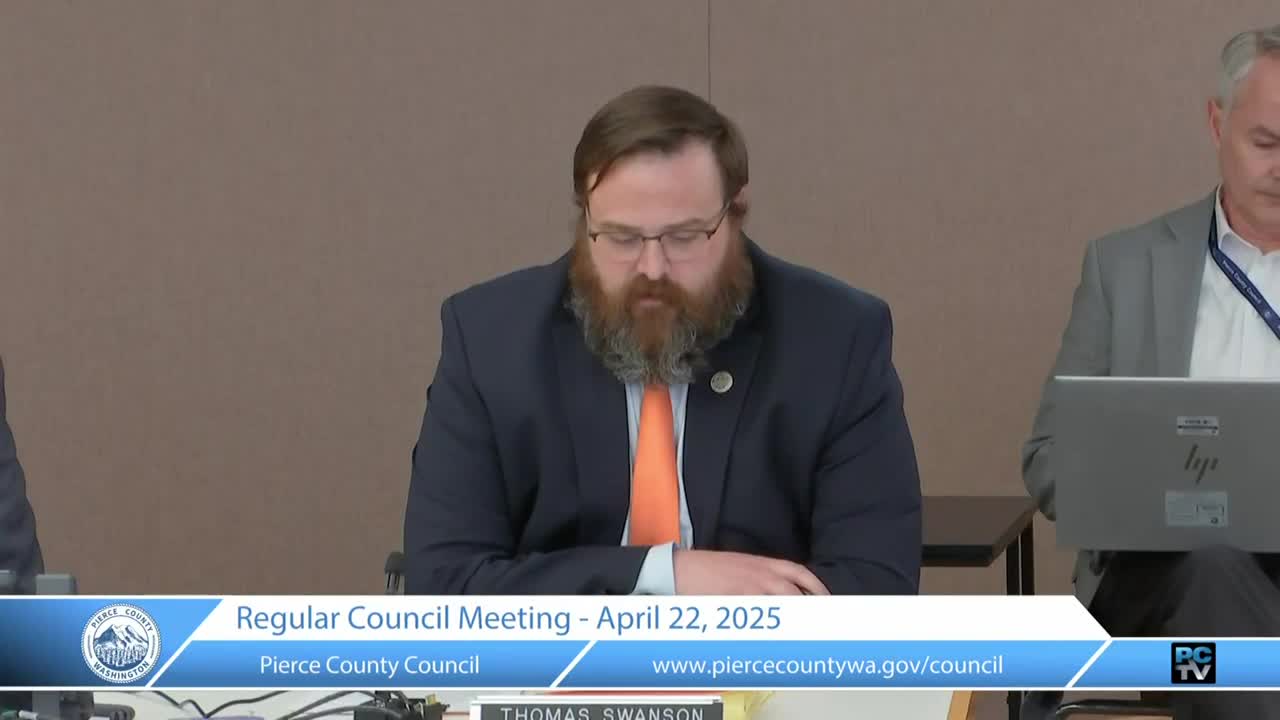
Tom Swanson, county staff who introduced the measure, told the council the study area and supporting maps are in the council packet (page 53–54). He said the resolution directs traffic engineering to return speed‑reduction and school‑zone recommendations “no later than July” of 2025 so any action could be taken before the next school year; signage and lighting recommendations would be returned no later than February 1 of the following year to allow those elements to be folded into a broader analysis.
Swanson said equity and fiscal analyses were included in the packet and that the evaluation work has been budgeted within traffic‑engineering’s existing annual program; he said additional county funding would only be requested if a separate capital project emerged from the study. Councilmember Bridal asked where the fiscal note appears; staff replied the evaluation is de minimis because it is funded from existing traffic engineering resources. The council also asked staff to consider agritourism traffic patterns (Christmas tree, pumpkin patch season) and weekdays versus weekends; staff said it would pass that request to traffic engineering.
A public hearing produced no public comment. The clerk called the roll: councilmembers Herrera, Yambe, Ayala, Kuver, Morrell, Denson and Hitchin voted aye. The resolution passed 7 ayes, 0 nays.
Council staff materials in the packet note maps, an equity analysis and a fiscal analysis; the county said further public outreach would depend on whether the study leads to minor striping/signage changes or to a larger TIP (Transportation Improvement Program) project that would trigger a broader public‑process timeline.