Get Full Government Meeting Transcripts, Videos, & Alerts Forever!
Get email alerts on the Ida Tax Credit Funding topic
No spam. Unsubscribe anytime.
Bipartisan bill would raise tax‑credit cap for Individual Development Accounts to widen enrollment; nonprofits urge passage
Summary
Representative Ricky Ruiz and IDA providers told the Revenue Committee that raising the IDA tax‑credit cap from $7.5 million to $16.5 million would restore program capacity and avoid repeated ad hoc general‑fund supplements; several community organizations and a large credit union testified in support.
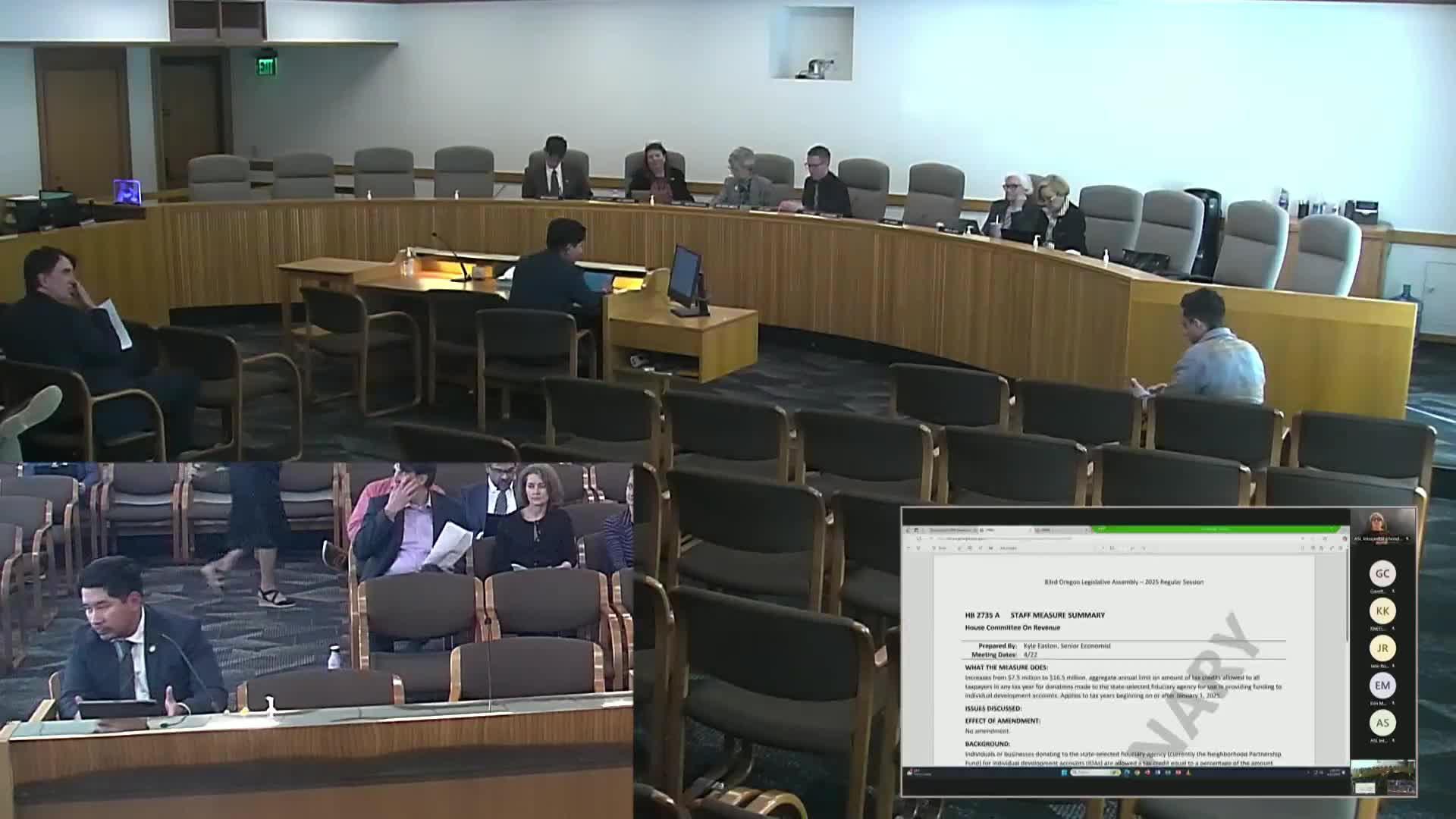
Representative Ricky Ruiz told the House Committee on Revenue on April 22 that House Bill 2,735 A would increase the annual cap on state tax credits that fund Individual Development Accounts (IDAs) from $7.5 million to $16.5 million, restoring capacity the sponsors say has been eroded by inflation and rising costs.
"Raising the tax credit cap to $16,500,000 will return this essential program to solid, sustainable financial ground," Representative Ruiz said. He said the IDA program, which matches savings for home purchase, business starts, postsecondary education and other assets, pairs money with financial coaching and has served Oregonians for more than 20 years.
Neighborhood Partnerships, which administers the statewide IDA initiative under a contract with Oregon Housing and Community Services, said the tax credit has been unchanged since 2009 and that the flat cap has forced repeated supplemental general‑fund requests. Justice Hager of Neighborhood Partnerships said the credit produces a steady stream of donations from individual donors and financial advisors and that the program has expanded by word of mouth; Amy Stuczynski, the organization's manager of data and evaluation, described a statewide network of 11 fiduciary organizations and more than 60 local providers that would find it harder to maintain reach if funding shrinks.
Community providers and partners testified that the program produces measurable outcomes. Justin Lowe of the Association of Oregon Counties and nonprofit providers including CASA of Oregon and OnPoint Community Credit Union described thousands of matched savings accounts, home purchases, business starts and vehicle purchases facilitated by the IDA program. Erin Moore of OnPoint said 92% of IDA homebuyers make timely mortgage payments and 72% of vehicle purchasers report higher income the year after purchase.
Not all witnesses supported the tax‑credit mechanism. Jody Weiser of Taxpayers for Oregon said the organization is neutral on total funding but opposes auctioning tax credits to the highest bidder and urged legislators to fund IDAs directly from the general fund instead. Committee members asked for fiscal details from the Legislative Revenue Office; the committee did not take a vote during the hearing and additional testimony was submitted to the record.