Get Full Government Meeting Transcripts, Videos, & Alerts Forever!
Get email alerts on the Public Pensions Climate Risk topic
No spam. Unsubscribe anytime.
Treasurer urges support for bill to assess climate risk to Oregon public pension fund; business group warns of fiduciary conflict
Summary
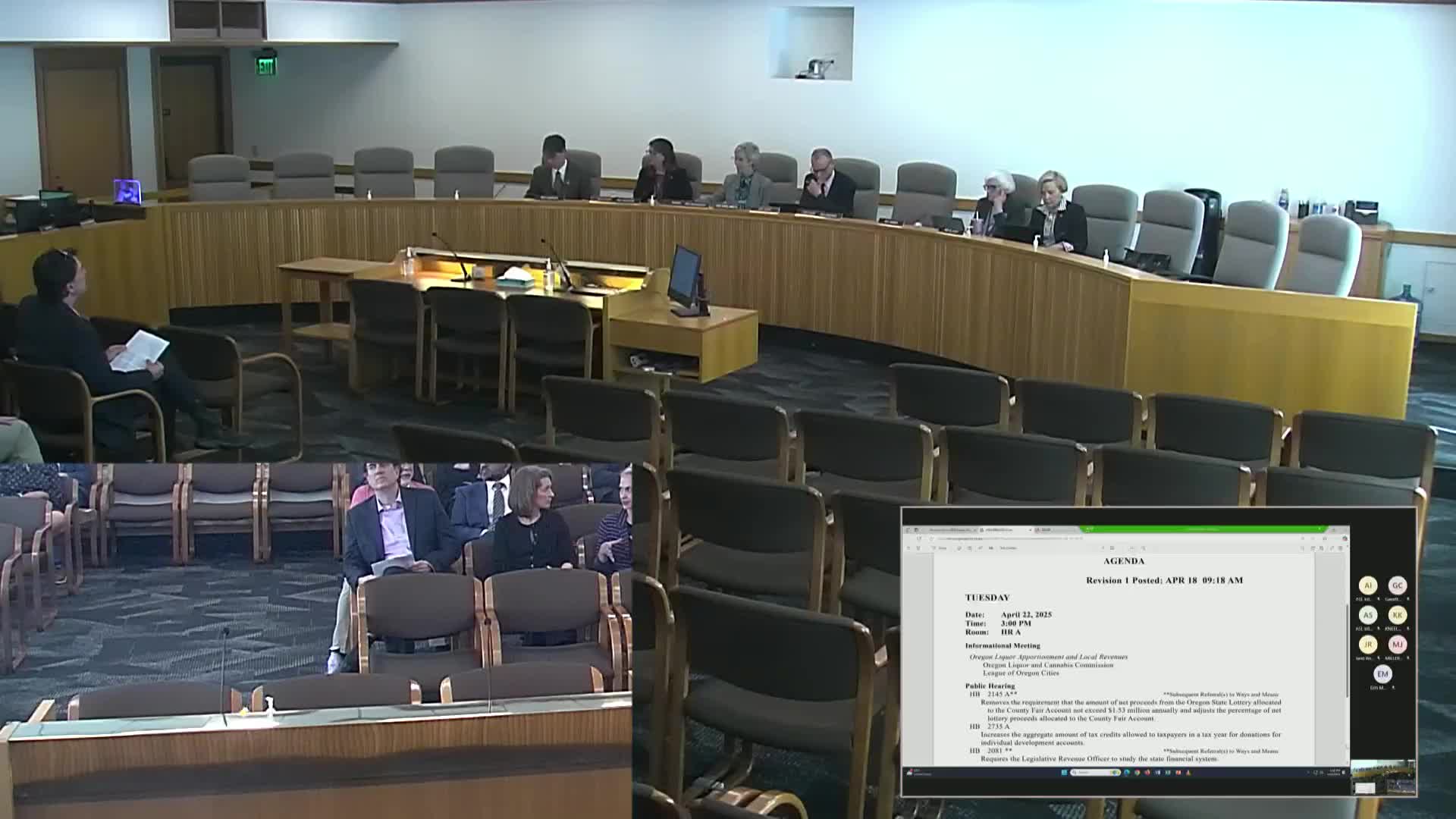
State Treasurer Elizabeth Steiner told the House Committee on Revenue on April 22 that House Bill 2,081, as amended by the dash 1, would require Treasury to evaluate and integrate climate‑associated financial risk into management of the Oregon Public Employee Retirement Fund, the state pension plan for public employees.
State Treasurer Elizabeth Steiner told the House Committee on Revenue on April 22 that House Bill 2,081, as amended by the dash 1, would require Treasury to evaluate and integrate climate-associated financial risk into management of the Oregon Public Employee Retirement Fund, the state pension plan for public employees.
The bill would require biennial reports to the Legislature and direct Treasury to analyze the effects of carbon‑intensive investments on long‑term fund returns. "Treasury is tasked with managing the Oregon public employee retirement fund or OPerf and has a fiduciary responsibility to maximize the long term returns of the fund on behalf of beneficiaries," Steiner said. She said the dash 1 emphasizes that fiduciary responsibility "comes first and it always will." Steiner urged committee members to support HB 2,081 with the dash 1 amendment.
The measure drew sharply different testimony. Mike Powers, policy strategist and immediate past president of SEIU Local 503, told the committee the bill would strengthen Treasury's ability to assess and manage climate‑ and fossil fuel‑related risks and "sets OPRF on a path toward achieving net 0 emissions in a manner aligned with fiduciary responsibility." Steven Demarest, a retired PERS beneficiary and past union president, said the unions that represent public employees support the dash 1 amendment.
Opposition came from Oregon Business and Industry. Derek Singston, policy director and counsel for OBI, said HB 2,081 "would impose requirements on the treasurer and the Oregon Investment Council that are inconsistent with its role as a state fiduciary" and could force divestment rather than maximum returns. Singston cited current law requiring prudent management under prevailing circumstances and referenced ORS 293.726 in his testimony.
Steiner and others described the bill as a study and implementation framework rather than an immediate mandate to divest. Steiner said the amendment is identical to the dash 1 that previously advanced from the House General Government Committee and described extensive stakeholder engagement during drafting, including outreach to public employee unions and advocates. She said Treasury views the work as a way to manage risk that could otherwise increase contribution rates for public employers and reduce funding available for public services.
Committee members asked about investment approach and liquidity. Representative Pam Levy pressed how Treasury would protect fund solvency if national policy shifted decisively in favor of fossil fuel development; Steiner replied that Treasury focuses on long‑term market signals, maintains diversified asset allocations across public and private markets, and works with a professional investment staff and external managers.
No formal action was taken in the Revenue committee during the hearing; Steiner said a work session on the bill was currently scheduled for Thursday. The committee closed the public hearing on HB 2,081 and moved to other agenda items.