Get Full Government Meeting Transcripts, Videos, & Alerts Forever!
Get email alerts on the Wildfire Preparedness topic
No spam. Unsubscribe anytime.
King County Emergency Management outlines wildfire preparedness, launches CWPP outreach and Ready, Set, Go activities
Summary
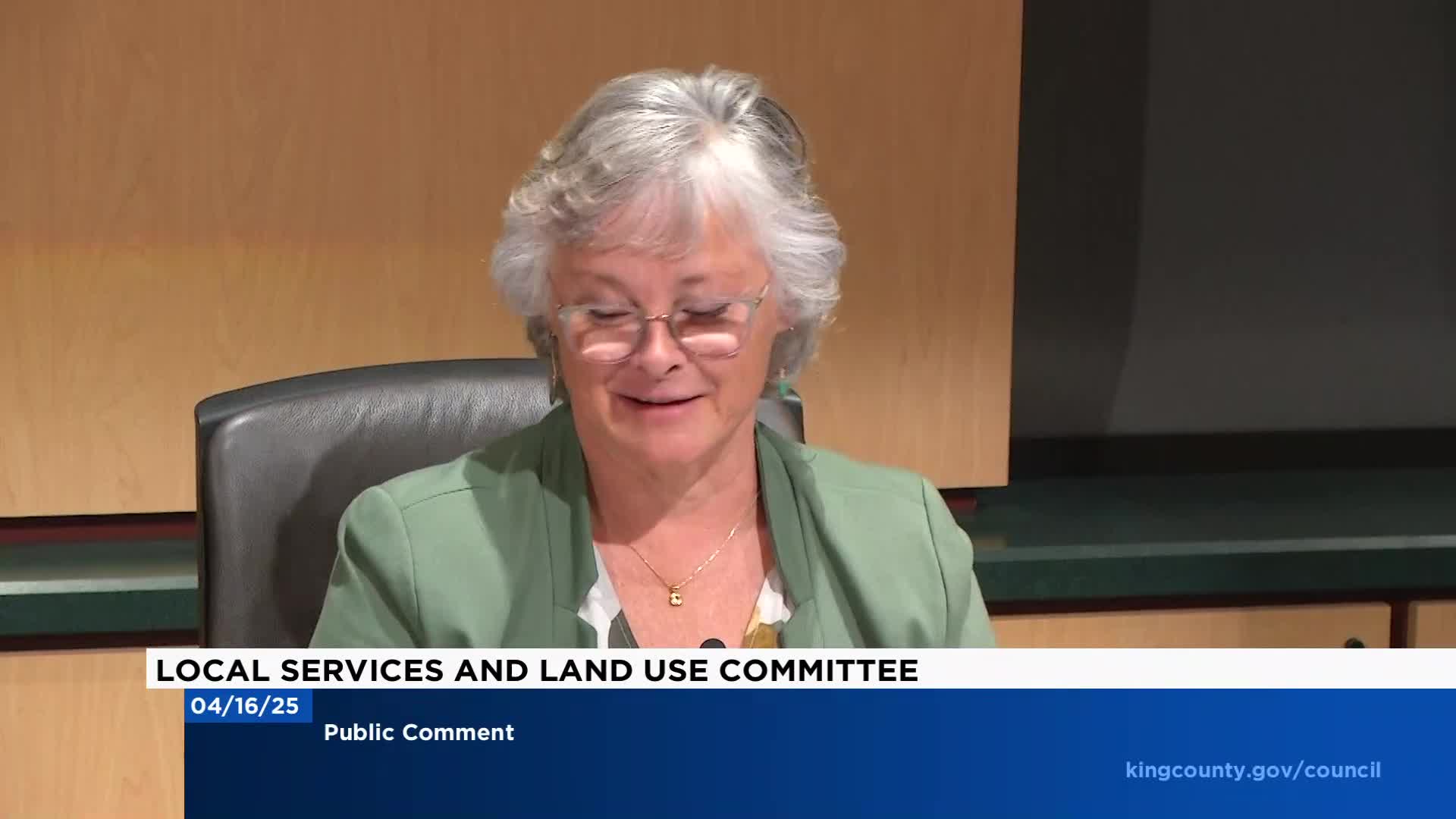
Brenda McCluskey, director of King County Office of Emergency Management, briefed the Local Services and Land Use Committee on wildfire risk, CWPP development and resident preparedness measures on April 16.
King County Emergency Management director Brenda McCluskey briefed the Local Services and Land Use Committee on April 16 about wildfire risks, the county's wildfire risk reduction strategy and the development of a Community Wildfire Protection Plan (CWPP). McCluskey described the county's ongoing actions to prepare communities in the wildland‑urban interface (WUI), encouraged residents to sign up for Alert King County, and reviewed federal funding uncertainties.
McCluskey said the National Interagency Fire Center's seasonal outlook indicated normal wildfire risk through June for western Washington, but that confidence decreases into late summer and fall. "August and September are really the months that have the most critical fire weather," she said, and noted that the county's highest risk often comes before the rains return. She described two main wildfire types the county sees: more common, low‑to‑moderate intensity fires and rarer, high‑intensity, wind‑driven events that can spread rapidly.
Why it matters: King County has more than 352,000 residents living within mapped WUI areas; the county lists wildfire and wildfire smoke among its top hazards in the Regional Hazard Mitigation Plan (RHMP). The county's 2022 wildfire risk reduction strategy recommended 12 actions across three priorities: forest resilience, WUI hardening and emergency response. McCluskey said many actions are being cross‑walked into the executive's forthcoming 2025 Strategic Climate Action Plan to improve funding eligibility and program continuity.
McCluskey described several near‑term deliverables and outreach efforts: a county wildfire preparedness landing page due in May that consolidates information from DNRP, Emergency Management, the Executive Climate Office and Public Health; a public survey and community workshops on the CWPP beginning in May; and the Ready, Set, Go evacuation messaging campaign, which the county now coordinates with 12 Western Washington counties. "Ultimately, the goal of this plan is to help King County become a fire adapted community," McCluskey said.
She briefed the committee on recent local fires and post‑fire hazards: the Bolt Creek (also spelled Bulk Creek in some sources) fire burned about 15,000 acres near US‑2/Skykomish, the Lock Katrine fire burned roughly 2,000 acres and the Murphy Lake fire burned about 500 acres. McCluskey described concerns that burn scars can increase the risk of debris flows and flash flooding and listed mitigation steps already taken, including roadside debris fencing and telemetered weather stations to monitor rain rates near burn scars.
On federal funding, McCluskey said roughly 42% of Emergency Management staffing (about 11 positions) is FEMA‑grant funded and that some FEMA programs (including BRIC) are under review; she warned of uncertainty about future grant streams but said local response and preparedness will continue regardless of federal funding changes. In response to council questions, she described FEMA mechanisms such as Fire Management Assistance Grants (FMAG) and the Emergency Management Assistance Compact and said states and local fire agencies have established mutual‑aid and reimbursement pathways for interstate deployments.
Committee members asked about outreach effectiveness and resident notification. McCluskey encouraged residents to sign up for Alert King County (text, call and email; available in 29 languages) and said the county is aligning Ready, Set, Go materials across multiple counties to improve clarity and cross‑jurisdictional coordination. She also noted that Alert King County will issue Level 1 (prepare), Level 2 (be ready to leave) and Level 3 (evacuate now) messages when appropriate and that residents should not wait to leave if they feel unsafe.
Ending: The committee thanked McCluskey for the briefing and asked follow‑up questions about FEMA appeals and coordination. McCluskey said the governor had 30 days to appeal a recent federal disaster denial related to a separate windstorm and that county coordination would continue while the appeal proceeds. The CWPP public survey and workshops are scheduled to begin in May; staff said more detailed CWPP and post‑fire mitigation work will be shared in subsequent briefings.