Get Full Government Meeting Transcripts, Videos, & Alerts Forever!
Get email alerts on the Youth Mental Health topic
No spam. Unsubscribe anytime.
County officials present youth behavioral-health data and policy options; highlight gaps in housing and recovery supports
Summary
Public Health Seattle & King County, Best Starts for Kids and behavioral-health partners briefed the Board on youth mental health and substance use, presenting hospitalization data, disparities among LGBTQ and BIPOC youth, and a set of policy and funding priorities including school-based supports and the updated Youth Action Plan.
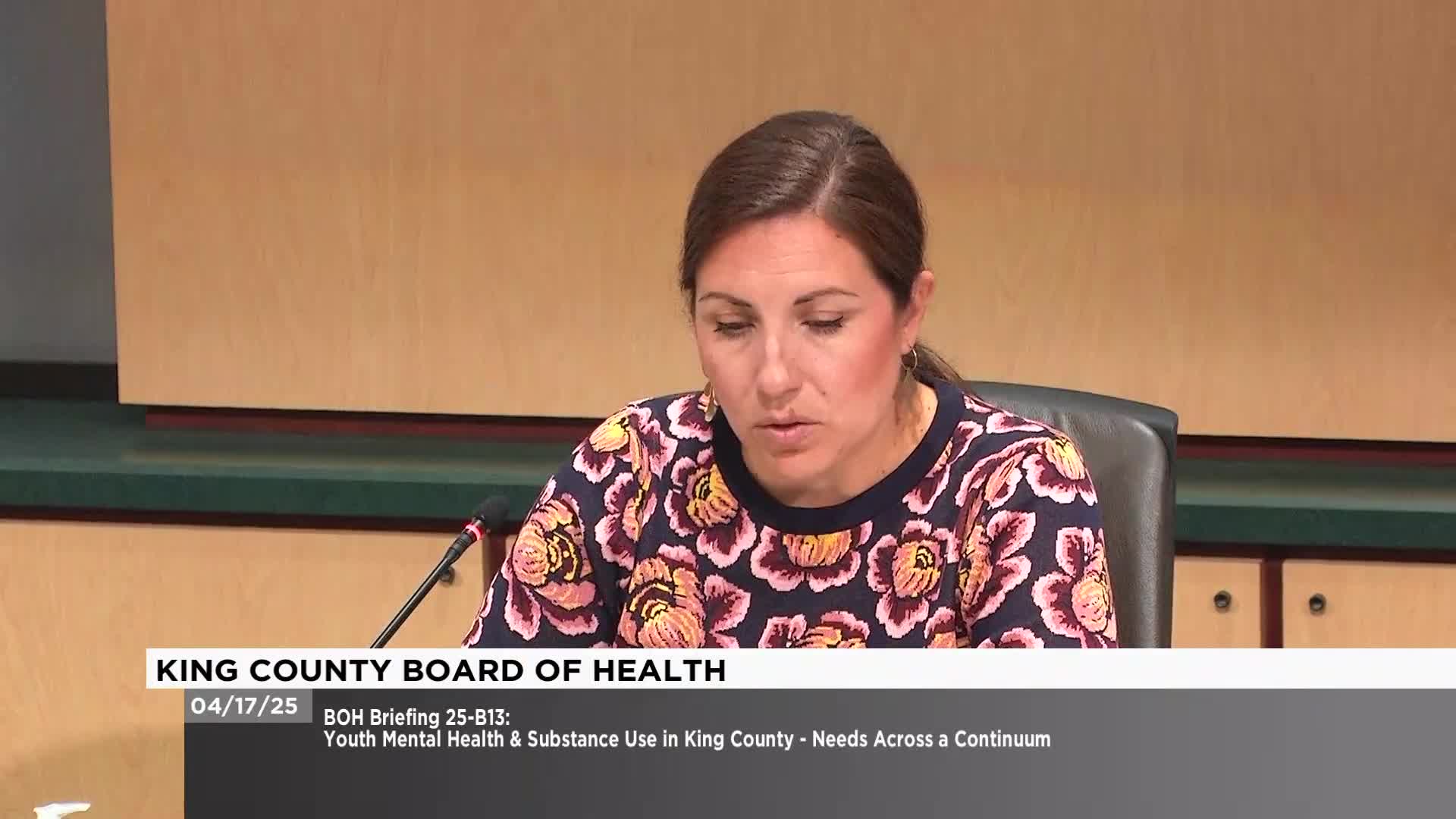
Public Health '1 Seattle & King County and partner agencies presented a data-driven overview April 11 of youth mental health and substance use and outlined policy options to expand prevention, treatment and recovery supports.
Sarah J. Sanford, epidemiologist at Public Health, reported that King County averages about 788 hospitalizations per year for mood disorders among children ages 1 to 17, a rate the presenters said is roughly 186 per 100,000 young people and accounts for 16% of hospitalizations in that age group. Sanford emphasized that hospitalizations represent the most severe cases and that a continuum of supports is needed to prevent escalation.
Presenters described a “continuum of supports” framework spanning promotion and prevention through crisis response and recovery. The county is updating its Youth Action Plan and will transmit the revised plan to the County Council later this year; the updated plan includes a youth behavioral-health section aligned with the continuum and highlights disproportionate impacts on BIPOC and LGBTQ youth.
County staff and partners described examples of existing and proposed work across the continuum: expanding school-based SBIRT (Screening, Brief Intervention, and Referral to Treatment) and school-based health centers; co-designed, youth-informed upstream prevention and promotion strategies; and strengthening places and services for recovery and reentry, including recovery high schools and alternative peer groups.
Althea Hong of YouthCare described front-line experience with youth who are homeless and have co-occurring substance use and mental-health challenges, and highlighted gaps in transitional and permanent supportive housing tailored for 18- to 24-year-olds. Hong said YouthCare frequently sees youth who leave shelter and struggle in standard leased apartments due to behavioral-health needs, and called for more low-barrier, youth-focused supportive housing options.
Presenters outlined near-term policy and funding opportunities: renewal of the behavioral-health sales tax (mid) and the Best Starts for Kids levy (expected on the 2027 ballot), and the Seattle Families Education Preschool and Promise Levy (on the 2025 ballot, with behavioral-health coordinators planned for Seattle Public Schools). The team urged investments across the full continuum, targeted supports for communities experiencing disproportionate harm, and expansion of school-based services.
Board members asked about prevention, inequalities in services across jurisdictions (noting Seattle-funded positions in Seattle Public Schools that are not available countywide), and lessons from existing crisis clinics. Presenters said ongoing co-design work, community engagement and youth-led development are central to implementing the recommendations.
The county will continue policy work and community co-design and return to the board as programs and funding opportunities progress.