Get Full Government Meeting Transcripts, Videos, & Alerts Forever!
Get email alerts on the Critical Areas Ordinance topic
No spam. Unsubscribe anytime.
Farmers and preservation groups urge changes to King County critical areas ordinance; staff outline proposed buffer increases
Summary
Chair Sarah Perry and County staff spent the bulk of the April 16 Local Services and Land Use Committee meeting on proposed updates to King County's Critical Areas Ordinance, a Growth Management Act‑required review that staff say must be updated by the end of 2025.
Chair Sarah Perry and County staff spent the bulk of the April 16 Local Services and Land Use Committee meeting on proposed updates to King County's Critical Areas Ordinance, a Growth Management Act‑required review that staff say must be updated by the end of 2025. Public commenters from the Snoqualmie Valley and other unincorporated areas urged the council to slow the process, strengthen farm engagement and adjust specific proposals before code changes are finalized.
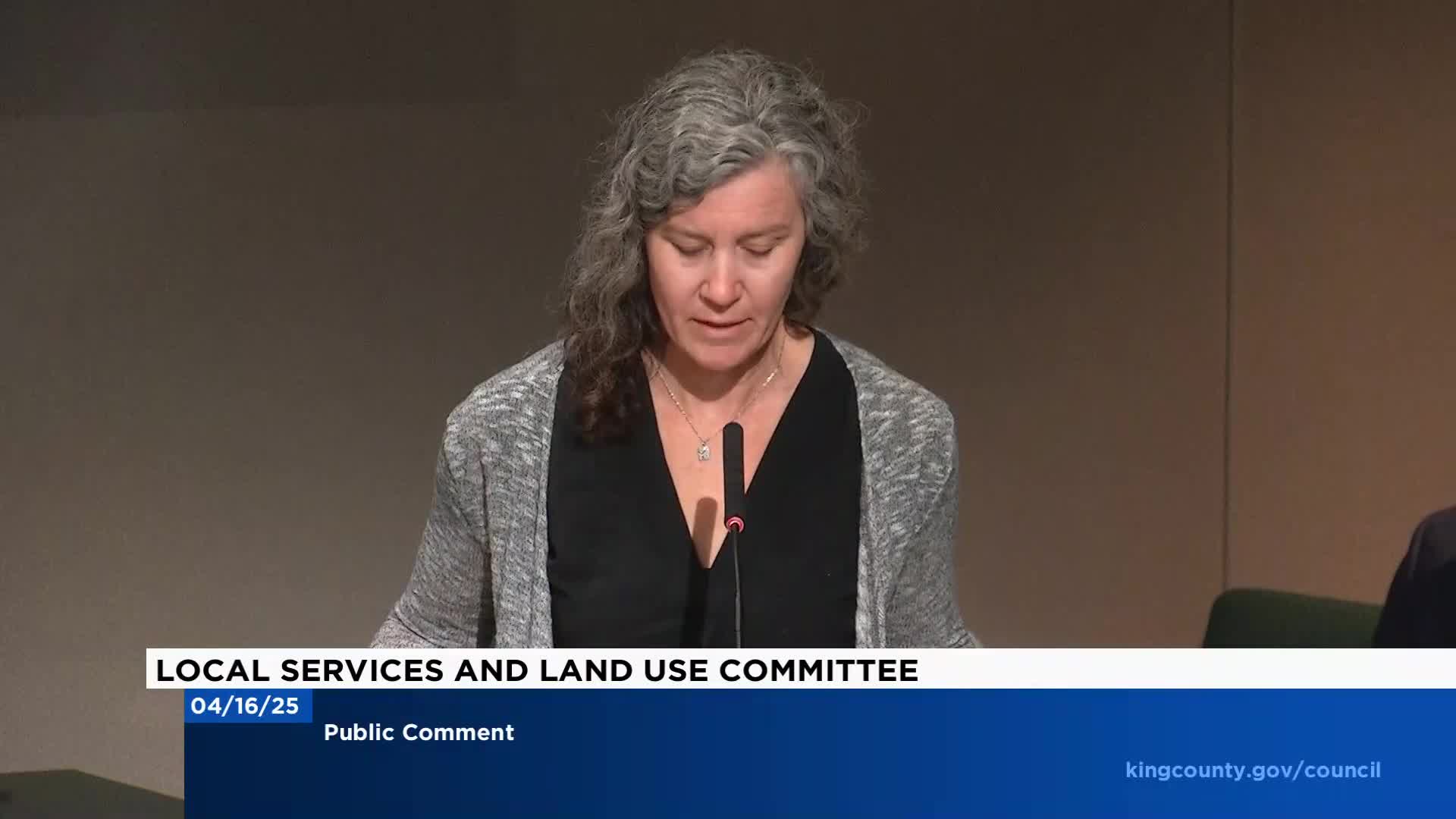
The committee heard repeated concerns that proposed riparian and wetland buffer expansions in the staff and executive proposals would reduce farmable acreage, lower land values and create new compliance burdens when land transfers occur. "If you take away the future possibility, you take away value in the land," said David Hawkinson, who identified himself as a farmer at Jubilee Farm in Carnation. "Who's gonna pay for it?" Erin Erickson, identified as director of the Snoqualmie Valley Watershed Improvement District, told the committee the farm caucus recommendations from the Farm‑Fish‑Flood (FFF) process had not been fully integrated and that the proposed ordinance, "as written ... fails to reflect the farm caucus recommendations."
Why it matters: county staff say the updates are intended to align county regulations with Best Available Science (BAS) and state Growth Management Act obligations, including the state requirement for no net loss of ecological function. Farmers and preservation advocates say the executive's package as presented lacks sufficient integration of decade‑long collaborative work in the Snoqualmie Agricultural Production District and that engagement with the agricultural community has not been deep enough to resolve tradeoffs between habitat protection and farm viability.
County staff described the package and highlighted several substantive proposals. Jenny Ngo of Council Central staff summarized the executive's BAS report (published October 2024) and a voluminous staff analysis matrix. Megan Smith, manager of Environment and Water Quality Policy in King County Department of Natural Resources and Parks (DNRP), said the executive and permitting staff conducted briefings with about a dozen community organizations and advisory groups and completed tribal consultation invitations; follow‑up consultations occurred with Suquamish, Tulalip and Snoqualmie tribal governments. Smith said staff had recently briefed the King County Agricultural Commission and offered to continue direct meetings with farm groups.
On technical changes, staff explained several of the more consequential proposals described in the packet: increased wetland buffer widths for some Category 1 wetlands and for all Category 4 wetlands, buffer increases between 20–50% in line with the BAS findings; new and larger riparian area widths for aquatic areas (the executive proposal raises some Type S and Type F widths to as much as 180–200 feet, and increases other riparian widths such as Type N from 65 to 100 feet and Type O from 25 to 50 feet in the proposal); designation of channel migration zones and alluvial fan hazard areas as discrete critical area types; and clarifications to CARA (critical aquifer recharge area) mapping and when site‑specific conditions would modify adopted maps. Staff noted the executive did not propose immediate map updates for CARAs in this package but indicated map updates may follow.
Public commenters raised several distinct, specific concerns during the public comment period: that the term "climate‑smart plants" broadens allowable revegetation species to nonnative or nonlocal taxa and risks food‑web impacts (Carolyn Boatsman); that increased grazing exclusion buffers and riparian widths could eliminate productive acreage and penalize farms that have previously invested in restoration (Corey Huskinson described an $80,000 investment he made through the conservation district); that CARA changes and related regulatory language could impose expensive septic system requirements on thousands of property owners (Michael Thomas said there are "more than 2,000" septic systems locally); and that public outreach and draft review opportunities were limited (Lauren Silver Turner, executive director of the Snoqualmie Valley Preservation Alliance, said the Farm caucus and Ag Commission were given brief presentations but not draft documents to review).
Committee members pressed staff on outreach and on the rationale for any departures from BAS. Megan Smith said BAS does not yield a single prescriptive answer and that Growth Management Act goals (housing, protection of resource lands, public health and safety) sometimes create tensions the county must balance. Chair Perry asked staff to meet again with ag stakeholders; staff agreed and said they had offered follow‑up briefings and Q&A sessions. Staff also reviewed the calendar: a chair's striking amendment is planned for release June 17, with a committee briefing June 18 and a target committee vote July 16; public line amendments would be released July 11 and a public hearing in front of the full Council is tentatively scheduled for October 21, 2025.
No formal action on the ordinance was taken at the April 16 meeting; the item was presented for committee discussion and to solicit public input. Chair Perry repeatedly invited additional engagement from farm and community stakeholders and asked staff to return with clearer impact information for agricultural operations.
Ending: Committee staff said striking‑amendment requests are due April 23 and that council member amendment requests are due June 23. The committee transitioned to executive session after closing the public discussion segment, with no legislative action taken on the CAO at this meeting.