Get Full Government Meeting Transcripts, Videos, & Alerts Forever!
Get email alerts on the Land Use Moratorium topic
No spam. Unsubscribe anytime.
Island County adopts 12‑month moratorium on mixed‑use rural development
Summary
The Board of Island County Commissioners voted 2‑1 to adopt Ordinance C‑29‑25, imposing a 12‑month emergency moratorium on most permit processing in mixed‑use rural zones while planners revise county code to meet state housing requirements.
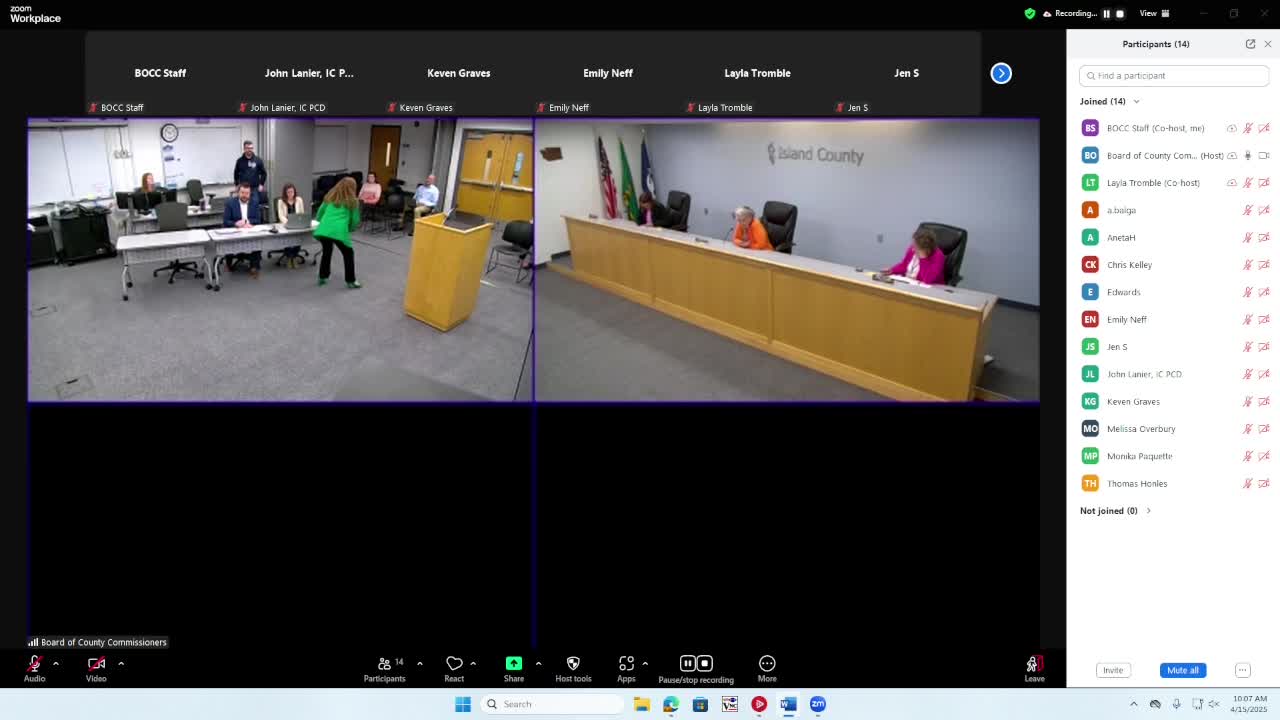
Island County Commissioners on April 15 adopted Ordinance C‑29‑25, a 12‑month emergency moratorium on the acceptance, processing, review or issuance of land‑use and building permits for most construction, use changes and land divisions in mixed‑use rural zones (rural center, rural village and Camano Gateway Village). The motion to adopt the ordinance with the removal of one proposed exception passed 2‑1.
The moratorium, effective April 15, 2025 through April 15, 2026 unless extended, was presented by Jonathan Lang, Planning and Community Development director, as a pause to allow the county to revise its zoning code to meet housing goals in the 2025 comprehensive plan. "We have before you this morning a recommendation for an emergency 12 month moratorium on the processing of applications for the construction and the mixed use rural areas," Lang said in his opening remarks. Planners said the pause is intended to prevent projects from vesting under current, lower‑density standards while the county crafts new regulations.
The ordinance applies to 11 mixed‑use areas identified in an exhibit attached to the proposed ordinance. Planning staff and consultants told the board the parcel‑level capacity analysis shows a large difference between current and proposed density standards: roughly 175 units of capacity under existing rules versus about 950 under the draft code the county is developing. Commissioners and staff said that allowing new applications under the current rules could ‘‘underutilize’’ limited locations where higher density is intended, making it harder for the county to meet state housing targets.
Assistant Director of Planning Emily Neff described the four exceptions the staff initially proposed and said one was a negotiated compromise: "That fourth exception there was a compromise our team came up with to let some mixed use multifamily development move forward in this interim state as we're developing our new code." The board decided to remove that fourth exception, which would have allowed mixed‑use developments that meet current Island County Code 17.03.35C standards to proceed during the moratorium.
The ordinance retains three exceptions: additions, repairs or remodels that do not increase a residential structure’s market value by 50% or more; replacement‑in‑kind, repair, maintenance or improvement of existing mobile or manufactured homes; and reconstruction of a single‑family residence on a like‑for‑like basis when destroyed or damaged by accident or disaster. Planning staff noted that pre‑application conferences do not constitute a complete application and that, as of the meeting, no complete land‑use or building permit applications in the affected zones had been submitted and vested.
Prosecuting Attorney Gregory Banks advised the board on procedural limits for changes after adoption: "It's a very unusual statutory provision that allows you to adopt this moratorium without notice ... But once you adopt it, that will be the matter that you're holding a public hearing on. And so like any other adoption of an ordinance at a public hearing, you're limited in your ability to make substantive changes at that hearing." The RCW citation provided by staff during the meeting was quoted as "Revised Code of Washington section 36.7a.039" in the staff presentation (as spoken in the record); the article references only the statute language as presented by staff at the hearing.
The board scheduled a public hearing within 60 days, setting June 3, 2025 as the hearing date on the moratorium ordinance. Staff said the moratorium will allow time to develop a work plan and revise the Island County code so mixed‑use areas can be used at densities envisioned in the comprehensive plan. Planning staff also told the commissioners that they will conduct the required concurrency and capital facilities analysis tied to any future land‑use changes (transportation, schools and other public services) after the land‑use direction is set.
Action at the meeting was limited to adopting the emergency moratorium ordinance and setting the public hearing; staff and commissioners said any future code changes and further extensions of the moratorium would be addressed at the hearing or subsequent meetings.
The moratorium and supporting materials will be placed on the consent agenda for the board to call up for the June 3 public hearing as required by statute. The ordinance as adopted is identified in the record as C‑29‑25.