Get Full Government Meeting Transcripts, Videos, & Alerts Forever!
Get email alerts on the Water Quality Seafood Mixing Zones topic
No spam. Unsubscribe anytime.
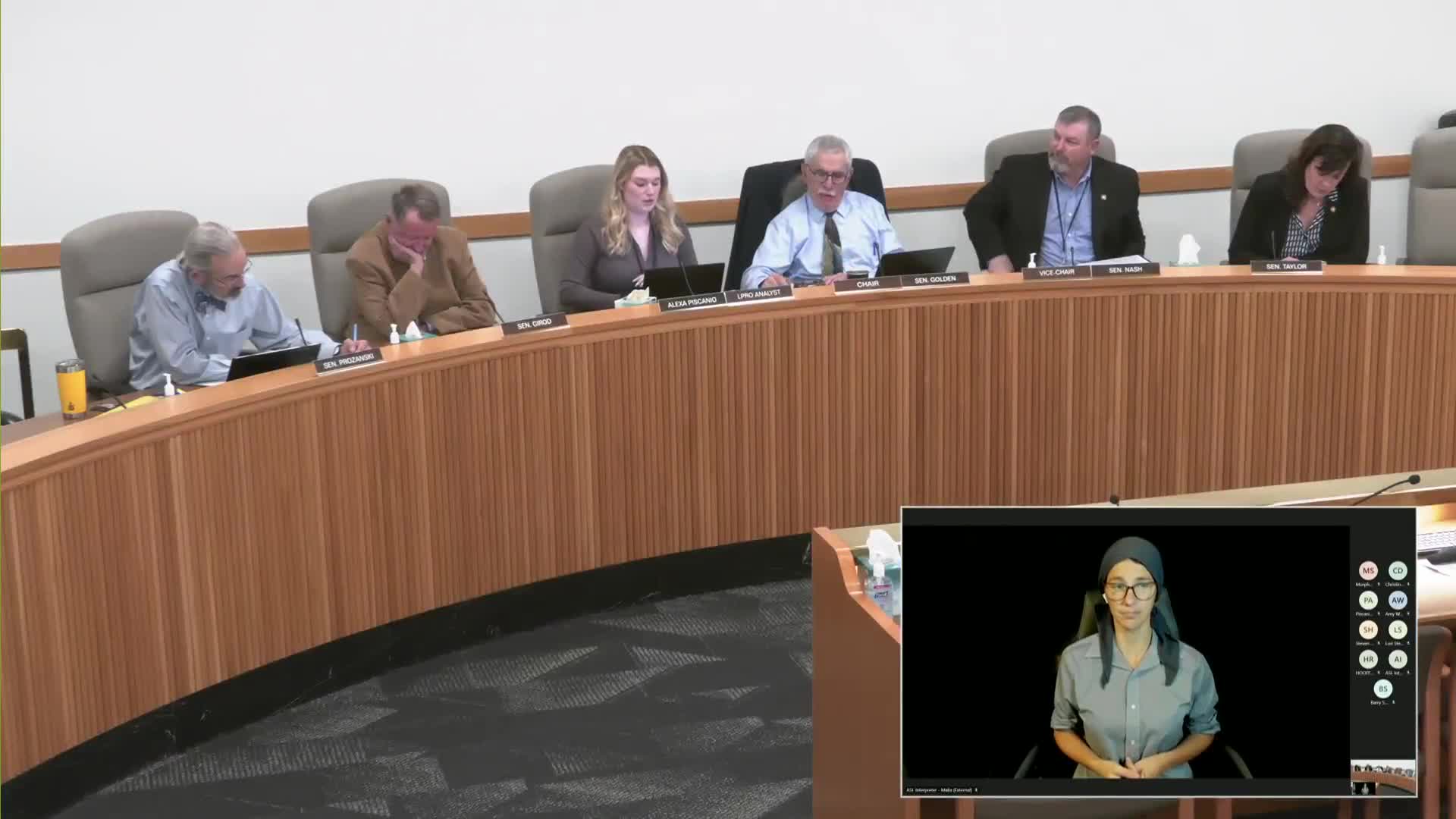
Senate committee hears testimony backing bill to allow mixing zones for seafood-processor bacteria limits
Summary
A Senate committee heard detailed testimony on April 22 about House Bill 3814A, which would allow the Environmental Quality Commission and the Department of Environmental Quality to issue permits that use a site‑specific mixing zone to establish bacteria limits for wastewater discharged by seafood processors, provided DEQ finds the zone does not pose a public‑health risk.
A Senate committee heard detailed testimony on April 22 about House Bill 3814A, which would allow the Environmental Quality Commission and the Department of Environmental Quality to issue permits that use a site‑specific mixing zone to establish bacteria limits for wastewater discharged by seafood processors, provided DEQ finds the zone does not pose a public‑health risk.
The bill's sponsor and industry witnesses told the Senate Committee on Natural Resources and Wildfire that the current state rule does not differentiate bacteria from human (warm‑blooded) sources and nonhuman (cold‑blooded or environmental) sources, and that applying a mixing zone for seafood processors would reflect scientific findings and EPA guidance while protecting human health.
“DEQ has no position officially on the bill, but we have been engaged in discussions about the amendments and the adopted version that's before you. We feel that this is workable and that DEQ would be able to allow for this process to proceed in a manner that is protective of human health and the environment,” said Ryan Hoof, policy and legislative analyst for water quality programs at DEQ.
Industry witnesses said seafood processors do not treat or discharge human waste and that the indicator bacteria referenced in permits—E. coli and enterococci—were selected to flag human sewage, not the normal microbial communities associated with fish or routine cleaning operations. Amy Wentworth, senior director of environmental health and safety for Pacific Seafood, testified that “Cold blooded animals do not actually have ***** coliforms. ***** coliforms are specifically in the gut and feces of warm blooded animals,” and that EPA’s 2024 technical work supports a lower risk from nonhuman sources.
Laurie Steele, executive director of the West Coast Seafood Processors Association, told the committee that without a mixing‑zone pathway some processors may be unable to obtain viable permits under current bacteria limits and could be forced to cease operations in Oregon. Several technical witnesses, including professor Christina DeWitt (food science and seafood safety) and consultant Steven Hammer (environmental engineer), described scientific and monitoring evidence that indicator bacteria in seafood plant effluent can come from fish, gulls, or environmental buildup in drains and do not necessarily indicate human‑sewage risk.
DEQ and industry participants said they have worked for more than a year to craft an approach the agency could implement within federal Clean Water Act permitting authority. DEQ staff signaled a likely technical amendment to the bill to replace language that currently reads “unless required by federal law” with wording that reflects when federal law would prohibit a mixing zone, not require one.
No formal committee vote on HB 3814A was recorded at the April 22 meeting; the day’s agenda recorded this item as a public hearing.
Ending notes: Committee members acknowledged the complex technical questions and asked DEQ staff to continue to coordinate language and any technical fixes prior to work‑session consideration.