Get Full Government Meeting Transcripts, Videos, & Alerts Forever!
Get email alerts on the Shoreline Management topic
No spam. Unsubscribe anytime.
County official urges coordinated outreach after MRC letter on 3 Crabs shoreline armoring
Summary
The MRC asked the county to consider actions on shoreline armoring at 3 Crabs Road; a Clallam County official said agencies should align on regulation, education and a phased approach before wide regulatory changes and discussed legal risks of title encumbrance and moratoria.
The Clallam County Marine Resources Committee presented a letter about shoreline armoring at 3 Crabs Road and proposed advisory work; a Clallam County official who attended the meeting urged coordination among agencies, careful public outreach and a stepwise policy approach.
Why it matters: shoreline armoring and related emergency permitting affect public resources, private properties and long-term county policy on coastal retreat and hazard disclosure. The issue raises legal and political questions about whether and how the county should restrict new protective structures.
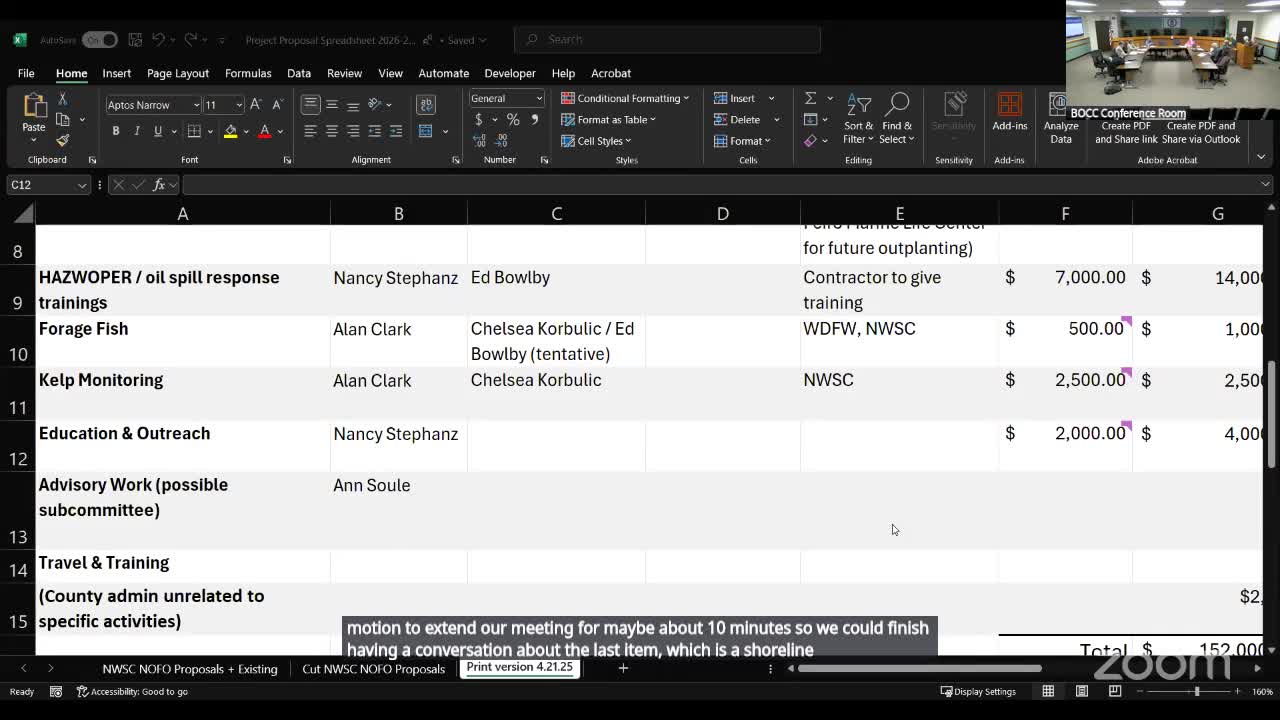
At the meeting, committee members asked the county to consider an advisory subcommittee to focus on shoreline and comprehensive-plan issues. The committee chair (name not specified) proposed changing an existing comprehensive-planning subcommittee to an "advisory subcommittee" and asked for volunteers to work with county staff and commissioners.
Bruce (Clallam County official) — who participated in the meeting on behalf of the county — said the MRC’s recommendations are useful but that agency alignment and a deliberate outreach strategy are necessary before imposing regulatory changes such as a moratorium. "I would like to be first before any moves are made," Bruce said, explaining he planned to discuss the matter individually with county board members and with state agencies.
Bruce summarized a multi-step approach he favored: (1) build agreement among state agencies (Department of Ecology, Department of Fish and Wildlife) and the tribe; (2) collect and analyze county-wide shoreline data, including the proposed study area at 3 Crabs and other vulnerable locations; (3) perform community outreach that explains the hazard and the consequences of different actions; and (4) consider objective, code-based standards that clearly state when protective structures may or may not be allowed. He said that ad hoc emergency permitting after storms can create difficult political outcomes and emphasized the need for consistent agency positions ahead of public engagement.
Bruce cautioned about legal trade-offs to imposing title encumbrances or immediate moratoria. He told the group that county legal counsel sees risk on both sides: failing to warn buyers of known risks could be actionable, but proactively encumbering titles or restricting development without clear, objective standards could be challenged as well. He said the county is working on building an evidentiary basis and policy pathway rather than moving straight to regulations. He also described a potential fellowship through Washington Sea Grant to support data collection and outreach for multiple shoreline areas, with 3 Crabs proposed as a core study site.
MRC members asked to be part of the advisory work and to help shape outreach and policy language. The committee did not adopt new regulations at the meeting; members agreed to form the advisory subcommittee and to follow up with county staff about next steps and meeting schedules.