Get Full Government Meeting Transcripts, Videos, & Alerts Forever!
Get email alerts on the Water Stewardship topic
No spam. Unsubscribe anytime.
Clallam County committee hears PUD briefing on Carlsberg deep well and debates a county 'water steward' role
Summary
The Clallam County Charter Review Commission’s Water Committee on April 18 heard a technical briefing from the Public Utility District on a newly drilled 900‑foot Carlsberg well and debated whether the county should create a non‑regulatory “water steward” to centralize monitoring, data analysis and public education.
The Clallam County Charter Review Commission’s Water Committee on April 18 heard a technical briefing from the county’s Public Utility District and discussed whether the county should create a dedicated “water steward” role to collect data, share information and support local decision‑making.
The discussion matters because committee members said up‑to‑date hydrogeologic data and a clear county technical lead are missing as the county and local utilities face climate‑linked shifts in surface flows and growing pressure to authorize development in urban growth areas. Without improved information, several speakers said, water‑rights limits, water‑quality problems and infrastructure decisions will be harder to plan and defend.
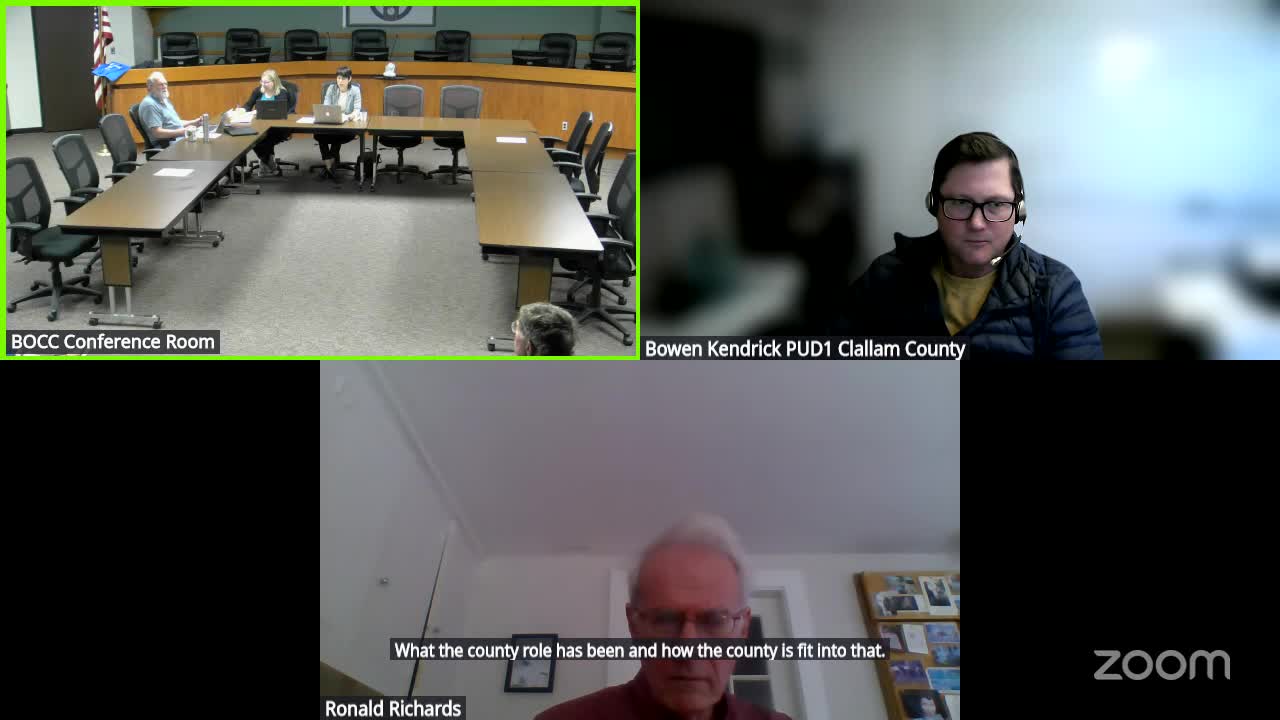
Bowen Kendrick, speaking as a PUD representative, briefed the committee on the utility’s operations and on recent Carlsberg system work. Kendrick told the committee the PUD “has about a 50 miles of water main within Clallam County,” that the district used a subrecipient ARPA award of about “three quarters of a million dollars” to extend transmission to a newly drilled parcel, and that a recently drilled Carlsberg production well reaches roughly 900 feet and taps a deeper, fourth aquifer. He said the well’s consultant estimated a capacity near 400 gallons per minute but recommended starting operations around 200–250 gpm and running longer‑term withdrawal tests before committing to a steady‑state pumping schedule. Kendrick said the PUD’s immediate priority is to address elevated nitrate levels in the system’s existing well and meet its statutory duty to provide safe drinking water to current customers before expanding service.
County staff described complementary capabilities and gaps. Bruce Emery of the Department of Community Development (DCD) reviewed the county’s watershed planning history and said the county previously employed hydrogeologic experts but that those positions have moved between departments and were not all refilled after retirements. Emery said DCD’s mission includes watershed planning and that some county projects — for example an off‑channel reservoir proposal for the Dungeness River — are already proceeding; he added, “I am supportive of that effort, the off channel reservoir for the Dungeness,” while urging careful evaluation of economic and environmental impacts. Jennifer Garcelon, representing the county’s environmental health unit, summarized three main program areas: drinking‑water permitting and the lab, well‑drilling review and well logs, and the on‑site septic and pollution‑identification program. Garcelon noted the county’s drinking‑water laboratory is a resource PUD staff rely on for required bacteriological testing after main breaks or before returning new infrastructure to service.
Speakers described operational constraints and monitoring gaps. Kendrick said parts of the PUD’s water portfolio — including surface sources such as Morse Creek — have legal provisions that require curtailment when flows fall below thresholds; he warned those interruptions are likely to occur more frequently as snowpack and seasonal patterns shift. He said some PUD wells (for example the “Bluffs” wells) now have transducer monitoring and show stable static levels and pumping performance, while other older or shallower wells have seen declines over time. Both Kendrick and Emery emphasized the need for longer‑term pumping tests and for monitoring that can detect saltwater intrusion in deep aquifers.
Committee members and invited staff debated what a county “water steward” should do. Several committee members, and multiple county staff speakers, said they favored a non‑regulatory role focused on compiling existing studies, maintaining monitoring networks, providing technical analysis to county departments and outside partners, and supporting public education. Commissioner Ron Richards (committee member) framed the role as primarily an information “clearinghouse”: “merely gather information needed by all of the other entities,” he said, and not an office that would impose regulations on other jurisdictions. Emery and Garcelon cautioned that placement, legal authority and sustainable funding would need careful design; DCD currently exercises watershed planning duties and environmental health has regulatory responsibilities tied to the Board of Health.
Public comment signaled competing concerns. Resident John Worthington urged the committee to examine the influence of outside nonprofit organizations on past watershed decisions and argued county policy should be consistent across basins; his testimony criticized prior local projects and stakeholders and called for clearer, consistent science on channel changes and management.
The committee did not take formal action and heard no votes. Members agreed to refine the steward concept in future meetings: defining the role’s boundaries (data, analysis, education versus regulation), possible placement within county structure, and funding options. Paul (chair), Nina (member) and others asked staff and members to compile the county’s existing studies, identify monitoring needs and produce a list of candidate funding sources so the committee can draft a clear job scope for later review.
Next steps: the committee scheduled follow‑up work and planned to meet again; staff and members will collect existing watershed reports, monitoring inventories and cost estimates for possible steward models and present them at the next meeting.