Get Full Government Meeting Transcripts, Videos, & Alerts Forever!
Get email alerts on the Wildfire Response topic
No spam. Unsubscribe anytime.
DNR outlines 2025 wildfire staffing, equipment and partner agreements for Olympic Region
Summary
A Washington Department of Natural Resources regional briefing described legal authority, funding, staffing and new equipment the agency will use in the 2025 wildfire season and stressed reliance on local fire districts and cooperative agreements.
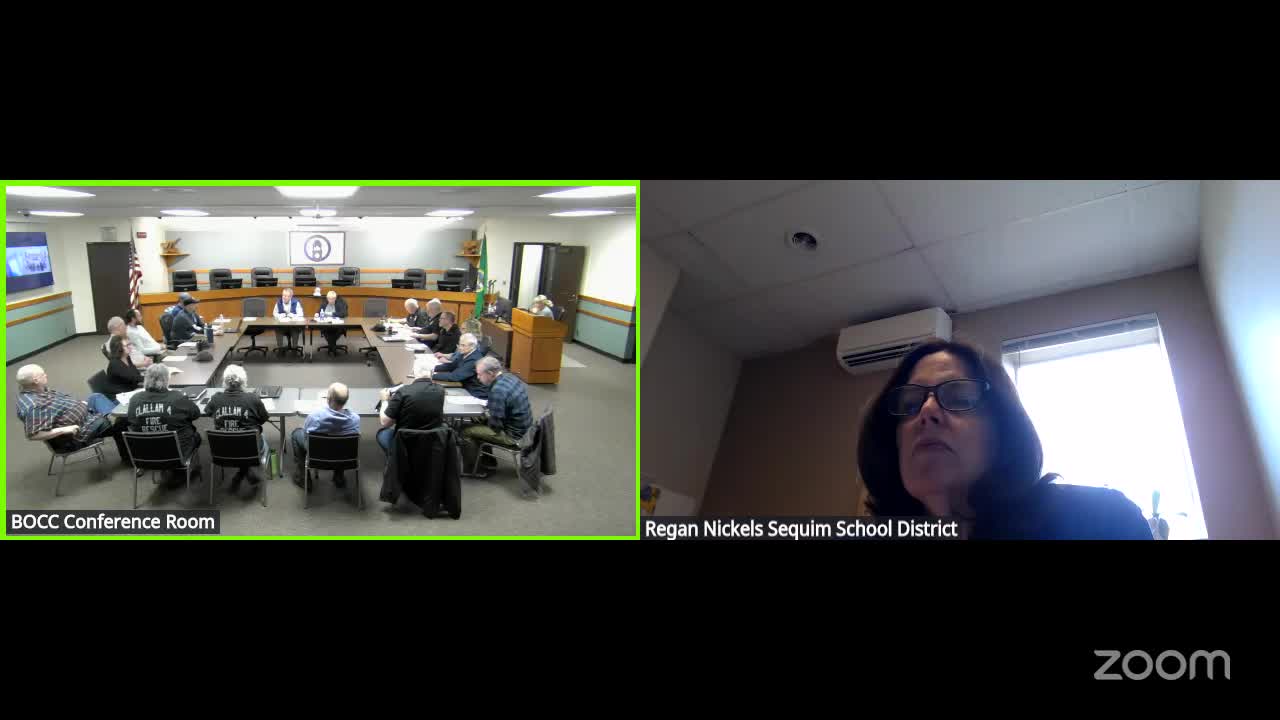
Jordan Hanwick, assistant regional manager for the Washington Department of Natural Resources (DNR) Olympic Region, briefed Clallam County taxing district representatives and other attendees on the agency's preparations for the 2025 wildfire season, including statutory authority, funding through the Forest Fire Protection Assessment, staffing levels, engines and aviation assets and use of unmanned aircraft systems.
Hanwick said RCW 76.04 gives DNR jurisdiction to respond on forested and certain protected private lands and that clear jurisdictional lines 'allow there to be no delay in our initial attack methodology,' enabling rapid state assistance to local incidents.
The report described how the Forest Fire Protection Assessment (FFPA) generates money through parcel assessments (land-use codes cited in the briefing included 88, 92 and 95). Hanwick said FFPA funding supports crews, engines and aircraft and that the state's FFPA program produces tens of millions annually; he estimated the statewide program generates between $17 million and $21 million a year. The briefing included the FFPA per-acre charge Hanwick cited (27 cents per acre for incidents over 50 acres, with a $25 minimum) and noted that county-specific FFPA totals were not available during the meeting.
Hanwick reviewed operational resources for the Olympic Region: nine fully staffed DNR engines by midseason (with two additional spare/co-op engines available), engines with roughly 420-gallon water capacities and off-road capability, and regional staffing that includes nine permanent fire-management positions and seasonal hires (Hanwick said DNR brought on 37 seasonal firefighters for this year). He described nine type-2, 10-person hand crews sourced from the state's incarcerated-individual program (OCC), and said DNR uses those crews for fire line work, food services and other incident tasks; Hanwick reported OCC provided roughly 50,000 meals to firefighters the prior year and that DNR sometimes assigns inmate crews to incidents outside the region.
Aviation and new technology were highlighted. Hanwick described Kodiak multi-mission aircraft used for mapping and infrared reconnaissance, regional helicopter response times (45'55 minutes to most of Clallam County from Olympia), and a fleet of moderned fixed-wing and rotorcraft assets. He also said the region will receive two unmanned aircraft systems (UAS) and is preparing FAA-authorized drone pilots; Hanwick noted both operational value and the safety challenge posed by private drones, saying that 'when it's in our control, it's just built into our command structure.'
Hanwick pointed to the statewide and local cooperative framework that enables DNR response: Master Cooperative Wildland Fire Management Agreements with federal partners (Forest Service, National Park Service, Bureau of Indian Affairs, BLM) under the Stafford Act for reimbursement and coordination; a local Olympic Region operating plan; and forest land response agreements (FLRAs) that allow mutual compensation and operational integration with local fire districts.
Speakers asked about funding stability and whether state or federal budget cuts threaten firefighting positions. Hanwick said he had not seen plans to cut firefighter positions locally and noted November legislation (a statewide biennial funding package he cited as roughly $140 million over two years) will add permanent positions and capacity in coming years.
On training and community programs, Hanwick described district-focused training days, a modified wildland-urban-interface program, treatment of surplus engines and equipment grants for rural districts, school outreach and Firewise/defensible-space programs. He emphasized local recruitment: Hanwick said about 85% of this year's seasonal hires came from Clallam, Jefferson and Grays Harbor counties.
Hanwick's concluding message stressed preparedness: DNR uses predictive services and daily fire-weather outlooks to surge and reposition resources before and during high-risk periods. He noted long-range outlooks show elevated fire potential in July and urged continued coordination with districts.
The briefing closed with questions about chemical retardants (Hanwick said DNR still uses PhosCheck and that DNR avoids dropping retardant into freshwater where possible), the state's tanker bases and licensing for drone pilots (the region is running a pilot training program to certify UAS operators), and a summary of recent regional incident history used to illustrate response needs.