Get Full Government Meeting Transcripts, Videos, & Alerts Forever!
Get email alerts on the State Legislation topic
No spam. Unsubscribe anytime.
Tennessee Senate adopts wide-ranging package of bills; debates over elections verification, human-rights enforcement, and wildlife rules
Summary
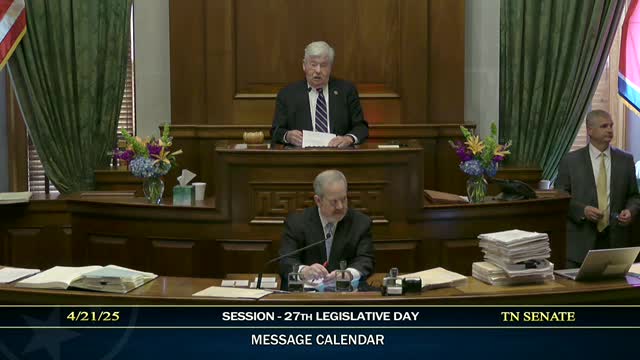
The Tennessee Senate considered and approved a broad slate of bills and resolutions during a floor session that included formal votes, committee referrals and several substantive floor debates on elections checks, civil-rights enforcement, hunting rules and other matters.
The Tennessee Senate considered and approved a broad slate of bills and resolutions during a floor session that included formal votes, committee referrals and several substantive floor debates on elections checks, civil-rights enforcement, hunting rules and other matters.
The most contested debates included a measure to change how voter registrations are screened before individuals are added to rolls, a plan to move enforcement of the Tennessee Human Rights Act from the Tennessee Human Rights Commission to the attorney general's office, and revisions expanding how the Tennessee Wildlife Resources Agency (TWRA) may spend certain acquisition funds and to allow baiting under a permit on private property.
Why it matters: The day's actions change procedures in areas that affect many Tennesseans: voter-registration processing, the handling and enforcement of civil-rights complaints, the use of opioid settlement funds, and wildlife and hunting regulation. Several bills also clarified administrative processes for conservation easements, specialty license plates and court clerk fees.
Most important actions and debates
- Voter verification: The Senate concurred in House Amendment No. 1 to House Bill 69 (filed in the Senate as Senate Bill 133), a measure directing the coordinator of elections to use a secure electronic portal to cross-check new voter-registration applicants against Department of Safety and TBI records for citizenship and felony status before adding them to voter rolls. Leader Johnson moved concurrence; the motion carried by constitutional majority.
- Human Rights enforcement transfer: House Bill 910 (a measure to transfer primary enforcement of the Tennessee Human Rights Act from the independent Tennessee Human Rights Commission to a new division inside the attorney general's office) drew extended floor debate. Supporters said the commission's backlog and vacancies required a new structure; opponents warned the attorney general's office is not a neutral forum and raised concerns about prosecutorial conflicts. The Senate adopted the bill after debate and a vote.
- TWRA funds and baiting: Senate Bill 843 (as amended) and Senate Bill 869 (as amended) given floor amendments and votes. Amendments allowed the TWRA to use excess balances from the Wetland Acquisition Fund to maintain state-owned wildlife properties and support certain law-enforcement personnel, and created a baiting license for deer on private property with fees and rulemaking authority left to the commission. Sponsors said the changes preserve land-acquisition priorities while giving TWRA discretion to support enforcement and operations.
- Opioid settlement guidance: House Joint Resolution 100, urging the Tennessee Opioid Abatement Council and participating counties to allocate at least 25% of opioid settlement funds to overdose-reversal initiatives until the state's overdose death rate falls by 25%, passed after floor debate. Supporters said more funds for immediate overdose reversal can save lives; some senators argued counties should retain flexibility to invest in prevention.
- PACT Act expansion resolution: House Joint Resolution 98, urging Congress to expand the PACT Act to include certain COVID-19 treatments given under emergency use authorization and anthrax vaccinations in qualifying care, passed by the Senate on final consideration.
Other notable items adopted or acted on (summary)
- Conservation easements: The Senate concurred in changes to Senate Bill 207 to broaden farmland-preservation easements to include both farmers and forest landowners, require easement holders to be 501(c)(3) nonprofits meeting commissioner-set criteria, and to confirm that easements are governed by the Conservation Easement Act of 1981.
- Education materials appeals: Senate Bill 416 (as amended) retains the current textbook appeals process and directs a permanent virtual materials approval process be established by a January deadline specified in the amendment.
- Specialty license plates and fees: House Bill 212 (as substituted) and its amendments extended a specialty plate program (Grammy Opry example) and adjusted reporting and fees for clerk offices (House Bill 487 as substituted) to fund continuing education with a $2 assessment on civil and criminal cases.
- Criminal justice workshops and restorative programs: House Bill 371 (conforming substitute of Senate Bill 300) and House Bill 371'related measures were adopted; one bill mandates county courts may require some misdemeanor offenders to complete cognitive-behavioral programs within court discretion, with payment caps and judge exceptions.
Votes at a glance (selected floor actions and outcomes)
- Consent Calendar No. 1 (memorializing resolutions): Ayes 33, Nays 0 — adopted. - Consent Calendar No. 2 (general bills): Ayes 33, Nays 0 — adopted. - Local bill consent calendar: Ayes 32, Nays 0 — adopted. - Senate Bill 207 (House amendment 1; farmland preservation): Concurrence adopted; recorded tally reported in session (constitutional majority). - Senate Bill 416 (House amendment 1; virtual materials/textbook appeals): Concurrence adopted; recorded Ayes 33. - Senate Bill 468: Referred back to Judiciary on objection/withdrawal. - Senate Bill 536 (House amendment 1; private institution/athletic association opt-outs): Concurrence adopted; Ayes 33. - Senate Bill 602 (House amendment 2; teacher accrued leave eligibility modification): Concurrence adopted; Ayes 33. - Senate Bill 773 (House amendment 2): Concurrence adopted; Ayes 33. - Senate Bill 937 (House amendment 1; changes from 'shall not ask' to 'shall not require', complaint process): Concurrence adopted; Ayes 27, Nays 6. - House Joint Resolution 98 (PACT Act expansion plea to Congress): Adopted; Ayes 27, Nays 6. - House Joint Resolution 100 (opioid settlement allocation guidance): Adopted; Ayes 28, Nays 4. - House Bill 69 (voter verification; Senate concurrence): Adopted; Ayes 33, Nays 0. - House Bill 175 (allowing drones for retrieving wounded deer on permitted property): Adopted; Ayes 32, Nays 0. - House Bill 212 (specialty license plate extension/amendment): Adopted; Ayes 32, Nays 0. - House Bill 371 (criminal-justice training courses for certain misdemeanants / Senate Bill 300 conforming substitute): Adopted; Ayes 25, Nays 5. - House Bill 1,200 (persistent domestic violence offender registry): Adopted; Ayes 32, Nays 0. - House Bill 487 (court fees and clerk continuing education fund / Senate Bill 409 conforming substitute): Adopted; Ayes 31, Nays 2. - House Bill 134 (removing certain synthetic food dye from schools / Senate Bill 476 conforming substitute): Adopted; Ayes 33. - House Bill 911 (transfer of Human Rights enforcement to attorney general / originally Senate Bill 861 / House Bill 910 referred during session as House Bill 9 10): Adopted after extended debate; Constitutional majority recorded. - Senate Bill 843 (TWRA Wetland Acquisition Fund language and maintenance authority as amended): Adopted; recorded Ayes 28, Nays 3. - Senate Bill 869 (hunting over bait with permit on private property; as amended): Adopted; Ayes 27, Nays 5.
Discussion, not action: Several bills were rolled to later calendars or referred back to committees for further vetting, including some raised by senators who asked for additional committee review.
Quotations from the floor
- "This is a great moment for the Senate. It represents the care and compassion that some people often accuse us of not having," Senator Watson said while urging support for House Bill 411 (Luca's Law), a healthcare coverage measure for pediatric acute-onset neuropsychiatric syndromes.
- "I have gone back through years of their reporting and seen all of the claims that have languished without action," Senator Stevens said on the floor while arguing for transferring Human Rights enforcement to the attorney general's office.
What to watch next: Several measures were set for follow-up in committee calendars, and the Senate scheduled additional committee meetings to vet late-filed amendments and resolutions, including a finance committee meeting to consider a memorializing resolution added by suspension of rules.
Ending: The Senate adjourned to reconvene at 8:30 a.m. Tuesday next. The clerk recorded the roll call and the chamber completed the consent calendars and a substantial number of third-reading and concurrence votes before adjournment.