Get Full Government Meeting Transcripts, Videos, & Alerts Forever!
Get email alerts on the Franchise Fees topic
No spam. Unsubscribe anytime.
Council narrows franchise-fee options, asks staff to return with three proposals for retaining walls and energy programs
Summary
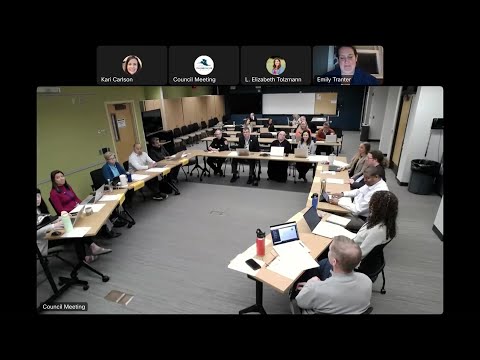
At a study meeting April 21, Bloomington City Council discussed adding franchise-fee revenue for retaining-wall repairs and sustainability programs and directed staff to return with three options that include no change, a modest retaining-wall-only increase and a larger package that funds both sustainability and walls.
Bloomington City Council members spent more than an hour on April 21 debating whether to increase the city's utility franchise fee to fund failing retaining walls and new sustainability programs, ultimately directing staff to return to a public hearing with three narrowed choices.
Council members heard presentations from city engineering and sustainability staff about the scale of retaining-wall needs and a proposal to use franchise-fee revenue to seed financing for home and business energy-efficiency upgrades. After questions about who would pay, program design and alternatives to a rate increase, the council coalesced around asking staff to bring options A, B and E back for public consideration.
The council's direction matters because the franchise fee is assessed to energy utilities that operate in city right-of-way; unlike property tax revenue, the fee applies to some properties that are tax-exempt (for example, some nonprofits) and so changes the distribution of who pays for local infrastructure. Staff said the current budget allocates about $45,000 annually for retaining-wall work but that some imminent projects have engineer estimates near $800,000'$900,000.
Engineering staff presented a citywide inventory of retaining walls and described a condition-rating system similar to the pavement-condition index. Bob Simons, senior civil engineer, said the city has only done a visual inspection and has not conducted tieback testing on many older walls. He said the city has several locations where smaller walls can be remediated by regrading with a property owner, but tall, failed walls (one cited on Ninetieth Street) require full replacement and carry much higher costs.
Emma (sustainability coordinator) outlined the proposed sustainability use: financing energy-efficiency improvements for homes and businesses based on recommendations from the city's energy-disclosure and home-energy audit programs. "Overall, the community is benefiting from less pollution, from generating energy, also less pressure on the energy grid," Emma said, describing potential co-benefits such as avoided peak demand and local economic reinvestment from energy-bill savings.
Staff described practical program models used by peer cities: rebate, cost-share and loan programs tied to utility rebates administered under the state's energy statutes (referred to in the presentation as the ECO Act). Staff noted CenterPoint Energy and Xcel Energy rebate programs already provide a portion of project funding; staff also said utility rebates and federal tax credits often require up-front financing because rebates and credits are received after installation.
Council members pressed staff on distributional effects and program mechanics. Council member Nelson asked whether franchise-fee increases would simply delay repairs if not adopted; staff replied the $45,000 budget and carryovers would not fund large replacements and carryovers are not guaranteed. Council member D'Alessandro said retaining walls align more closely with typical franchise-fee uses for roads, sidewalks and trails, and suggested a retaining-wall-only option might be appropriate. Several council members asked staff to check how many tax-exempt entities (for example, schools and some nonprofits) would pay the fee under the different structures.
On program design, staff said existing HRA-administered loan products are capped at 80% AMI and that using HRA levy funds instead of CDBG or federal sources could broaden eligibility; however, they cautioned CDBG-funded loan repayments remain subject to CDBG eligibility rules. Staff also said raising loan program income or hiring an outside administrator were viable structural options.
Cost scenarios presented by staff (residential per-utility rates): the city currently bills about $5.95 per month. Staff presented several configurations: a combined option that would yield roughly a $1.86 monthly increase on a residential account to fund $1,000,000 for sustainability and $250,000 for retaining walls; a half-million-dollar sustainability option; and a smaller retaining-wall-only option that staff estimated as cents-to-dimes per month depending on scope. Council discussion included whether to pause portions of the pavement program (PMP) to reprioritize funds; staff warned suspending PMP would affect staffing funded through capital and could require layoffs.
After discussion and public-engagement background (open house, an online survey with 38 responses through the study-session period), the council directed staff to prepare materials for a public hearing that include three narrowed choices: (1) Option A (no change), (2) Option B (retaining walls focus) and (3) Option E (full package: sustainability plus retaining walls). Council members also asked staff to follow up with the utilities and the state PUC about whether utilities would pass any franchise-fee increase to customers.
The council did not adopt an ordinance or vote on a fee tonight; the item will return for a formal public hearing after staff provides additional analyses and outreach.