Get Full Government Meeting Transcripts, Videos, & Alerts Forever!
Get email alerts on the Zoning Pud Amendment topic
No spam. Unsubscribe anytime.
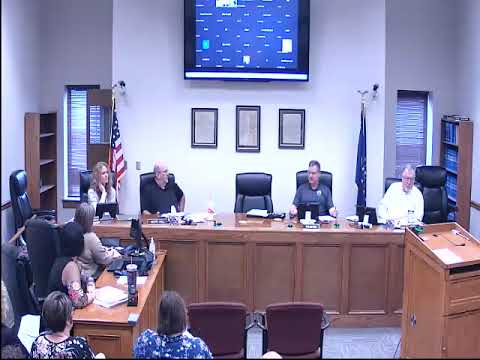
Boone County approves zoning text amendment (Ordinance 2025-02); residents raise concerns about PUDs and water/sewer safeguards
Summary
The Boone County Board of Commissioners approved Ordinance 2025-02, amending zoning text on planned unit developments. During public comment several residents and an area planning commission member urged clearer guardrails about interim septic/well use and required connection when utilities become available.
The Boone County Board of Commissioners on April 21 approved Ordinance 2025-02, an amendment to county zoning text governing planned unit developments (PUDs).
The ordinance, introduced as a text amendment, modifies eligibility language for PUDs; the adopted language requires PUD uses to connect to water and sewer services when those utilities become available, and allows a commitment to use well and septic temporarily where services are not yet present. The amendment’s codified language appears in Exhibit A to the ordinance; county legal staff said explanatory language in the ordinance preamble (the “whereas” clauses) does not itself change the code.
During the public-comment period multiple residents and at least one Area Planning Commission (APC) member said the ordinance as drafted lacked adequate guardrails for interim septic and well use. A speaker who identified herself as a resident (name given in the record) said the change could permit large-scale developments on septic and wells in areas that lack utilities, and pressed the commissioners to require more detailed, objective limits such as acreage thresholds, demonstrated well capacity or developer-provided water studies. “We have to consider the people that live there,” a resident said, urging commissioners to require factual water-use data from developers.
An APC member present said she had consulted attorneys and interpreted the change the same way: new PUDs would no longer have to be connected to public sewer and water at adoption, but must commit to connecting when utilities become available. County legal counsel clarified that Exhibit A contains the enforceable requirements and that the “whereas” language was explanatory. Counsel described Exhibit A language as “the minimal requirements” that make a parcel eligible for PUD consideration; project-level permitting and site-specific approvals remain subject to the county’s normal review process.
Commissioners approved the ordinance on voice vote. The record shows follow-up: commissioners and staff acknowledged the need to ensure the APC and staff have clear guidelines for evaluating proposed PUDs, including when interim well/septic use is acceptable and what information developers must submit.