Get Full Government Meeting Transcripts, Videos, & Alerts Forever!
Get email alerts on the County Budget Audit topic
No spam. Unsubscribe anytime.
Erie County councilors press for clearer fund-balance reporting as audits and overtime pressures mount
Summary
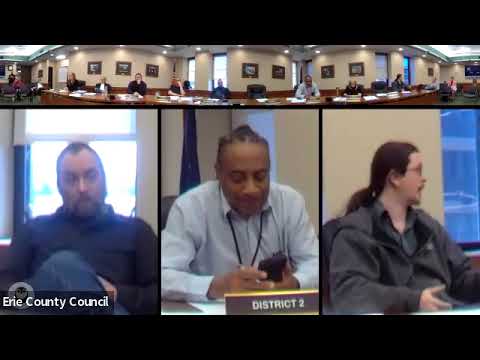
Erie County Council and finance staff on April 8 discussed a gap in routine fund-balance reporting, rising overtime expenses in the county prison and sheriff's department, and steps administration officials plan to take to avoid drawing down general fund reserves.
Erie County Council and finance staff on April 8 discussed a gap in routine fund-balance reporting, rising overtime expenses in the county prison and sheriff's department, and steps administration officials plan to take to avoid drawing down general fund reserves.
Council members said they have not received the fund-balance analysis that historically accompanied finance meetings and expressed concern because several line items are over budget. A council member noted that prison overtime is fully expensed and at about 13 percent over projection and that the sheriff’s overtime line is about 15 percent over. Finance staff said a budget transfer for the sheriff’s department has already been entered and that a roughly $300,000 transfer to the prison overtime line will be submitted next week, with an additional supplemental appropriation expected later to recognize increased federal revenue at the prison and offset overtime costs.
Why it matters: councilors warned auditors could flag budget practices, and one outside auditor told the council there is a risk of a material weakness finding if internal budgeting controls and procedures are not followed. A material weakness in the audit report would signal that required internal controls or laws are not being followed — a finding with implications for bond ratings and public confidence in county finances.
Finance staff explained the administration’s approach is to make incremental transfers as actual need appears rather than request a single large supplemental appropriation up front. “We didn’t want to come down here and do a supplemental appropriation for $1.7 million of general fund balance that we likely would never need,” a finance representative said, explaining the intent to adjust monthly and then reassess later in the fiscal year. The council member pushing for more proactive transfers said that practice is common in similarly sized counties and urged midyear transfers when expenditure trajectories are known.
Council members also discussed smaller supplemental appropriations on the agenda: an Ordinance No. 18 to supplement the library fund by $77,330 and a $25,000 general-fund supplemental appropriation for safety and security improvements that will be reimbursed through an AODC safety and security grant. Both items were described as first-reading items with no substantive questions raised during the meeting.
The auditors' role and next steps drew sustained attention. A council member who had consulted with the county’s auditor said the auditor offered to brief the council on likely audit issues for the 2024 and 2025 audits, including steps the council and administration could take to reduce audit risk. Council members asked that the administration resume providing regular fund-balance analyses to restore visibility.
The council also discussed internal responsibility for transfers: finance staff said department heads are expected to monitor their own budgets and initiate transfer forms when a line is overspent; general accounting processes transfers once departments submit them. That policy drew criticism from council members who said in past years some row offices received transfers handled by central administration and that the current practice places more burden on individual offices.
Councilors asked staff to continue monthly updates on transfers and any supplemental appropriations brought forward. The meeting did not record a formal vote on the planned prison transfer or the larger supplemental appropriation; staff described next steps and timing rather than reporting a finalized ordinance.
Looking ahead: council members requested a return to routine fund-balance reporting and accepted staff’s commitment to monitor overtime and revenue developments and present supplemental appropriation requests if and when figures require them.